CLIP - Childhood Leukaemia Investigation Prague, Prague, Czech Republic.
Department of Paediatric Haematology and Oncology, Second Faculty of Medicine, Charles University/University Hospital Motol, Prague, Czech Republic.
Mol Cancer. 2024 Jul 5;23(1):138. doi: 10.1186/s12943-024-02053-4.
The BCR::ABL1 is a hallmark of chronic myeloid leukemia (CML) and is also found in acute lymphoblastic leukemia (ALL). Most genomic breaks on the BCR side occur in two regions - Major and minor - leading to p210 and p190 fusion proteins, respectively.
By multiplex long-distance PCR or next-generation sequencing technology we characterized the BCR::ABL1 genomic fusion in 971 patients (adults and children, with CML and ALL: pediatric ALL: n = 353; pediatric CML: n = 197; adult ALL: n = 166; adult CML: n = 255 patients) and designed "Break-App" web tool to allow visualization and various analyses of the breakpoints. Pearson's Chi-Squared test, Kolmogorov-Smirnov test and logistic regression were used for statistical analyses.
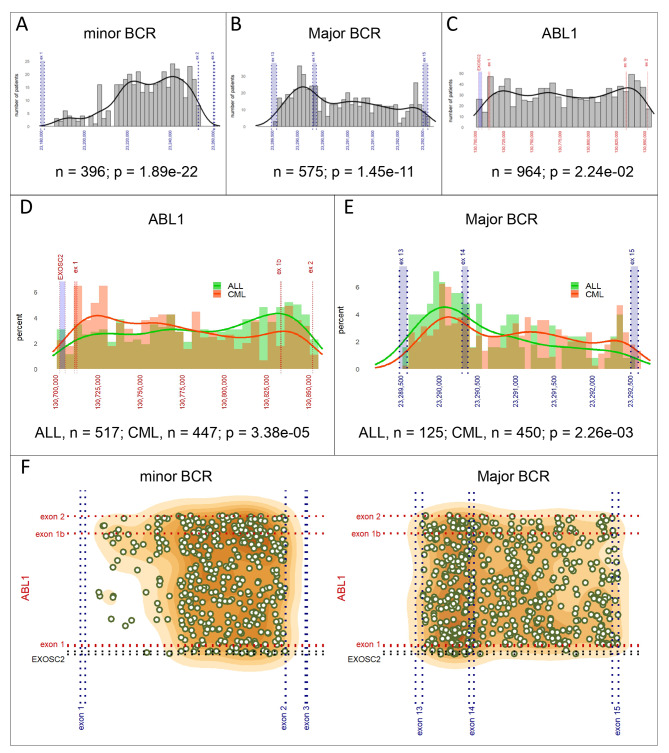
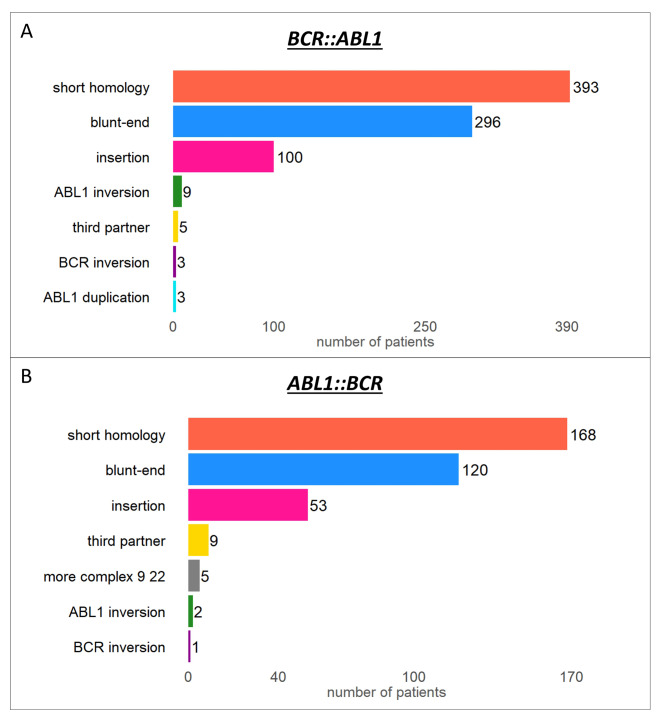
Detailed analysis showed a non-random distribution of breaks in both BCR regions, whereas ABL1 breaks were distributed more evenly. However, we found a significant difference in the distribution of breaks between CML and ALL. We found no association of breakpoints with any type of interspersed repeats or DNA motifs. With a few exceptions, the primary structure of the fusions suggests non-homologous end joining being responsible for the BCR and ABL1 gene fusions. Analysis of reciprocal ABL1::BCR fusions in 453 patients showed mostly balanced translocations without major deletions or duplications.
Taken together, our data suggest that physical colocalization and chromatin accessibility, which change with the developmental stage of the cell (hence the difference between ALL and CML), are more critical factors influencing breakpoint localization than presence of specific DNA motifs.
BCR::ABL1 是慢性髓系白血病(CML)的标志,也存在于急性淋巴细胞白血病(ALL)中。BCR 侧的大多数基因组断裂发生在两个区域 - 主要和次要 - 分别导致 p210 和 p190 融合蛋白。
通过多重长距离 PCR 或下一代测序技术,我们对 971 例患者(成人和儿童,包括 CML 和 ALL:儿科 ALL:n = 353;儿科 CML:n = 197;成人 ALL:n = 166;成人 CML:n = 255 例)的 BCR::ABL1 基因组融合进行了特征描述,并设计了“Break-App”网络工具,以允许可视化和对断点进行各种分析。使用 Pearson 卡方检验、Kolmogorov-Smirnov 检验和逻辑回归进行统计分析。
详细分析显示,BCR 两个区域的断裂分布均无随机性,而 ABL1 断裂分布更为均匀。然而,我们发现 CML 和 ALL 之间的断裂分布存在显著差异。我们没有发现断点与任何类型的散在重复或 DNA 基序之间存在关联。除了少数例外,融合的主要结构表明非同源末端连接负责 BCR 和 ABL1 基因融合。对 453 例患者的相互 ABL1::BCR 融合进行分析表明,大多数为平衡易位,没有主要缺失或重复。
综上所述,我们的数据表明,物理共定位和染色质可及性(随着细胞发育阶段而变化,因此 ALL 和 CML 之间存在差异)是影响断点定位的更关键因素,而不是特定 DNA 基序的存在。