Laboratoire de Virologie ULR3610, Université de Lille, CHU Lille, Lille, France.
Nat Rev Endocrinol. 2022 Aug;18(8):503-516. doi: 10.1038/s41574-022-00688-1. Epub 2022 Jun 1.
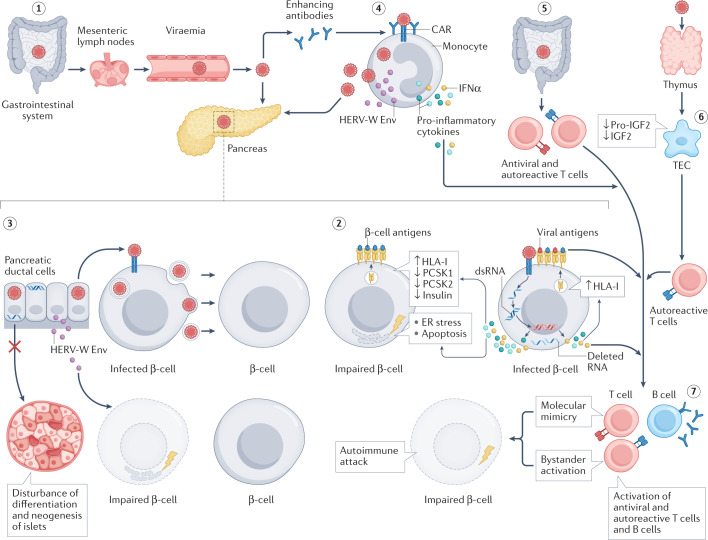
Enteroviruses are believed to trigger or accelerate islet autoimmunity in genetically susceptible individuals, thereby resulting in loss of functional insulin-producing β-cells and type 1 diabetes mellitus (T1DM). Although enteroviruses are primarily involved in acute and lytic infections in vitro and in vivo, they can also establish a persistent infection. Prospective epidemiological studies have strongly associated the persistence of enteroviruses, especially coxsackievirus B (CVB), with the appearance of islet autoantibodies and an increased risk of T1DM. CVB can persist in pancreatic ductal and β-cells, which leads to structural or functional alterations of these cells, and to a chronic inflammatory response that promotes recruitment and activation of pre-existing autoreactive T cells and β-cell autoimmune destruction. CVB persistence in other sites, such as the intestine, blood cells and thymus, has been described; these sites could serve as a reservoir for infection or reinfection of the pancreas, and this persistence could have a role in the disturbance of tolerance to β-cells. This Review addresses the involvement of persistent enterovirus infection in triggering islet autoimmunity and T1DM, as well as current strategies to control enterovirus infections for preventing or reducing the risk of T1DM onset.
肠病毒被认为在遗传易感个体中引发或加速胰岛自身免疫,从而导致功能性胰岛素产生β细胞的丧失和 1 型糖尿病(T1DM)。尽管肠病毒主要参与体外和体内的急性和裂解感染,但它们也可以建立持续性感染。前瞻性流行病学研究强烈表明,肠病毒,特别是柯萨奇病毒 B(CVB)的持续存在与胰岛自身抗体的出现和 T1DM 的风险增加有关。CVB 可在胰腺导管和β细胞中持续存在,导致这些细胞的结构或功能改变,并引发慢性炎症反应,促进先前存在的自身反应性 T 细胞的募集和激活以及β细胞自身免疫破坏。已经描述了 CVB 在其他部位(如肠道、血细胞和胸腺)的持续存在;这些部位可能是胰腺感染或再感染的储库,这种持续存在可能在破坏对β细胞的耐受性方面发挥作用。本综述讨论了持续性肠病毒感染在引发胰岛自身免疫和 T1DM 中的作用,以及目前控制肠病毒感染以预防或降低 T1DM 发病风险的策略。