Colombo Delia, Bianchi Luca, Fabbrocini Gabriella, Corrao Salvatore, Offidani Annamaria, Stingeni Luca, Costanzo Antonio, Pellacani Giovanni, Peris Ketty, Bardazzi Federico, Argenziano Giuseppe, Ruffolo Silvana, Dapavo Paolo, Carrera Carlo, Fargnoli Maria Concetta, Parodi Aurora, Romanelli Marco, Malagoli Piergiorgio, Zullo Alessandro, Ferri Fabio, Fiocchi Martina, Zagni Emanuela
Novartis Farma S.p.A, Italy.
Pharmacologist and Dermatologist Private Office, Milan, Italy.
Womens Health Rep (New Rochelle). 2022 May 2;3(1):450-457. doi: 10.1089/whr.2021.0124. eCollection 2022.
In psoriasis, several studies have indicated sex differences in clinical characteristics, type of treatment, and outcomes. A higher impact of psoriasis on quality of life (QoL) and a lower treatment satisfaction have been reported in women by different authors.
This article reports the results of a gender analysis of CANOVA study, aimed at assessing 16/24/52-week effectiveness of biologics in patients with moderate-severe plaque psoriasis.
CANOVA was a real-world, multicenter, noninterventional, retro-prospective study conducted in 17 Italian hospital dermatology clinics.
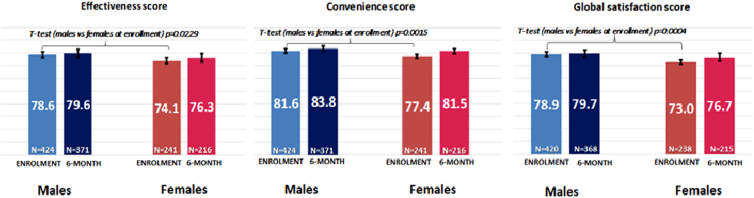
Of the 669 eligible patients, 63.8% were men. Demographic and baseline characteristics and duration of disease were rather homogeneous between sexes. Slightly more women had been treated with biologics (50.4% vs. 46.5%) and had received ≥2 biologic treatment lines (17.2% vs. 12.4%) before study treatment. The most frequently used biologics were secukinumab, ustekinumab, adalimumab, and ixekizumab in both sexes. At 6 months, Psoriasis Area Severity Index (PASI) 75/90/100 responders were 90.8%/72.3%/45.3% of men and 89.2%/76.6%/48.2% of women. Sustained PASI responders were 79.5% of men and 75.9% of women. Treatment satisfaction was significantly lower in women at enrolment for all subscales, and was still lower at 6 months, no longer significantly. Gender distribution in Dermatology Life Quality Index total score classes showed a significantly greater effect of psoriasis on QoL in women, both at enrolment and at the 6-month follow-up.
In conclusion, this gender analysis confirms in both genders the efficacy of biologics in psoriasis. However, women reported a greater impact of the disease on QoL and lower treatment satisfaction.
在银屑病方面,多项研究表明,银屑病在临床特征、治疗类型和治疗结果上存在性别差异。不同作者报告称,银屑病对女性生活质量(QoL)的影响更大,且女性的治疗满意度较低。
本文报告了CANOVA研究的性别分析结果,该研究旨在评估生物制剂对中度至重度斑块状银屑病患者的16/24/52周疗效。
CANOVA是一项在17家意大利医院皮肤科诊所开展的真实世界、多中心、非干预性、回顾性前瞻性研究。
在669例符合条件的患者中,63.8%为男性。男女之间的人口统计学和基线特征以及病程相当一致。在研究治疗前,接受生物制剂治疗的女性略多于男性(50.4%对46.5%),且接受过≥2种生物制剂治疗方案的女性也更多(17.2%对12.4%)。男女最常用的生物制剂均为司库奇尤单抗、乌司奴单抗、阿达木单抗和依奇珠单抗。6个月时,银屑病面积和严重程度指数(PASI)改善75/90/100的男性患者比例分别为90.8%/72.3%/45.3%,女性患者比例分别为89.2%/76.6%/48.2%。持续达到PASI改善的男性患者比例为79.5%,女性患者比例为75.9%。在入组时,女性在所有子量表上的治疗满意度均显著较低,6个月时仍然较低,但不再具有统计学意义。皮肤科生活质量指数总分类别中的性别分布显示,在入组时和6个月随访时,银屑病对女性生活质量的影响均显著更大。
总之,这项性别分析证实了生物制剂对银屑病患者的疗效在男女中均存在。然而,女性报告称该疾病对生活质量的影响更大,且治疗满意度较低。