From the Departments of Psychiatry and Child and Adolescent Psychiatry, NYU Grossman School of Medicine, New York, NY.
Otsuka Pharmaceutical Development & Commercialization, Inc, Princeton, NJ.
J Clin Psychopharmacol. 2022;42(5):429-439. doi: 10.1097/JCP.0000000000001575. Epub 2022 Jun 2.
PURPOSE/BACKGROUND: Centanafadine is an inhibitor of norepinephrine, dopamine, and serotonin reuptake transporters under investigation for the treatment of attention-deficit/hyperactivity disorder (ADHD).
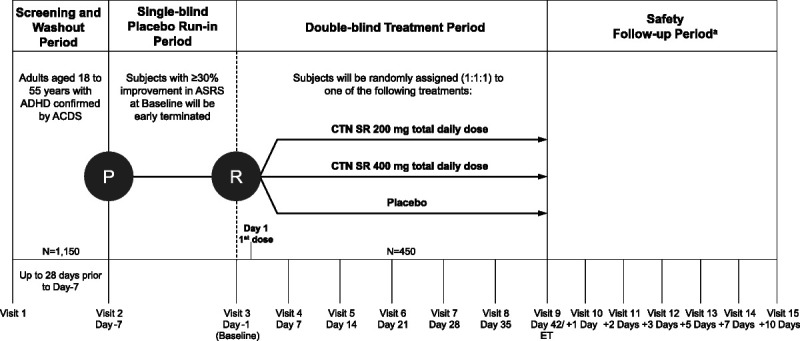
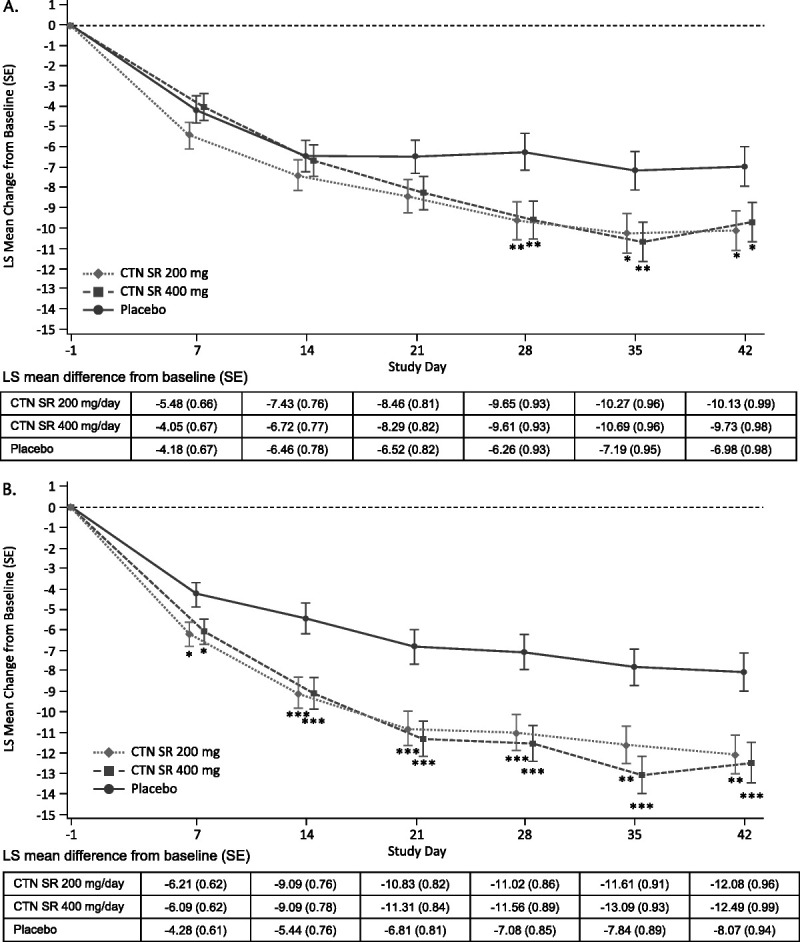
METHODS/PROCEDURES: Two phase 3 randomized, double-blind, placebo-controlled, parallel-group studies of 200 mg/d or 400 mg/d centanafadine sustained-release tablets versus placebo included adults (18-55 years of age) with a diagnosis of ADHD. The primary and key secondary efficacy endpoints were the change from baseline at day 42 in the Adult ADHD Investigator Symptom Rating Scale (AISRS) total score and the Clinical Global Impression-Severity of Illness Scale, respectively.
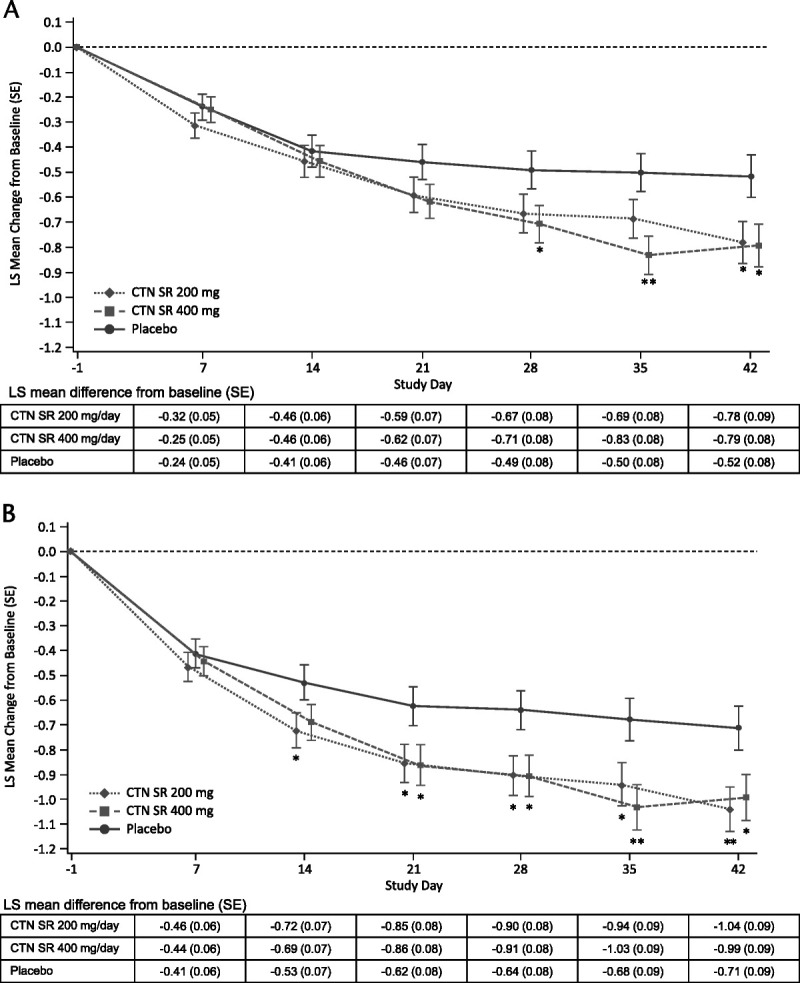
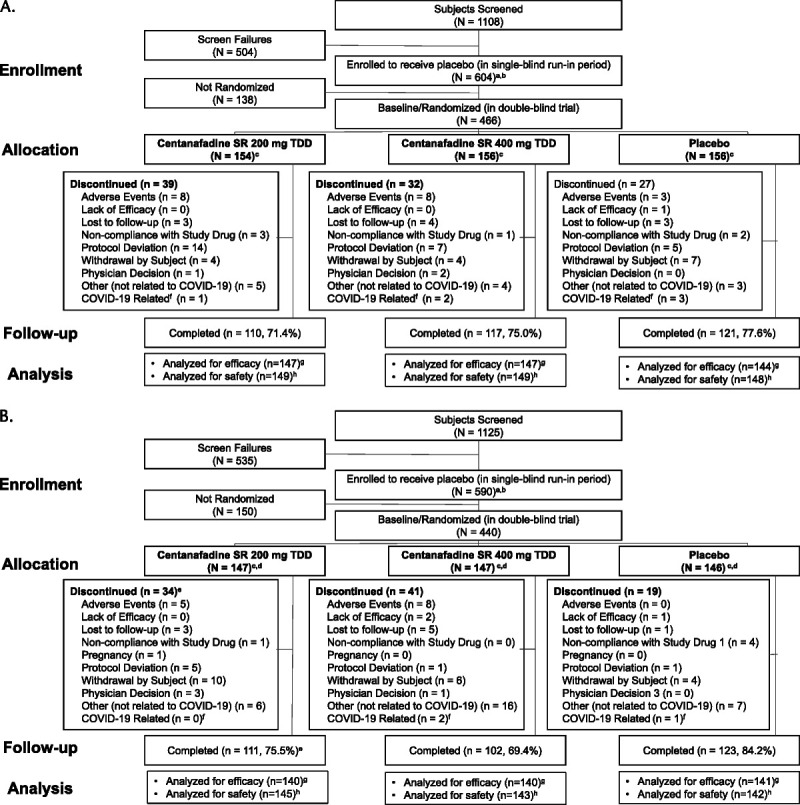
FINDINGS/RESULTS: Subjects randomized in study 1 (centanafadine 200 mg/d, n = 149; centanafadine 400 mg/d, n = 149; placebo, n = 148) and study 2 (centanafadine 200 mg/d, n = 145; centanafadine 400 mg/d, n = 143; placebo, n = 142) had moderate to severe ADHD (mean AISRS total score, 38.7 [SD, 6.8] across both studies). At day 42, statistically significant least-squares mean differences in AISRS total score were observed in favor of centanafadine versus placebo in study 1 (200 mg/d: -3.16, P = 0.019; 400 mg/d: -2.74, P = 0.039) and study 2 (200 mg/d: -4.01, P = 0.002; 400 mg/d: -4.47, P = 0.001). Effect sizes versus placebo were -0.28 for 200 mg/d and -0.24 for 400 mg/d in study 1 and -0.37 for 200 mg/d and -0.40 for 400 mg/d in study 2. The overall rate of treatment-emergent adverse events (TEAEs) was low, but there was a small increase in TEAE occurrence with increasing dose. Incidences of serious TEAEs and abuse potential-related AEs were low.
IMPLICATIONS/CONCLUSIONS: These are the first large-scale studies to demonstrate the efficacy and safety profiles of 200 mg/d and 400 mg/d centanafadine in adults with ADHD.
目的/背景: Centanafadine 是一种去甲肾上腺素、多巴胺和 5-羟色胺再摄取转运体的抑制剂,正在研究用于治疗注意力缺陷/多动障碍(ADHD)。
方法/程序: 两项 3 期随机、双盲、安慰剂对照、平行组研究包括年龄在 18-55 岁之间的诊断为 ADHD 的成年人。主要和关键次要疗效终点分别是第 42 天成人 ADHD 研究者症状评定量表(AISRS)总分和临床总体印象-疾病严重程度量表的变化。
结果/发现: 研究 1(centanafadine 200 mg/d,n = 149;centanafadine 400 mg/d,n = 149;安慰剂,n = 148)和研究 2(centanafadine 200 mg/d,n = 145;centanafadine 400 mg/d,n = 143;安慰剂,n = 142)中随机分组的受试者均患有中度至重度 ADHD(两项研究中平均 AISRS 总分均为 38.7[标准差,6.8])。第 42 天,与安慰剂相比,centanafadine 在研究 1(200 mg/d:-3.16,P = 0.019;400 mg/d:-2.74,P = 0.039)和研究 2(200 mg/d:-4.01,P = 0.002;400 mg/d:-4.47,P = 0.001)中观察到 AISRS 总分的统计学显著最小二乘均值差异均有利于 centanafadine。与安慰剂相比,研究 1 的效应量为 200 mg/d 时为-0.28,400 mg/d 时为-0.24,研究 2 的效应量为 200 mg/d 时为-0.37,400 mg/d 时为-0.40。治疗中出现的不良事件(TEAEs)的总体发生率较低,但随着剂量的增加,TEAE 的发生略有增加。严重 TEAEs 和与滥用潜力相关的 AE 的发生率较低。
这些是首次证明 200 mg/d 和 400 mg/d centanafadine 在成人 ADHD 中的疗效和安全性的大规模研究。