National Heart Lung Institute, Imperial College London, London, United Kingdom; Royal Brompton Hospital (Guy's and St Thomas's NHS Foundation Trust), London, United Kingdom.
Cardiovascular Research Institute Maastricht (CARIM), Maastricht University Medical Center, Maastricht, the Netherlands; Department of Clinical Genetics, Maastricht University Medical Center, Maastricht, the Netherlands.
J Am Coll Cardiol. 2022 Jun 7;79(22):2219-2232. doi: 10.1016/j.jacc.2022.03.375.
Dilated cardiomyopathy (DCM) is a final common manifestation of heterogenous etiologies. Adverse outcomes highlight the need for disease stratification beyond ejection fraction.
The purpose of this study was to identify novel, reproducible subphenotypes of DCM using multiparametric data for improved patient stratification.
Longitudinal, observational UK-derivation (n = 426; median age 54 years; 67% men) and Dutch-validation (n = 239; median age 56 years; 64% men) cohorts of DCM patients (enrolled 2009-2016) with clinical, genetic, cardiovascular magnetic resonance, and proteomic assessments. Machine learning with profile regression identified novel disease subtypes. Penalized multinomial logistic regression was used for validation. Nested Cox models compared novel groupings to conventional risk measures. Primary composite outcome was cardiovascular death, heart failure, or arrhythmia events (median follow-up 4 years).
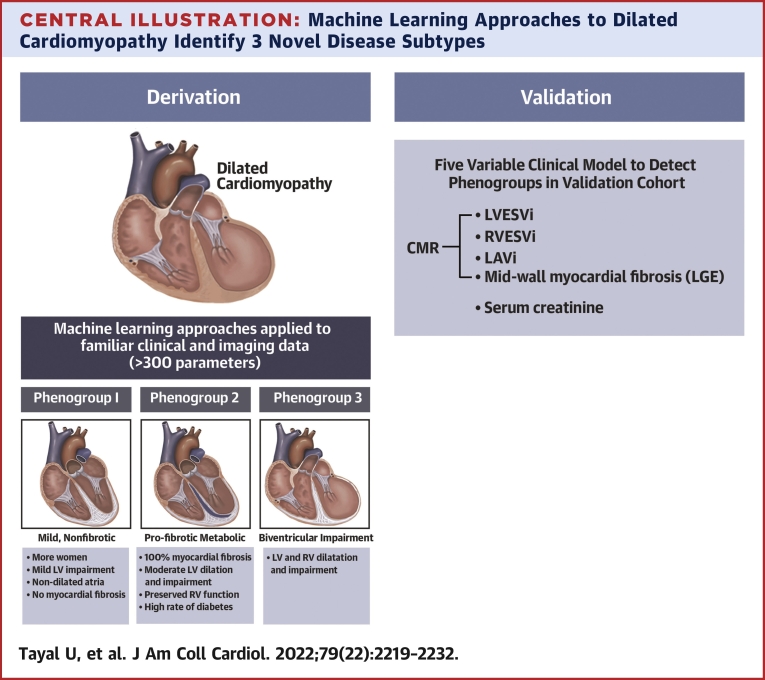
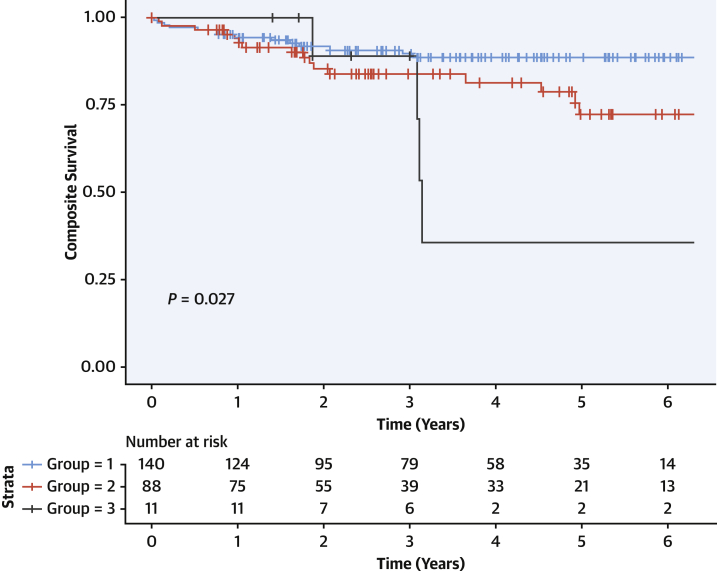
In total, 3 novel DCM subtypes were identified: profibrotic metabolic, mild nonfibrotic, and biventricular impairment. Prognosis differed between subtypes in both the derivation (P < 0.0001) and validation cohorts. The novel profibrotic metabolic subtype had more diabetes, universal myocardial fibrosis, preserved right ventricular function, and elevated creatinine. For clinical application, 5 variables were sufficient for classification (left and right ventricular end-systolic volumes, left atrial volume, myocardial fibrosis, and creatinine). Adding the novel DCM subtype improved the C-statistic from 0.60 to 0.76. Interleukin-4 receptor-alpha was identified as a novel prognostic biomarker in derivation (HR: 3.6; 95% CI: 1.9-6.5; P = 0.00002) and validation cohorts (HR: 1.94; 95% CI: 1.3-2.8; P = 0.00005).
Three reproducible, mechanistically distinct DCM subtypes were identified using widely available clinical and biological data, adding prognostic value to traditional risk models. They may improve patient selection for novel interventions, thereby enabling precision medicine.
扩张型心肌病(DCM)是多种病因的共同终末表现。不良结局突出表明需要对射血分数以外的疾病进行分层。
本研究旨在使用多参数数据识别 DCM 的新型可重复亚表型,以改善患者分层。
使用纵向、观察性的英国衍生队列(n=426;中位年龄 54 岁;67%为男性)和荷兰验证队列(n=239;中位年龄 56 岁;64%为男性)对 DCM 患者(2009-2016 年招募)进行临床、遗传、心血管磁共振和蛋白质组学评估。使用轮廓回归的机器学习方法确定新的疾病亚型。使用惩罚多项逻辑回归进行验证。嵌套 Cox 模型比较了新型分组与传统风险指标。主要复合结局是心血管死亡、心力衰竭或心律失常事件(中位随访 4 年)。
总共确定了 3 种新型 DCM 亚型:纤维增生代谢型、轻度非纤维增生型和双心室损伤型。在两个衍生队列(P<0.0001)和验证队列中,不同亚型之间的预后不同。新型纤维增生代谢型糖尿病、普遍心肌纤维化、右心室功能保存和肌酐升高的发生率更高。对于临床应用,5 个变量足以进行分类(左、右心室收缩末期容积、左心房容积、心肌纤维化和肌酐)。添加新型 DCM 亚型可将 C 统计量从 0.60 提高到 0.76。白细胞介素-4 受体-α被鉴定为衍生队列中的新型预后生物标志物(HR:3.6;95%CI:1.9-6.5;P=0.00002)和验证队列(HR:1.94;95%CI:1.3-2.8;P=0.00005)。
使用广泛可用的临床和生物学数据识别了三种可重复的、机制不同的 DCM 亚型,为传统风险模型增加了预后价值。它们可能改善新型干预措施的患者选择,从而实现精准医学。