Department of Gastrointestinal Surgery, Jiangxi Provincial People's Hospital, Nanchang 330006, Jiangxi, China.
Department of Medical Imaging, Jiangxi Provincial People's Hospital, Nanchang 330006, Jiangxi, China.
Comput Intell Neurosci. 2022 May 24;2022:1852718. doi: 10.1155/2022/1852718. eCollection 2022.
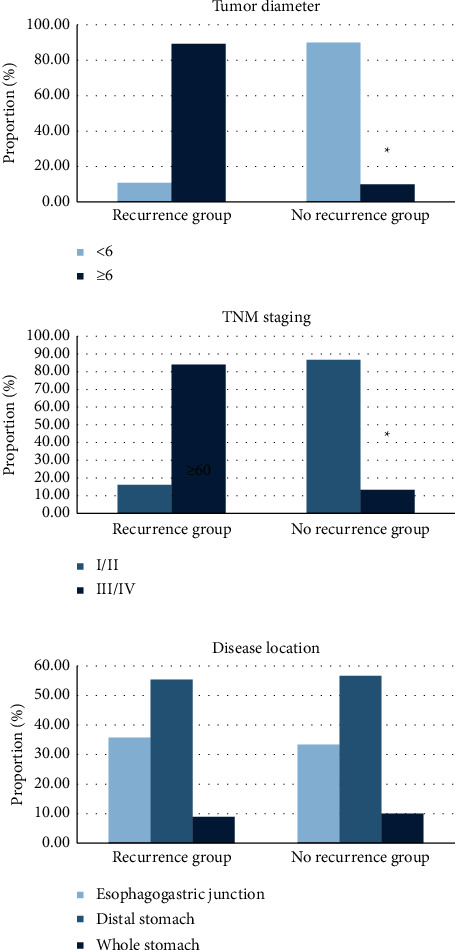
Computer tomography texture analysis (CTTA) based on the V-Net convolutional neural network (CNN) algorithm was used to analyze the recurrence of advanced gastric cancer after radical treatment. Meanwhile, the clinical characteristics of patients were analyzed to explore the recurrence factors. 86 patients who underwent the advanced radical gastrectomy for gastric cancer were retrospectively selected as the research objects. Patients were divided into the no-recurrence group (30 cases) and the recurrence group (56 cases) according to whether there was recurrence after radical treatment. CTTA was performed before and after surgery in both groups to analyze the risk factors for recurrence. The results showed that the dice coefficient (0.9209) and the intersection over union (IOU) value (0.8392) of the V-CNN segmentation effect were signally higher than those of CNN, V-Net, and context encoder network (CE-Net) ( < 0.05). The mean value of arterial phase and portal phase (65.29 ± 9.23)/(79.89 ± 10.83), kurtosis (3.22)/(3.13), entropy (9.99 ± 0.53)/(9.97 ± 0.83), and correlation (4.12 × 10/4.21 × 10) of the recurrence group was higher than the no-recurrence group, while the skewness (0.01)/(-0.06) of the recurrence group was lower than that of the no-recurrence group ( < 0.05). Patients aged 60 years old and above, with a tumor diameter of 6 cm and above, and in the stage III/IV in the recurrence group were higher than those in the no-recurrence group, and patients with chemotherapy were lower ( < 0.05). To sum up, age, tumor diameter, whether chemotherapy should be performed, and tumor staging were all the risk factors of postoperative recurrence among patients with gastric cancer. Besides, CT texture parameter could be used to predict and analyze the postoperative recurrence of gastric cancer with good clinical application values.
基于 V-Net 卷积神经网络(CNN)算法的计算机断层扫描纹理分析(CTTA)被用于分析根治性治疗后晚期胃癌的复发情况。同时,分析了患者的临床特征,以探讨复发的相关因素。回顾性选择 86 例接受晚期胃癌根治性手术的患者作为研究对象。根据根治性治疗后是否复发,将患者分为无复发组(30 例)和复发组(56 例)。对两组患者进行术前和术后 CTTA,分析复发的危险因素。结果表明,V-CNN 分割效果的 Dice 系数(0.9209)和交并比(IOU)值(0.8392)显著高于 CNN、V-Net 和上下文编码器网络(CE-Net)(<0.05)。复发组动脉期和门静脉期的平均值(65.29±9.23)/(79.89±10.83)、峰度(3.22)/(3.13)、熵(9.99±0.53)/(9.97±0.83)、相关系数(4.12×10/4.21×10)均高于无复发组,而复发组的偏度(0.01)/(-0.06)则低于无复发组(<0.05)。复发组中年龄 60 岁及以上、肿瘤直径 6cm 及以上、III/IV 期的患者比例高于无复发组,化疗的患者比例低于无复发组(<0.05)。综上所述,年龄、肿瘤直径、是否化疗以及肿瘤分期均为胃癌患者术后复发的危险因素。此外,CT 纹理参数可用于预测和分析胃癌术后复发,具有良好的临床应用价值。