Liu Lang, Javed Hafiz Umer, Xiao Jie
Guangdong Provincial Key Laboratory of Functional Food Active Substances, College of Food Sciences, South China Agricultural University, Guangzhou, China.
School of Chemistry and Chemical Engineering, Zhongkai University of Agricultural and Engineering, Guangzhou, China.
Front Nutr. 2022 May 17;9:890188. doi: 10.3389/fnut.2022.890188. eCollection 2022.
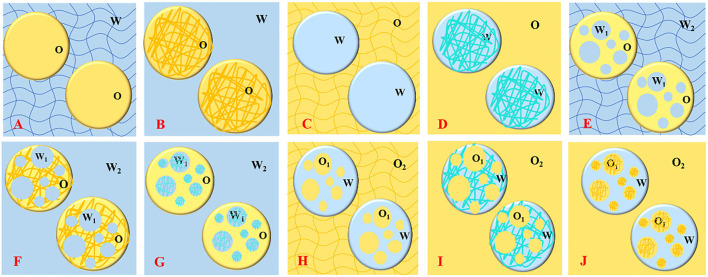
Gels are functional materials with well-defined structures (three-dimensional networks) assembled from the dispersed colloids, and capable of containing a large amount of water, oil, or air (by replacing the liquid within the gel pores), known as a hydrogel, oleogel, and aerogel, respectively. An emulsion gel is a gelled matrix filled with emulsion dispersion in which at least one phase, either continuous phase or dispersed phase forms spatial networks leading to the formation of a semisolid texture. Recently, the interest in the application of gels as functional colloids has attracted great attention in the food industry due to their tunable morphology and microstructure, promising physicochemical, mechanical, and functional properties, and superior stability, as well as controlled release, features for the encapsulated bioactive compounds. This article covers recent research progress on functional colloids (emulsion gels), including their fabrication, classification (protein-, polysaccharide-, and mixed emulsion gels), and properties specifically those related to the gel-body interactions (texture perception, digestion, and absorption), and industrial applications. The emerging applications, including encapsulation and controlled release, texture design and modification, fat replacement, and probiotics delivery are summarized. A summary of future perspectives to promote emulsion gels' use as functional colloids and delivery systems for scouting potential new applications in the food industry is also proposed. Emulsion gels are promising colloids being used to tailor breakdown behavior and sensory perception of food, as well as for the processing, transportation, and targeted release of food additives, functional ingredients, and bioactive substances with flexibility in designing structural and functional parameters.
凝胶是一种功能材料,具有由分散的胶体组装而成的明确结构(三维网络),并且能够容纳大量的水、油或空气(通过取代凝胶孔隙内的液体),分别称为水凝胶、油凝胶和气凝胶。乳液凝胶是一种填充有乳液分散体的凝胶基质,其中至少一相,无论是连续相还是分散相,形成空间网络,从而形成半固体质地。近年来,由于凝胶具有可调节的形态和微观结构、良好的物理化学、机械和功能特性、卓越的稳定性以及对封装生物活性化合物的控释特性,因此将凝胶用作功能性胶体在食品工业中引起了极大关注。本文涵盖了功能性胶体(乳液凝胶)的最新研究进展,包括其制备、分类(蛋白质基、多糖基和混合乳液凝胶)以及特性,特别是那些与凝胶-体相互作用(质地感知、消化和吸收)相关的特性,以及工业应用。总结了新兴应用,包括封装和控释、质地设计和改性、脂肪替代和益生菌递送。还提出了未来展望的总结,以促进乳液凝胶作为功能性胶体和递送系统的应用,从而在食品工业中探索潜在的新应用。乳液凝胶是一种很有前途的胶体,可用于调整食品的分解行为和感官感知,以及灵活设计结构和功能参数来加工、运输和靶向释放食品添加剂、功能成分和生物活性物质。