Sanabria-Cabrera Judith, Tabbai Sara, Niu Hao, Alvarez-Alvarez Ismael, Licata Anna, Björnsson Einar, Andrade Raul J, Lucena M Isabel
Servicio de Farmacología Clínica, Instituto de Investigación Biomédica de Málaga-IBIMA, Hospital Universitario Virgen de la Victoria, Universidad de Málaga, Málaga, Spain.
UCICEC IBIMA, Plataforma ISCIII de soporte para la Investigación Clínica, Málaga, Spain.
Front Pharmacol. 2022 May 17;13:876868. doi: 10.3389/fphar.2022.876868. eCollection 2022.
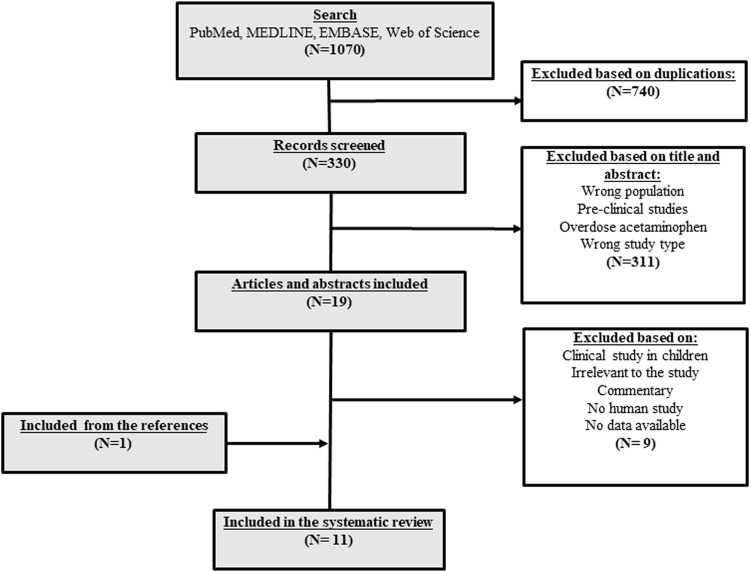
Idiosyncratic drug-induced liver injury (DILI) is a rare adverse reaction to drugs and other xenobiotics. DILI has different grades of severity and may lead to acute liver failure (ALF), for which there is no effective therapy. N-acetylcysteine (NAC) has been occasionally tested for the treatment of non-acetaminophen drug-induced ALF. However, limited evidence for its efficacy and safety is currently available. Our aim was to elucidate the benefit and safety of NAC in DILI and evaluate its hepatoprotective effect. We conducted a systematic review to evaluate the management and prevention focused on NAC in idiosyncratic DILI. The main outcomes included mortality due to DILI, time to normalization of liver biochemistry, transplant-free survival, and adverse events. We included clinical trials and observational studies, either prospective or retrospective. A total of 11 studies were included after literature screening. All studies had different methodologies, and some of them had important risk of bias that may lead to interpreting their findings with caution. The majority of the studies proved NAC efficacy in a cohort of patients with ALF due to different etiologies, where DILI represented a subgroup. NAC seemed to improve transplant-free survival; however, its benefit was inconclusive in terms of overall survival. With regard to safety, NAC showed an adequate safety profile. In prevention studies, NAC showed a possible hepatoprotective effect; however, this finding is limited by the lack of studies and presence of bias. NAC treatment seems to have some benefit in non-acetaminophen drug-induced liver failure patients with acceptable safety; however, due to the lack of evidence and limitations detected across studies, its benefit must be corroborated in clinical trials with adequate methodology.
特异质性药物性肝损伤(DILI)是一种罕见的药物及其他异生物质不良反应。DILI有不同程度的严重程度,可能导致急性肝衰竭(ALF),对此尚无有效治疗方法。N-乙酰半胱氨酸(NAC)偶尔被用于非对乙酰氨基酚药物性ALF的治疗测试。然而,目前其疗效和安全性的证据有限。我们的目的是阐明NAC在DILI中的益处和安全性,并评估其肝脏保护作用。我们进行了一项系统评价,以评估针对特异质性DILI中NAC的管理和预防。主要结局包括DILI导致的死亡率、肝脏生化指标恢复正常的时间、无移植生存以及不良事件。我们纳入了前瞻性或回顾性的临床试验和观察性研究。文献筛选后共纳入11项研究。所有研究方法各异,其中一些存在重要的偏倚风险,可能需要谨慎解读其研究结果。大多数研究证明NAC在一组因不同病因导致ALF的患者中有效,其中DILI是一个亚组。NAC似乎可改善无移植生存;然而,就总体生存而言,其益处尚无定论。在安全性方面,NAC显示出良好的安全性。在预防研究中,NAC显示出可能的肝脏保护作用;然而,这一发现因研究缺乏和存在偏倚而受到限制。NAC治疗似乎对非对乙酰氨基酚药物性肝衰竭患者有一定益处且安全性可接受;然而,由于缺乏证据以及各项研究中发现的局限性,其益处必须在采用适当方法的临床试验中得到证实。