School of Biomolecular Science and Engineering, Vidyasirimedhi Institute of Science and Technology (VISTEC), Rayong, 21210, Thailand.
Department of Chemistry, Faculty of Science, Chulalongkorn University, Bangkok, 10330, Thailand.
Angew Chem Int Ed Engl. 2022 Sep 12;61(37):e202203061. doi: 10.1002/anie.202203061. Epub 2022 Jun 21.
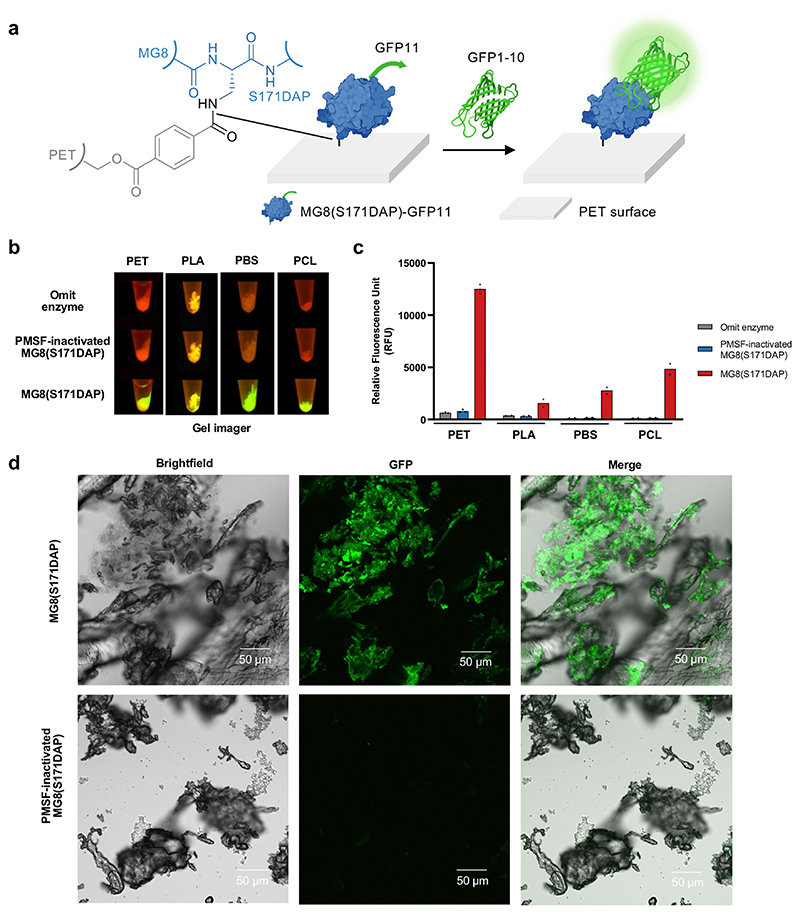
We report a bioinformatic workflow and subsequent discovery of a new polyethylene terephthalate (PET) hydrolase, which we named MG8, from the human saliva metagenome. MG8 has robust PET plastic degradation activities under different temperature and salinity conditions, outperforming several naturally occurring and engineered hydrolases in degrading PET. Moreover, we genetically encoded 2,3-diaminopropionic acid (DAP) in place of the catalytic serine residue of MG8, thereby converting a PET hydrolase into a covalent binder for bio-functionalization of PET. We show that MG8(DAP), in conjunction with a split green fluorescent protein system, can be used to attach protein cargos to PET as well as other polyester plastics. The discovery of a highly active PET hydrolase from the human metagenome-currently an underexplored resource for industrial enzyme discovery-as well as the repurposing of such an enzyme into a plastic functionalization tool, should facilitate ongoing efforts to degrade and maximize reusability of PET.
我们报告了一种生物信息学工作流程,并随后从人类唾液宏基因组中发现了一种新的聚对苯二甲酸乙二醇酯(PET)水解酶,我们将其命名为 MG8。MG8 在不同温度和盐度条件下具有强大的 PET 塑料降解活性,在降解 PET 方面优于几种天然存在和工程化的水解酶。此外,我们在 MG8 的催化丝氨酸残基处进行了基因编码 2,3-二氨基丙酸(DAP)的替换,从而将 PET 水解酶转化为用于 PET 生物功能化的共价结合物。我们表明,MG8(DAP) 与分裂的绿色荧光蛋白系统结合,可用于将蛋白质有效负载附着到 PET 以及其他聚酯塑料上。从人类宏基因组中发现一种高度活跃的 PET 水解酶——目前这是工业酶发现的一个未充分探索的资源——以及将这种酶重新用作塑料功能化工具,应该有助于正在进行的努力,以降解和最大限度地提高 PET 的可重复使用性。