Section of Cardiology Department of Medicine Baylor College of Medicine Houston TX.
Section of Cardiology Michael E. DeBakey Veterans Affairs Hospital Houston TX.
J Am Heart Assoc. 2022 Jun 7;11(11):e024107. doi: 10.1161/JAHA.121.024107. Epub 2022 Jun 3.
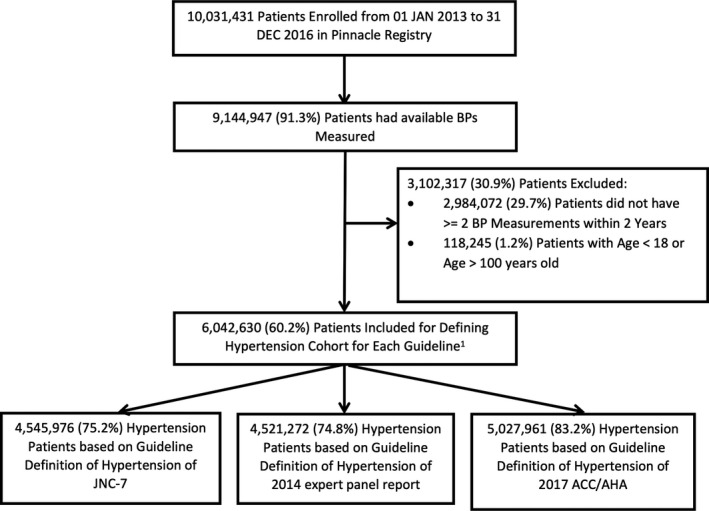
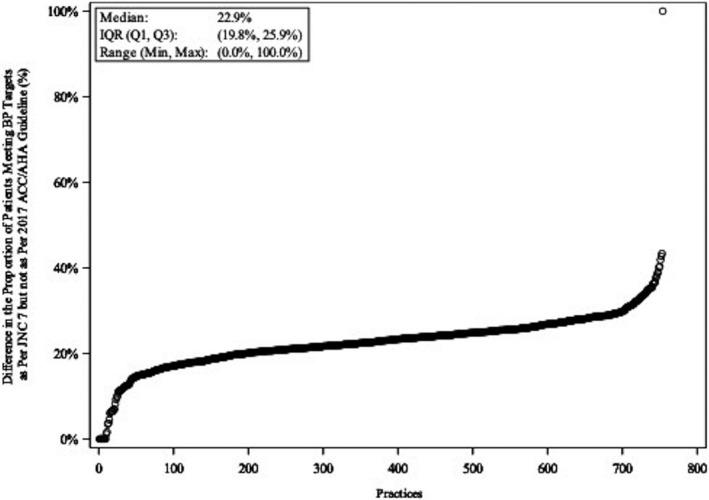
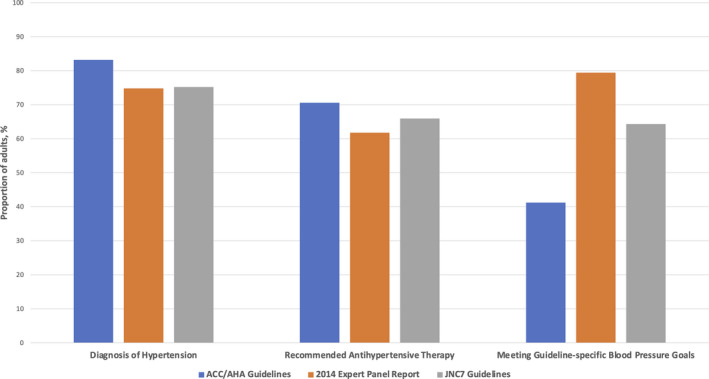
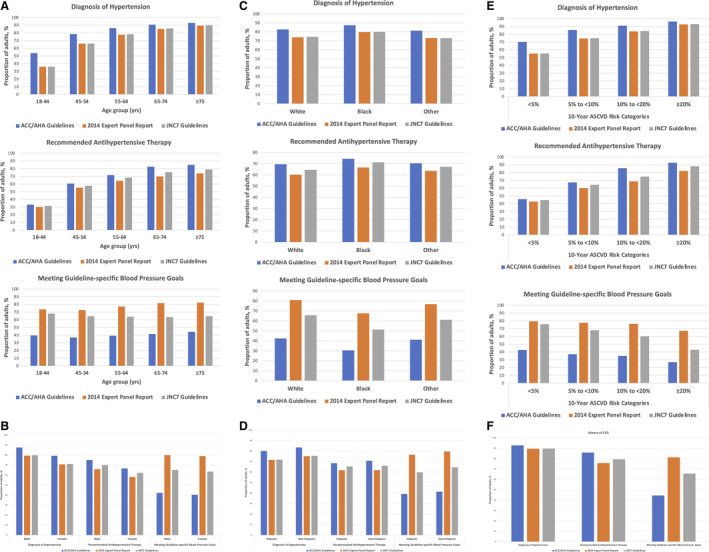
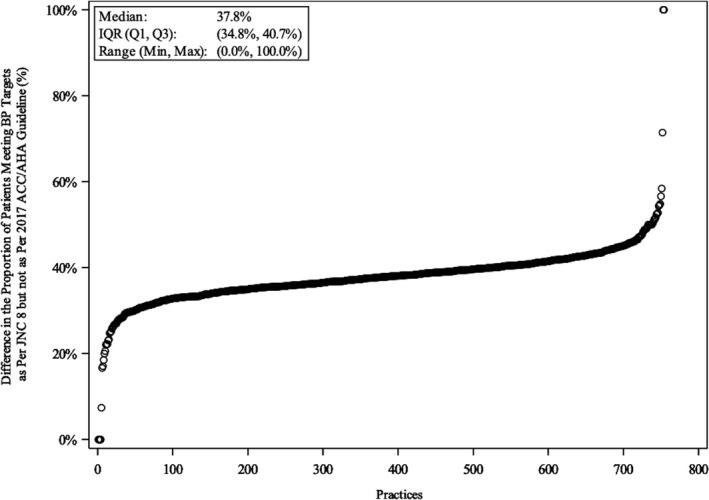
Background Clinical implications of change in the 2017 American College of Cardiology (ACC)/American Heart Association (AHA) guideline on the diagnosis and management of hypertension, compared with recommendations by 2014 expert panel and Seventh Report of the Joint National Committee on Prevention, Detection, Evaluation, and Treatment of High Blood Pressure (JNC7), are not known. Methods and Results Using data from the NCDR (National Cardiovascular Data Registry) PINNACLE (Practice Innovation and Clinical Excellence) Registry (January 2013-Decemver 2016), we compared the proportion and clinical characteristics of patients seen in cardiology practices diagnosed with hypertension, recommended antihypertensive treatment, and achieving blood pressure (BP) goals per each guideline document. In addition, we evaluated the proportion of patients at the level of practices meeting BP targets defined by each guideline. Of 6 042 630 patients evaluated, 5 027 961 (83.2%) were diagnosed with hypertension per the 2017 ACC/AHA guideline, compared with 4 521 272 (74.8%) per the 2014 panel and 4 545 976 (75.2%) per JNC7. The largest increase in hypertension prevalence was seen in younger ages, women, and those with lower cardiovascular risk. Antihypertensive medication was recommended to 70.6% of patients per the ACC/AHA guideline compared with 61.8% and 65.9% per the 2014 panel and JNC7, respectively. Among those on antihypertensive agents, 41.2% achieved BP targets per the ACC/AHA guideline, compared with 79.4% per the 2014 panel and 64.3% per JNC7. Lower proportions of women, non-White (Black and "other") races, and those at higher cardiovascular risk achieved BP goals. Median practice-level proportion of patients meeting BP targets per the 2014 panel but not the ACC/AHA guideline was 37.8% (interquartile range, 34.8%-40.7%) and per JNC7 but not the ACC/AHA guideline was 22.9% (interquartile range, 19.8%-25.9%). Conclusions Following publication of the 2017 guideline, significantly more people, particularly younger people and those with lower cardiovascular risk, will be diagnosed with hypertension and need antihypertensive treatment compared with previous recommendations. Significant practice-level variation in BP control also exists. Efforts are needed to improve guideline-concordant hypertension management in an effort to improve outcomes.
与 2014 年专家小组和第七次联合国家委员会预防、检测、评估和治疗高血压报告(JNC7)的建议相比,2017 年美国心脏病学会(ACC)/美国心脏协会(AHA)关于高血压诊断和治疗的指南的变化对临床的影响尚不清楚。
利用 NCDR(国家心血管数据登记处)PINNACLE(实践创新和临床卓越)登记处(2013 年 1 月至 2016 年 12 月)的数据,我们比较了根据每个指南文件诊断为高血压、建议接受抗高血压治疗和达到血压(BP)目标的患者比例和临床特征。此外,我们还评估了每个指南定义的达到 BP 目标的实践水平的患者比例。在评估的 6042630 名患者中,根据 2017 年 ACC/AHA 指南,5027961 名(83.2%)被诊断为高血压,而根据 2014 年小组和 JNC7 指南,4521272 名(74.8%)和 4545976 名(75.2%)被诊断为高血压。高血压患病率的最大增加出现在年龄较小、女性和心血管风险较低的患者中。根据 ACC/AHA 指南,70.6%的患者被建议使用抗高血压药物,而 2014 年小组和 JNC7 指南的建议比例分别为 61.8%和 65.9%。在接受抗高血压药物治疗的患者中,根据 ACC/AHA 指南,41.2%的患者达到了 BP 目标,而根据 2014 年小组和 JNC7 指南,分别有 79.4%和 64.3%的患者达到了 BP 目标。女性、非白种人(黑人和“其他”种族)和心血管风险较高的患者达到 BP 目标的比例较低。符合 2014 年小组指南但不符合 ACC/AHA 指南的患者中,中位数实践水平达到 BP 目标的比例为 37.8%(四分位距为 34.8%至 40.7%),符合 JNC7 但不符合 ACC/AHA 指南的患者中,中位数实践水平达到 BP 目标的比例为 22.9%(四分位距为 19.8%至 25.9%)。
与之前的建议相比,2017 年指南发布后,更多的人,特别是年轻人和心血管风险较低的人,将被诊断为高血压并需要抗高血压治疗。血压控制方面也存在显著的实践水平差异。需要努力改善符合指南的高血压管理,以改善结果。