School of Public Health, College of Medicine and Health Science, Wolaita Sodo University, Wolaita Sodo, Ethiopia.
School of Public Health, College of Medicine and Health Science, Dilla University, Dilla, Ethiopia.
PLoS One. 2022 Jun 3;17(6):e0267545. doi: 10.1371/journal.pone.0267545. eCollection 2022.
Unintended pregnancy due to disuse of family planning is the main cause of abortion globally. Women with a history of abortion are at higher risk of developing another unintended pregnancy, which may lead to repeated abortions and life-threatening complications. The immediate post-abortion period before women leave health institutions is a crucial time to provide family planning services. In Ethiopia, many women leave health facilities without using family planning methods. Therefore, this study aimed to determine the utilization of post-abortion family planning and its associated factors in health institutions in Wolaita Zone, Southern Ethiopia.
Facility-based mixed cross sectional study was conducted between April 1 and June 30, 2018. A systematic sampling method was used to select the 408 participants. Seven key informants were selected for in-depth interviews and observations were made using a checklist. Data were collected through face-to-face interviews using a structured questionnaire. Data were entered into EPI INFO 3.5.1 and exported to SPSS 21 for cleaning and analysis. Bivariate analysis was employed and a P-value <0.25 was considered for the multivariable analysis. Qualitative data were coded and thematically analyzed to support the quantitative findings.
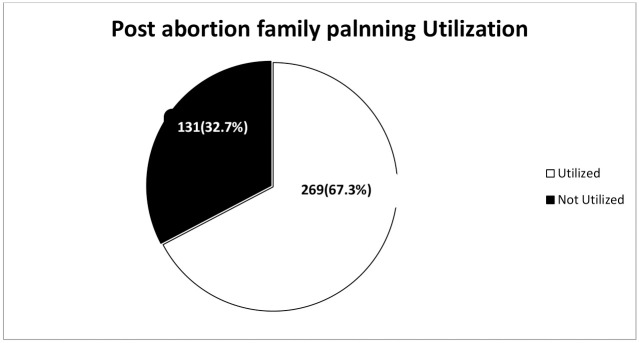
Data were obtained from 400 participants (response rate, 98%). The magnitude of post-abortion family planning was 67.3% [95% CI (62.8, 71.8)]. Marital status [AOR 95% CI 3.86(1.9, 7.8)], Good knowledge about post-abortion family planning [AOR 95% CI 2.48(1.22, 5.03)], Non-governmental health facility [AOR 95% CI 6.62(3.47, 12.6)] Counseling [AOR 95% CI 3.6(2.02, 6.4)] and husbands' support [AOR 95% CI 3.21(1.81-5.7)] were significantly associated with Post-abortion family planning utilization.
The utilization of post-abortion family planning was low in Wolaita Sodo health institutions. Marital status, knowledge of post-abortion family planning, use of services at non-governmental health facilities, counseling, and husbands' support were determinants of post-abortion family planning.
全球范围内,因计划生育措施使用不当而导致的意外怀孕是堕胎的主要原因。有堕胎史的女性再次意外怀孕的风险更高,这可能导致反复堕胎和危及生命的并发症。在女性离开医疗机构的堕胎后立即时期是提供计划生育服务的关键时期。在埃塞俄比亚,许多女性在离开卫生机构时没有使用计划生育方法。因此,本研究旨在确定在埃塞俄比亚沃莱塔地区医疗机构中,堕胎后计划生育的利用及其相关因素。
本研究为 2018 年 4 月 1 日至 6 月 30 日期间进行的基于机构的混合横断面研究。采用系统抽样方法选择了 408 名参与者。选择了 7 名关键信息提供者进行深入访谈,并使用检查表进行观察。通过面对面访谈使用结构化问卷收集数据。数据输入 EPI INFO 3.5.1 并导出到 SPSS 21 进行清理和分析。进行了双变量分析,将 P 值<0.25 的因素纳入多变量分析。对定性数据进行编码和主题分析,以支持定量结果。
从 400 名参与者(应答率为 98%)中获得了数据。堕胎后计划生育的实施比例为 67.3%[95%置信区间(62.8, 71.8)]。婚姻状况[比值比 95%置信区间 3.86(1.9, 7.8)]、良好的堕胎后计划生育知识[比值比 95%置信区间 2.48(1.22, 5.03)]、非政府卫生机构[比值比 95%置信区间 6.62(3.47, 12.6)]、咨询[比值比 95%置信区间 3.6(2.02, 6.4)]和丈夫支持[比值比 95%置信区间 3.21(1.81-5.7)]与堕胎后计划生育的使用显著相关。
在沃莱塔索多卫生机构中,堕胎后计划生育的利用程度较低。婚姻状况、堕胎后计划生育知识、在非政府卫生机构的服务使用、咨询和丈夫支持是堕胎后计划生育的决定因素。