Department of Academic Haematology, University College London Cancer Institute, London, WC1E 6DD, UK.
Katharine Dormandy Haemophilia and Thrombosis Centre, Royal Free NHS Trust Pond Street, London, NW3 2QG, UK.
Breast Cancer Res. 2022 Jun 3;24(1):39. doi: 10.1186/s13058-022-01531-1.
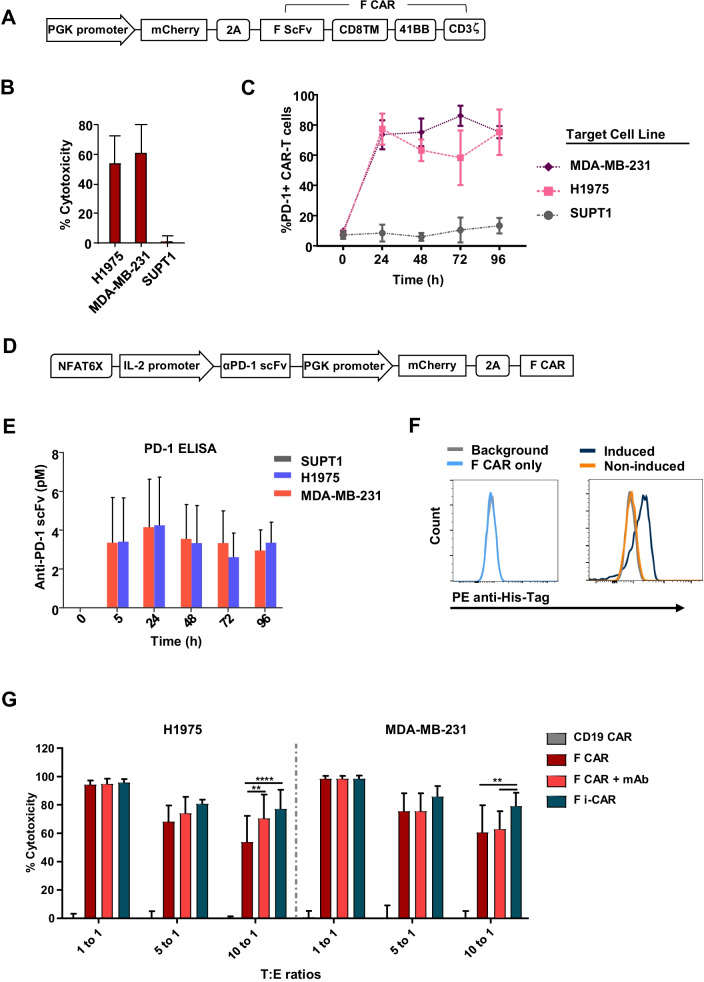
Chimeric antigen receptor (CAR)-T cells can induce powerful immune responses in patients with hematological malignancies but have had limited success against solid tumors. This is in part due to the immunosuppressive tumor microenvironment (TME) which limits the activity of tumor-infiltrating lymphocytes (TILs) including CAR-T cells. We have developed a next-generation armored CAR (F i-CAR) targeting receptor tyrosine kinase-like orphan receptor 1 (ROR1), which is expressed at high levels in a range of aggressive tumors including poorly prognostic triple-negative breast cancer (TNBC). The F i-CAR-T is designed to release an anti-PD-1 checkpoint inhibitor upon CAR-T cell activation within the TME, facilitating activation of CAR-T cells and TILs while limiting toxicity.
To bolster potency, we developed a F i-CAR construct capable of IL-2-mediated, NFAT-induced secretion of anti-PD-1 single-chain variable fragments (scFv) within the tumor microenvironment, following ROR1-mediated activation. Cytotoxic responses against TNBC cell lines as well as levels and binding functionality of released payload were analyzed in vitro by ELISA and flow cytometry. In vivo assessment of potency of F i-CAR-T cells was performed in a TNBC NSG mouse model.
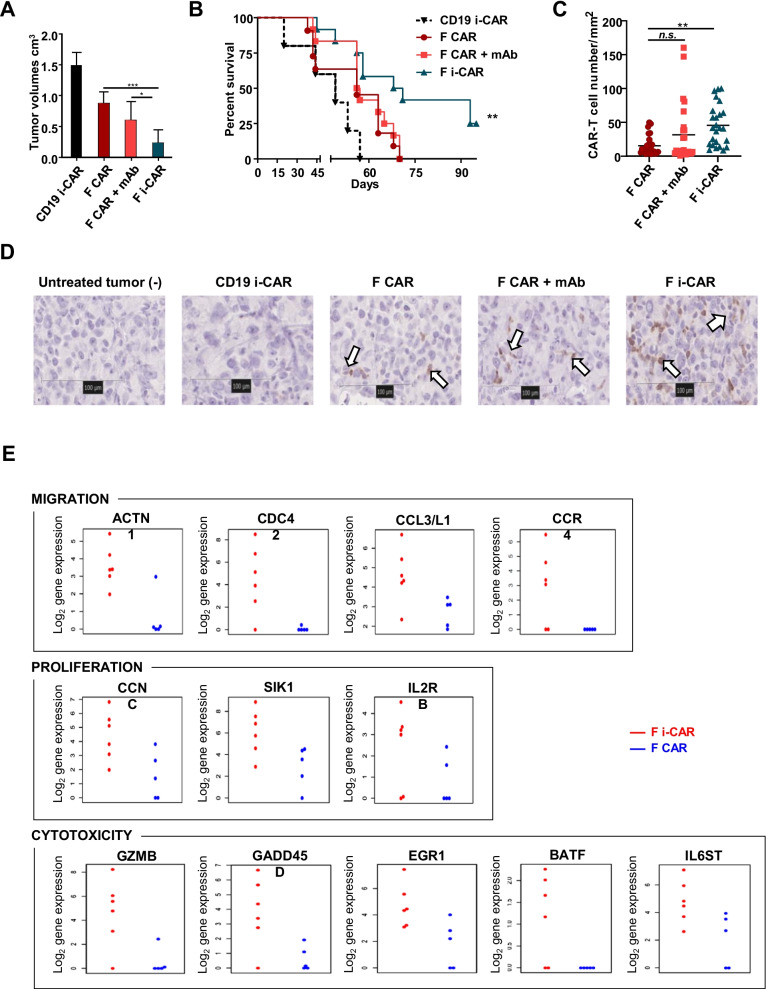
F i-CAR-T cells released measurable levels of anti-PD-1 payload with 5 h of binding to ROR1 on tumor and enhanced the cytotoxic effects at challenging 1:10 E:T ratios. Treatment of established PDL1 + TNBC xenograft model with F i-CAR-T cells resulted in significant abrogation in tumor growth and improved survival of mice (71 days), compared to non-armored CAR cells targeting ROR1 (F CAR-T) alone (49 days) or in combination with systemically administered anti-PD-1 antibody (57 days). Crucially, a threefold increase in tumor-infiltrating T cells was observed with F i-CAR-T cells and was associated with increased expression of genes related to cytotoxicity, migration and proliferation.
Our next-generation of ROR1-targeting inducible armored CAR platform enables the release of an immune stimulating payload only in the presence of target tumor cells, enhancing the therapeutic activity of the CAR-T cells. This technology provided a significant survival advantage in TNBC xenograft models. This coupled with its potential safety attributes merits further clinical evaluation of this approach in TNBC patients.
嵌合抗原受体 (CAR)-T 细胞可在血液恶性肿瘤患者中引发强大的免疫反应,但对实体瘤的疗效有限。这在一定程度上是由于免疫抑制性肿瘤微环境 (TME) 限制了肿瘤浸润淋巴细胞 (TIL) 的活性,包括 CAR-T 细胞。我们开发了一种针对受体酪氨酸激酶样孤儿受体 1 (ROR1) 的下一代装甲 CAR (F i-CAR),该受体在一系列侵袭性肿瘤中高表达,包括预后不良的三阴性乳腺癌 (TNBC)。F i-CAR-T 设计为在 TME 中 CAR-T 细胞激活时释放抗 PD-1 检查点抑制剂,促进 CAR-T 细胞和 TIL 的激活,同时限制毒性。
为了提高效力,我们开发了一种 F i-CAR 构建体,该构建体能够在 ROR1 介导的激活后,在肿瘤微环境中通过 IL-2 介导、NFAT 诱导分泌抗 PD-1 单链可变片段 (scFv)。通过 ELISA 和流式细胞术分析 TNBC 细胞系的细胞毒性反应以及释放的有效载荷的水平和结合功能。在 TNBC NSG 小鼠模型中进行了 F i-CAR-T 细胞效力的体内评估。
F i-CAR-T 细胞在与肿瘤上的 ROR1 结合 5 小时后释放可测量水平的抗 PD-1 有效载荷,并在具有挑战性的 1:10 E:T 比下增强了细胞毒性作用。与单独靶向 ROR1 的非装甲 CAR 细胞 (F CAR-T) 或与系统给予的抗 PD-1 抗体联合治疗 (57 天) 相比,用 F i-CAR-T 细胞治疗已建立的 PDL1+TNBC 异种移植模型导致肿瘤生长显著消退和小鼠存活时间延长 (71 天)。重要的是,用 F i-CAR-T 细胞观察到肿瘤浸润 T 细胞增加了三倍,并且与细胞毒性、迁移和增殖相关基因的表达增加有关。
我们的新一代靶向 ROR1 的诱导性装甲 CAR 平台仅在存在靶肿瘤细胞的情况下释放免疫刺激有效载荷,从而增强了 CAR-T 细胞的治疗活性。这项技术为 TNBC 异种移植模型提供了显著的生存优势。再加上其潜在的安全性特征,值得在 TNBC 患者中进一步评估这种方法。