Department of Physiotherapy, Maastricht University Medical Centre, P.O. Box 5800, 6202 AZ, Maastricht, the Netherlands.
CAPHRI School for Public Health and Primary Care, Maastricht University, P.O. Box 616, 6200 MD, Maastricht, the Netherlands.
BMC Geriatr. 2022 Jun 3;22(1):479. doi: 10.1186/s12877-022-03146-9.
Inactive behaviour is common in older adults during hospitalisation and associated with poor health outcomes. If patients at high risk of spending little time standing/walking could be identified early after admission, they could be given interventions aimed at increasing their time spent standing/walking. This study aims to identify older adults at high risk of low physical activity (PA) levels during hospitalisation.
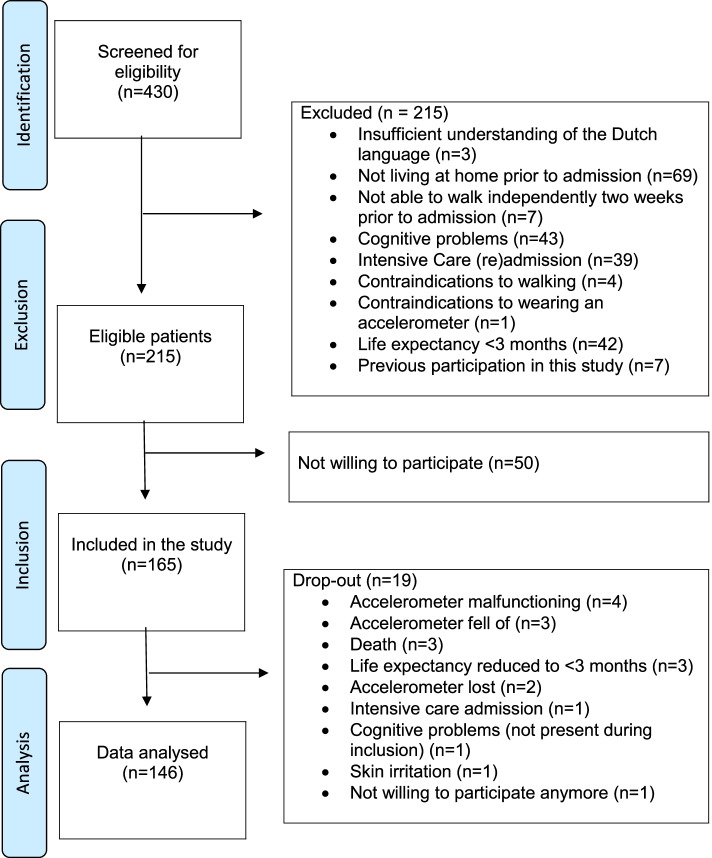
Prospective cohort study of 165 older adults (≥ 70 years) admitted to the department of Internal Medicine of Maastricht University Medical Centre for acute medical illness. Two prediction models were developed to predict the probability of low PA levels during hospitalisation. Time spent standing/walking per day was measured with an accelerometer until discharge (≤ 12 days). The average time standing/walking per day between inclusion and discharge was dichotomized into low/high PA levels by dividing the cohort at the median (50.0%) in model 1, and lowest tertile (33.3%) in model 2. Potential predictors-Short Physical Performance Battery (SPPB), Activity Measure for Post-Acute Care (AM-PAC), age, sex, walking aid use, and disabilities in activities of daily living-were selected based on literature and analysed using logistic regression analysis. Models were internally validated using bootstrapping. Model performance was quantified using measures of discrimination (area under the receiver operating characteristic curve (AUC)) and calibration (Hosmer and Lemeshow (H-L) goodness-of-fit test and calibration plots).
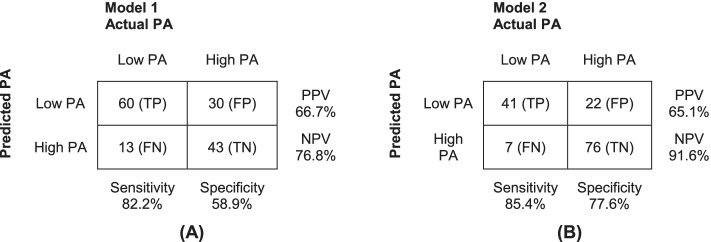
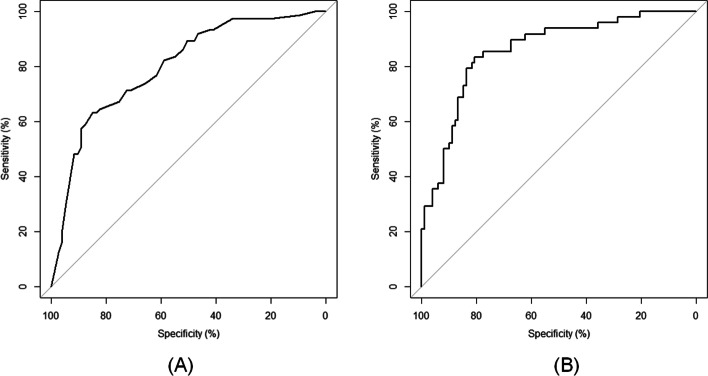
Model 1 predicts a probability of spending ≤ 64.4 min standing/walking and holds the predictors SPPB, AM-PAC and sex. Model 2 predicts a probability of spending ≤ 47.2 min standing/walking and holds the predictors SPPB, AM-PAC, age and walking aid use. AUCs of models 1 and 2 were .80 (95% confidence interval (CI) = .73-.87) and .86 (95%CI = .79-.92), respectively, indicating good discriminative ability. Both models demonstrate near perfect calibration of the predicted probabilities and good overall performance, with model 2 performing slightly better.
The developed and internally validated prediction models may enable clinicians to identify older adults at high risk of low PA levels during hospitalisation. External validation and determining the clinical impact are needed before applying the models in clinical practise.
老年人在住院期间活动量普遍较少,且与健康状况不佳有关。如果能在入院后早期识别出那些有久坐/少走动风险的患者,就可以为他们提供旨在增加站立/走动时间的干预措施。本研究旨在确定在住院期间体力活动(PA)水平较低的老年人的高危人群。
前瞻性队列研究纳入了 165 名(≥70 岁)入住马斯特里赫特大学医学中心内科的急性内科疾病患者。建立了两个预测模型来预测住院期间低 PA 水平的概率。使用加速度计测量每天站立/行走的时间,直至出院(≤12 天)。根据模型 1 的中位数(50.0%)将每天站立/行走的时间分为低/高 PA 水平,根据模型 2的最低三分位数(33.3%)将每天站立/行走的时间分为低/高 PA 水平。基于文献选择潜在预测因子-简短体能测试(SPPB)、急性后护理活动测量(AM-PAC)、年龄、性别、助行器使用和日常生活活动中的残疾情况,并使用逻辑回归分析进行分析。使用 bootstrap 对模型进行内部验证。使用区分度(接受者操作特征曲线下面积(AUC))和校准(Hosmer 和 Lemeshow(H-L)拟合优度检验和校准图)来评估模型性能。
模型 1 预测站立/行走时间≤64.4 分钟的概率,包含 SPPB、AM-PAC 和性别作为预测因子。模型 2 预测站立/行走时间≤47.2 分钟的概率,包含 SPPB、AM-PAC、年龄和助行器使用作为预测因子。模型 1 和模型 2 的 AUC 分别为 0.80(95%置信区间(CI):0.73-0.87)和 0.86(95%CI:0.79-0.92),表明具有良好的区分能力。两个模型均显示出预测概率的近乎完美校准和良好的整体性能,模型 2 略好一些。
所开发的内部验证预测模型可以帮助临床医生识别出住院期间 PA 水平较低的老年人高危人群。在将模型应用于临床实践之前,需要进行外部验证并确定其临床影响。