Department of Physiology, Keimyung University School of Medicine, Daegu 42601, Republic of Korea.
Department of Food Science and Technology, Chonnam National University, Gwangju 61186, Republic of Korea.
J Adv Res. 2023 Mar;45:1-13. doi: 10.1016/j.jare.2022.05.013. Epub 2022 May 31.
Sterol regulatory element binding protein (SREBP) cleavage-associating protein (SCAP) is a sterol-regulated escort protein that translocates SREBPs from the endoplasmic reticulum to the Golgi apparatus, thereby activating lipid metabolism and cholesterol synthesis. Although SCAP regulates lipid metabolism in metabolic tissues, such as the liver and muscle, the effect of macrophage-specific SCAP deficiency in adipose tissue macrophages (ATMs) of patients with metabolic diseases is not completely understood.
Here, we examined the function of SCAP in high-fat/high-sucrose diet (HFHS)-fed mice and investigated its role in the polarization of classical activated macrophages in adipose tissue.
Macrophage-specific SCAP knockout (mKO) mice were generated through crossbreeding lysozyme 2-cre mice with SCAP floxed mice which were then fed HFHS for 12 weeks. Primary macrophages were derived from bone marrow cells and analyzed further.
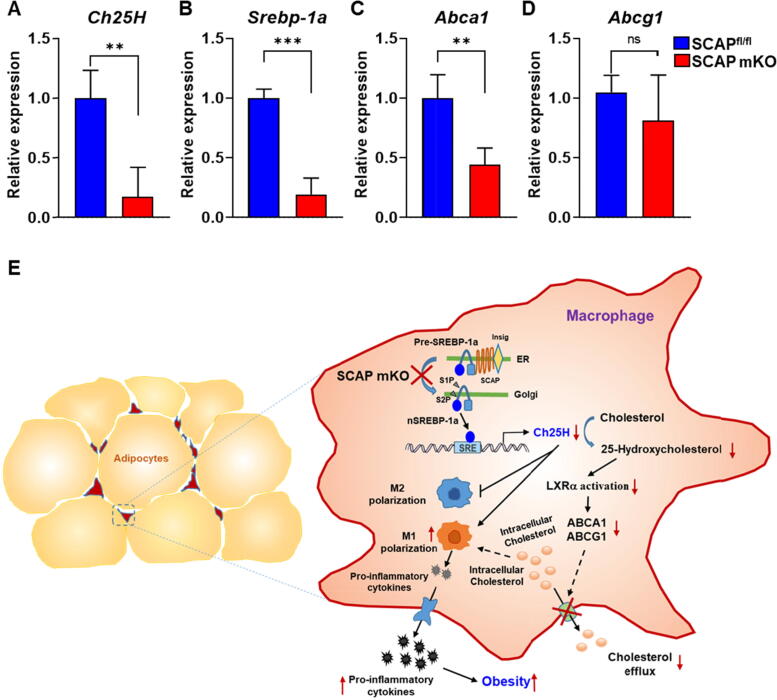
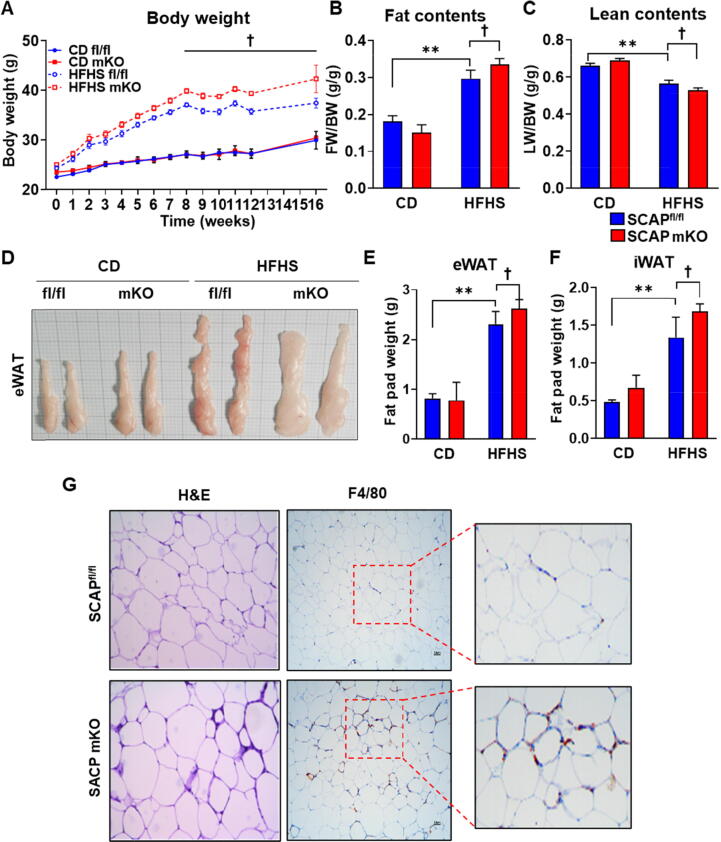
We found that fat accumulation and the appearance of proinflammatory M1 macrophages were both higher in HFHS-fed SCAP mKO mice relative to floxed control mice. We traced the effect to a defect in the lipopolysaccharide-mediated increase in SREBP-1a that occurs in control but not SCAP mKO mice. Mechanistically, SREBP-1a increased expression of cholesterol 25-hydroxylase transcription, resulting in an increase in the production of 25-hydroxycholesterol (25-HC), an endogenous agonist of liver X receptor alpha (LXRα) which increased expression of cholesterol efflux to limit cholesterol accumulation and M1 polarization. In the absence of SCAP mediated activation of SREBP-1a, increased M1 macrophage polarization resulted in reduced cholesterol efflux downstream from 25-HC-dependent LXRα activation.
Overall, the activation of the SCAP-SREBP-1a pathway in macrophages may provide a novel therapeutic strategy that ameliorates obesity by controlling cholesterol homeostasis in ATMs.
固醇调节元件结合蛋白(SREBP)切割相关蛋白(SCAP)是一种固醇调节的伴侣蛋白,它将 SREBPs 从内质网转运到高尔基体,从而激活脂质代谢和胆固醇合成。尽管 SCAP 调节代谢组织中的脂质代谢,如肝脏和肌肉,但代谢疾病患者脂肪组织巨噬细胞(ATMs)中巨噬细胞特异性 SCAP 缺失的影响尚不完全清楚。
本研究旨在研究 SCAP 在高脂肪/高蔗糖饮食(HFHS)喂养小鼠中的作用,并探讨其在脂肪组织中经典激活型巨噬细胞极化中的作用。
通过将溶菌酶 2-cre 小鼠与 SCAP floxed 小鼠杂交,产生巨噬细胞特异性 SCAP 敲除(mKO)小鼠,然后用 HFHS 喂养 12 周。从骨髓细胞中分离原代巨噬细胞并进一步分析。
我们发现,与 floxed 对照小鼠相比,HFHS 喂养的 SCAP mKO 小鼠的脂肪积累和促炎 M1 巨噬细胞的出现都更高。我们将这种效应追溯到 LPS 介导的 SREBP-1a 增加的缺陷,这种缺陷发生在对照小鼠中,但不在 SCAP mKO 小鼠中。从机制上讲,SREBP-1a 增加了胆固醇 25-羟化酶转录的表达,导致内源性肝 X 受体 alpha(LXRα)激动剂 25-羟胆固醇(25-HC)的产生增加,从而增加胆固醇外排以限制胆固醇积累和 M1 极化。在没有 SCAP 介导的 SREBP-1a 激活的情况下,增加的 M1 巨噬细胞极化导致 25-HC 依赖性 LXRα 激活下游的胆固醇外排减少。
总之,巨噬细胞中 SCAP-SREBP-1a 通路的激活可能提供一种新的治疗策略,通过控制 ATMs 中的胆固醇稳态来改善肥胖。