Rush University Medical Center, Chicago, IL.
J Arthroplasty. 2022 Jul;37(7S):S457-S464. doi: 10.1016/j.arth.2021.10.023. Epub 2022 Feb 18.
The impact of a postoperative diagnosis of COVID-19 in patients undergoing total joint arthroplasty (TJA) remains unknown. The objective of this study is to characterize the effect of COVID-19 infection following TJA on perioperative complication rates.
The Mariner database was queried for patients undergoing total hip and total knee arthroplasty from January 2018 to April 2020. TJA patients who were diagnosed with COVID-19 within 90 days postoperatively were matched in a 1:3 fashion based on age, gender, iron deficiency anemia, payer status, and Charlson Comorbidity Index with patients who were not diagnosed with COVID-19. Preoperative comorbidity profiles and complications within 3 months of surgery were compared. Statistical analysis included chi-squared tests and multivariate logistic regression with outcomes considered significant at P < .05.
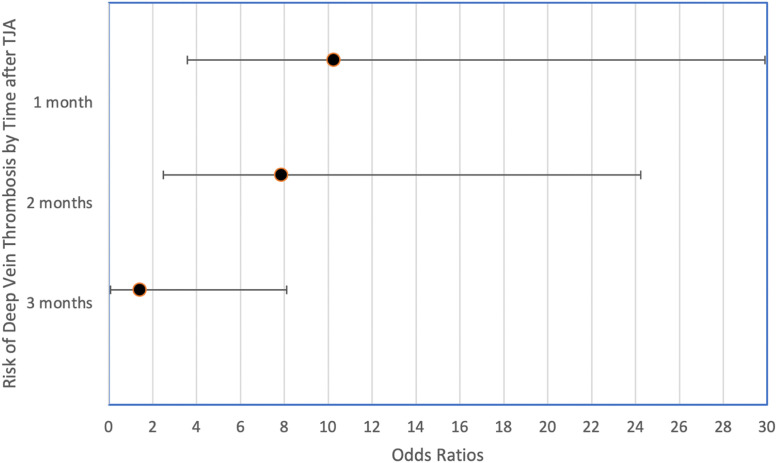
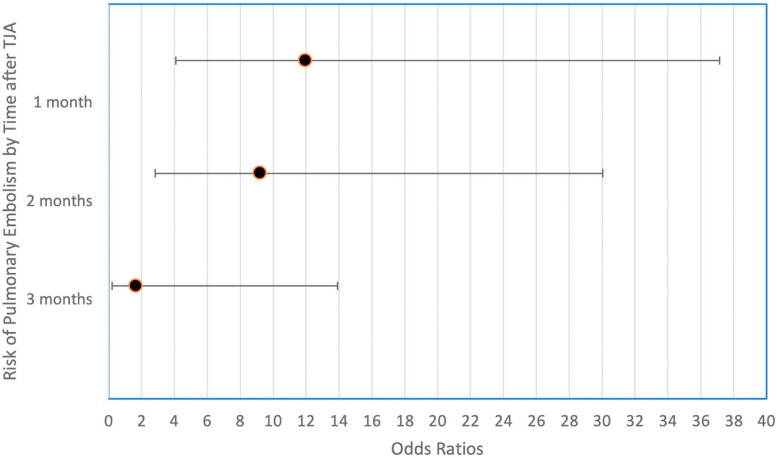
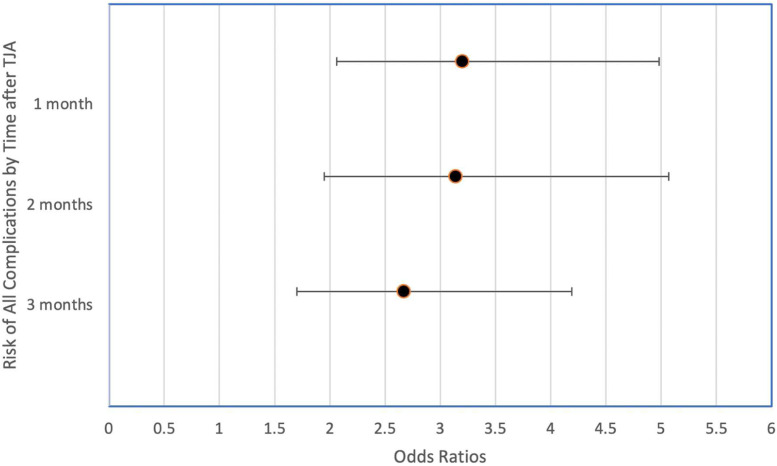
Of the 239 COVID-19 positive patients, 132 (55.2%) underwent total hip arthroplasty. On multivariate analysis, COVID-19 diagnosis was associated with increased odds of deep vein thrombosis (odds ratio [OR] 4.86, 95% confidence interval [CI] 2.10-11.81, P < .001), pulmonary embolism (OR 6.27, 95% CI 2.57-16.71, P < .001), and all complications (OR 3.36, 95% CI 2.47-4.59, P < .001). Incidence of deep vein thrombosis/pulmonary embolism was greater the closer in time the COVID-19 diagnosis was to the surgical procedure (10.24 times at 1 month, 7.87 times at 2 months, and 1.42 times at 3 months; P < .001). A similar relationship was observed with all complications.
Postoperative COVID-19 infection is associated with higher rates of cardiopulmonary complications, thromboembolic disease, renal injury, and urinary tract infections in patients undergoing hip and knee arthroplasty. COVID-19 infection earlier in the postoperative period is associated with a higher risk of complications.
COVID-19 术后诊断对接受全关节置换术(TJA)的患者的影响尚不清楚。本研究的目的是描述 TJA 后 COVID-19 感染对围手术期并发症发生率的影响。
从 2018 年 1 月至 2020 年 4 月,在 Mariner 数据库中查询接受全髋关节和全膝关节置换术的患者。将术后 90 天内被诊断为 COVID-19 的 TJA 患者按年龄、性别、缺铁性贫血、支付者状态和 Charlson 合并症指数与未被诊断为 COVID-19 的患者进行 1:3 匹配。比较术前合并症谱和术后 3 个月内的并发症。统计分析包括卡方检验和多变量逻辑回归,以 P <.05 为结果有统计学意义。
在 239 例 COVID-19 阳性患者中,132 例(55.2%)行全髋关节置换术。多变量分析显示,COVID-19 诊断与深静脉血栓形成(优势比 [OR] 4.86,95%置信区间 [CI] 2.10-11.81,P <.001)、肺栓塞(OR 6.27,95% CI 2.57-16.71,P <.001)和所有并发症(OR 3.36,95% CI 2.47-4.59,P <.001)的发生风险增加相关。COVID-19 诊断与手术时间越接近,深静脉血栓形成/肺栓塞的发生率越高(1 个月时为 10.24 倍,2 个月时为 7.87 倍,3 个月时为 1.42 倍;P <.001)。所有并发症也观察到类似的关系。
COVID-19 术后感染与接受髋关节和膝关节置换术的患者心肺并发症、血栓栓塞性疾病、肾损伤和尿路感染的发生率较高有关。术后早期 COVID-19 感染与更高的并发症风险相关。