Centre for Research on Environment, Society and Health, Department of Geography, School of GeoSciences, The University of Edinburgh, Edinburgh, UK.
Department of Psychiatry, University of Oxford, Oxford, UK.
Lancet Public Health. 2022 Jun;7(6):e557-e568. doi: 10.1016/S2468-2667(22)00093-7.
Comorbid mental illnesses and substance use disorders are associated with adverse criminal, social, and health outcomes. Yet, their burden is not reliably known among prison populations. We therefore aimed to estimate the prevalence of comorbid serious mental illnesses and substance use disorders (dual disorders) among people in prison worldwide.
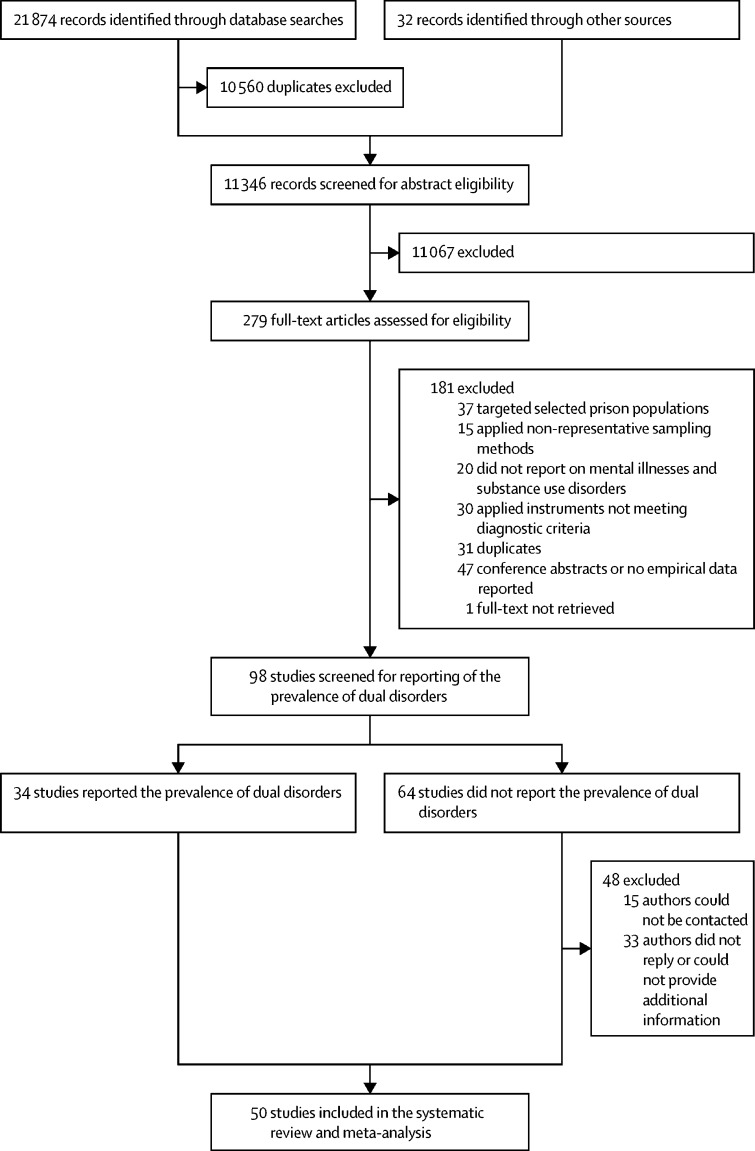
In this systematic review and meta-analysis, we searched 15 electronic databases (ASSIA, CAB Abstracts, Criminal Justice Database, Embase, Global Health, Global Index Medicus, IBSS, MEDLINE, NCJRS, PAIS Index, PsycINFO, Russian Science Citation Index, Scielo, Social Services Abstracts, and Web of Science) and the grey literature (Open Grey and ProQuest Dissertations & Theses Global) for studies reporting the prevalence of serious mental illnesses and substance use disorders in prison populations published between Jan 1, 1980, and Sept 25, 2021, and contacted the authors of relevant studies. Empirical studies among unselected adult prison populations that applied representative sampling strategies and validated diagnostic instruments, and either reported the prevalence of dual disorders or had authors who could provide prevalence data in correspondence, were included. Two reviewers (GB and SDL) independently extracted data from the eligible studies; both current (up to 1 year) and lifetime prevalence were extracted, if available. We sought summary estimates. Our primary outcomes were comorbid non-affective psychosis with substance use disorders and comorbid major depression with substance use disorders. We conducted a random-effects meta-analysis, explored between-sample heterogeneity with meta-regression, and calculated odds ratios (ORs) to assess bidirectional relationships between mental and substance use disorders. Risk of bias was assessed by use of a standard tool. The study protocol was registered with PROSPERO, CRD42020207301.
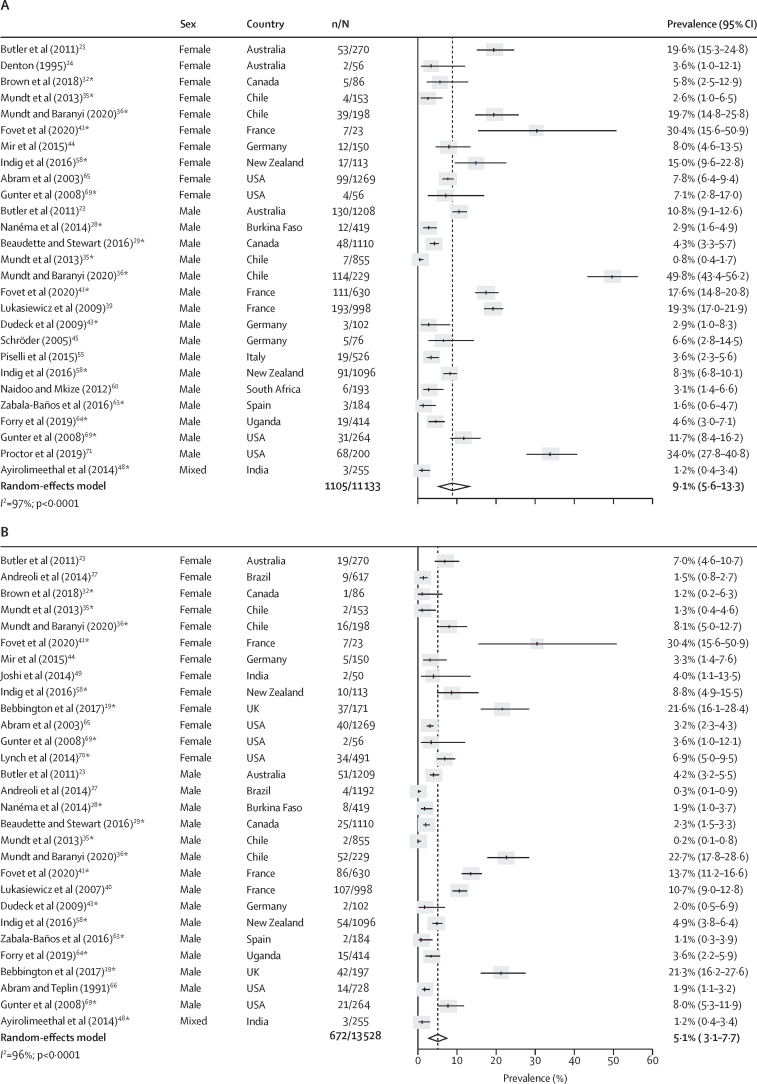
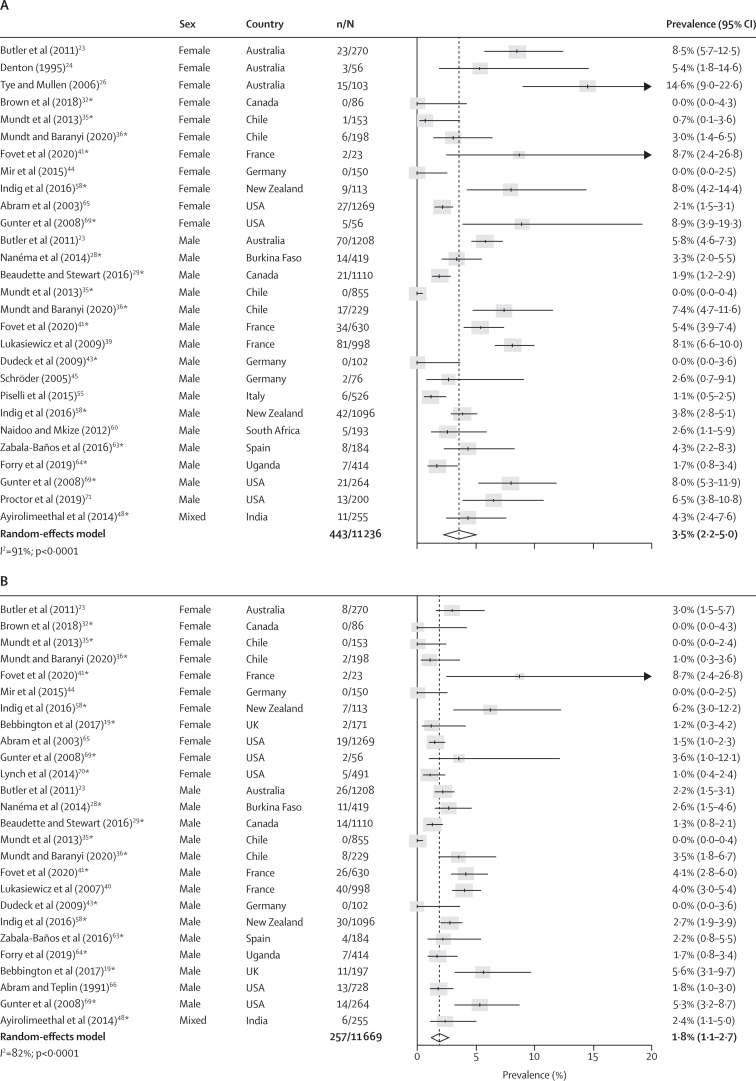
Of 11 346 records screened, we identified 34 studies reporting the prevalence of dual disorders among individuals in prison and received unpublished prevalence data for 16 studies, totalling 50 eligible studies and 24 915 people. The mean quality score of included studies was 7·8 (SD 1·2). We found that 3·5% (95% CI 2·2-5·0) had current non-affective psychosis with any comorbid substance use disorder, representing 443 (49·2%) of 900 people with non-affective psychosis, and 9·1% (5·6-13·3) had current major depression and comorbid substance use disorders, representing 1105 (51·6%) of 2143 people with major depression. Between-sample heterogeneity was high (I>80%). People in prison with current non-affective psychosis were significantly more likely to have substance use disorders compared with those without (OR 1·7, 95% CI 1·4-2·2). People with major depression had higher odds of substance use disorders than those without (1·6, 1·3-2·0).
Around half of the prison population with non-affective psychosis or major depression have a comorbid substance use disorder. Consideration should be given to screening for dual disorders and implementing integrated and scalable treatments.
Economic and Social Research Council, Agencia Nacional de Investigación y Desarrollo (Chile), and the Wellcome Trust.
合并存在精神疾病和物质使用障碍与不良的犯罪、社会和健康后果相关。然而,在监狱人群中,这些疾病的负担尚无法可靠地确定。因此,我们旨在估计全世界监狱人群中合并存在严重精神疾病和物质使用障碍(双重障碍)的患病率。
在这项系统评价和荟萃分析中,我们检索了 15 个电子数据库(ASSIA、CAB 摘要、刑事司法数据库、Embase、全球健康、全球医学索引、IBSS、MEDLINE、NCJRS、PAIS 索引、PsycINFO、俄罗斯科学引文索引、Scielo、社会服务摘要和 Web of Science)和灰色文献(Open Grey 和 ProQuest Dissertations & Theses Global),以获取发表于 1980 年 1 月 1 日至 2021 年 9 月 25 日的、报告监狱人群中严重精神疾病和物质使用障碍患病率的研究,并与相关研究的作者联系。纳入了针对未选择的成年监狱人群的经验研究,这些研究应用了代表性抽样策略和经过验证的诊断工具,报告了双重障碍的患病率,或者有作者可以在通信中提供患病率数据。两位审稿人(GB 和 SDL)独立从合格研究中提取数据;如果有当前(1 年内)和终身患病率数据,则同时提取。我们寻求汇总估计值。我们的主要结局是合并存在非情感性精神病和物质使用障碍,以及合并存在重度抑郁症和物质使用障碍。我们进行了随机效应荟萃分析,通过荟萃回归探索样本间的异质性,并计算比值比(OR)以评估精神和物质使用障碍之间的双向关系。使用标准工具评估偏倚风险。研究方案在 PROSPERO 上注册,注册号为 CRD42020207301。
在筛选出的 11346 条记录中,我们确定了 34 项报告监狱人群中双重障碍患病率的研究,并收到了 16 项研究的未发表患病率数据,总计纳入了 50 项合格研究和 24915 人。纳入研究的平均质量评分为 7.8(SD 1.2)。我们发现,3.5%(95%CI 2.2-5.0)的人当前患有非情感性精神病且合并存在任何一种物质使用障碍,占 900 名非情感性精神病患者中的 443 名(49.2%),9.1%(5.6-13.3)的人当前患有重度抑郁症且合并存在物质使用障碍,占 2143 名重度抑郁症患者中的 1105 名(51.6%)。样本间异质性很高(I>80%)。与没有非情感性精神病的人相比,患有当前非情感性精神病的监狱人群更有可能存在物质使用障碍(OR 1.7,95%CI 1.4-2.2)。与没有重度抑郁症的人相比,患有重度抑郁症的人更有可能存在物质使用障碍(1.6,1.3-2.0)。
大约一半患有非情感性精神病或重度抑郁症的监狱人群存在合并存在的物质使用障碍。应考虑对双重障碍进行筛查,并实施综合和可扩展的治疗方法。
经济和社会研究理事会、智利国家调查和发展局以及惠康基金会。