Sreekantam Srividya, Smith Laura, Stewart Catherine, Kearney Shauna, Lawson Sarah, Raiman Julian, Vijay Suresh, Santra Saikat
Department of Inherited Metabolic Disorders, Birmingham Women's And Children's Hospital NHS Trust, UK.
Department of Clinical Psychology, Birmingham Women's And Children's Hospital NHS Trust, UK.
Mol Genet Metab Rep. 2022 May 31;32:100881. doi: 10.1016/j.ymgmr.2022.100881. eCollection 2022 Sep.
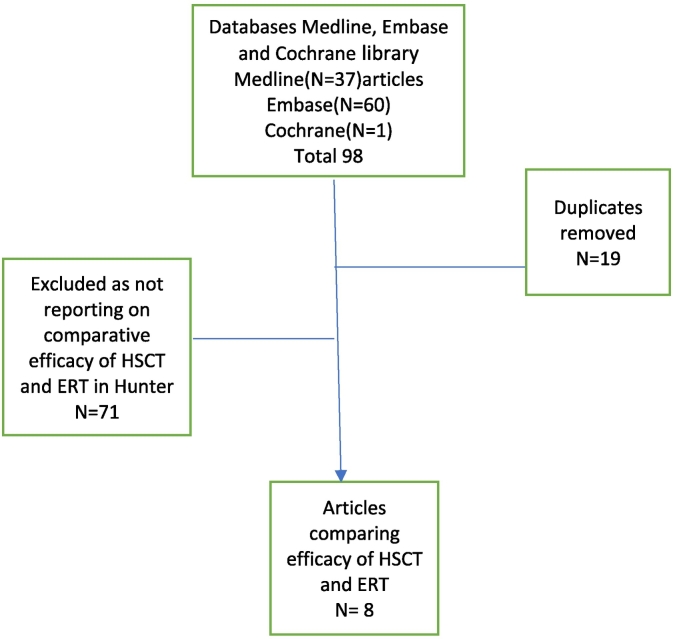
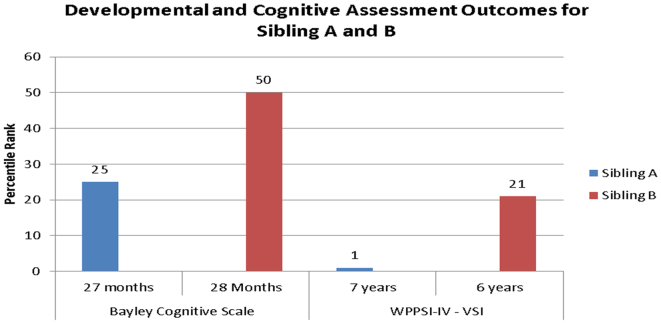
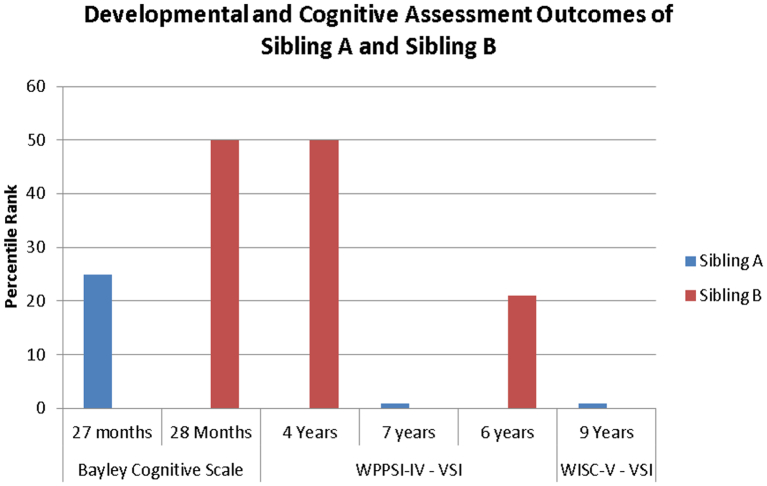
Hunter syndrome is a neurodegenerative lysosomal storage disorder with limited treatment options to halt the progressive neurocognitive decline. Whilst Intravenous enzyme replacement therapy (ERT) does not cross the blood brain barrier; Intrathecal ERT, in clinical studies, did not demonstrate significant effect on cognition, despite having better CNS delivery. Hematopoietic stem cell transplantation (HSCT) has the potential to treat CNS disease. We reviewed the literature and outline our experience of treating two siblings with severe Hunter syndrome: 'Sibling A' with intravenous and intrathecal ERT and 'Sibling B' with Early HSCT. A literature review identified 8 articles reporting on the comparative efficacy of both treatments. Our clinical outcomes indicate that Sibling B performed better than Sibling A in relation to early developmental milestones as well as neurocognition, activities of daily living, quality of life and neurophysiological outcomes in mid childhood. Sibling A's developmental trajectory fell within the extremely low range and Sibling B's development trajectory fell within the low-average to average range. This suggests HSCT had a disease modifying effect and highlights the efficacy of early HSCT in moderating the CNS progression in Hunter syndrome. Long term follow up is needed to elucidate the efficacy of HSCT on neurological progression.
亨特综合征是一种神经退行性溶酶体贮积症,治疗选择有限,难以阻止进行性神经认知衰退。静脉内酶替代疗法(ERT)无法穿过血脑屏障;鞘内ERT在临床研究中,尽管具有更好的中枢神经系统递送效果,但对认知功能并未显示出显著影响。造血干细胞移植(HSCT)有治疗中枢神经系统疾病的潜力。我们回顾了文献,并概述了治疗两名患有严重亨特综合征的兄弟姐妹的经验:“兄弟姐妹A”接受静脉内和鞘内ERT治疗,“兄弟姐妹B”接受早期HSCT治疗。一项文献综述确定了8篇报告两种治疗方法比较疗效的文章。我们的临床结果表明,在儿童中期的早期发育里程碑、神经认知、日常生活活动、生活质量和神经生理结果方面,兄弟姐妹B的表现优于兄弟姐妹A。兄弟姐妹A的发育轨迹处于极低范围,而兄弟姐妹B的发育轨迹处于低平均到平均范围。这表明HSCT具有疾病修饰作用,并突出了早期HSCT在减缓亨特综合征中枢神经系统进展方面的疗效。需要长期随访以阐明HSCT对神经进展的疗效。