Tomita Kazuyoshi, Okamoto Shungo, Seto Toshiyuki, Hamazaki Takashi
Department of Pediatrics Osaka City University Graduate School of Medicine, Japan.
Mol Genet Metab Rep. 2021 Oct 22;29:100816. doi: 10.1016/j.ymgmr.2021.100816. eCollection 2021 Dec.
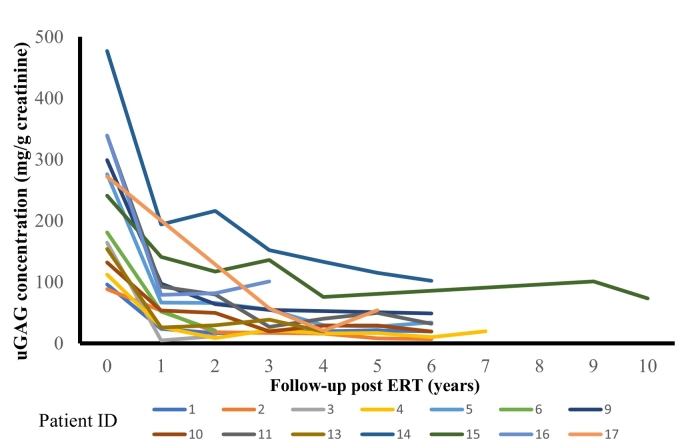
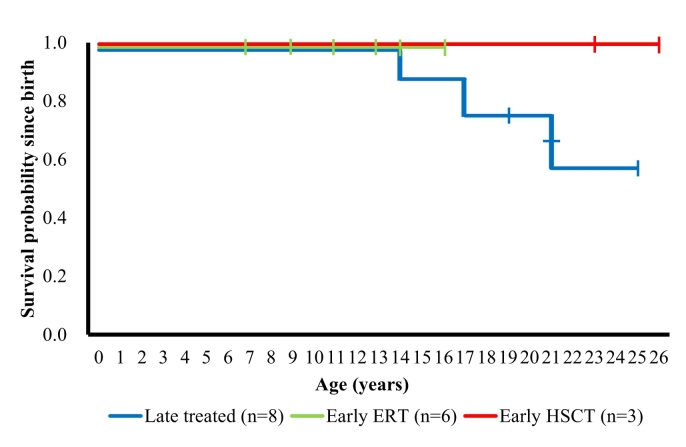
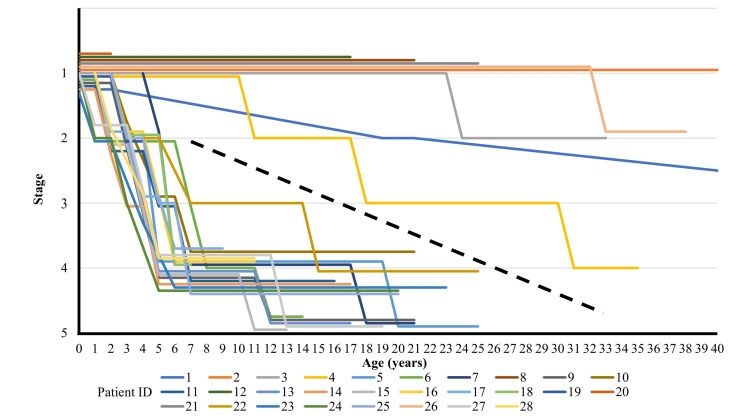
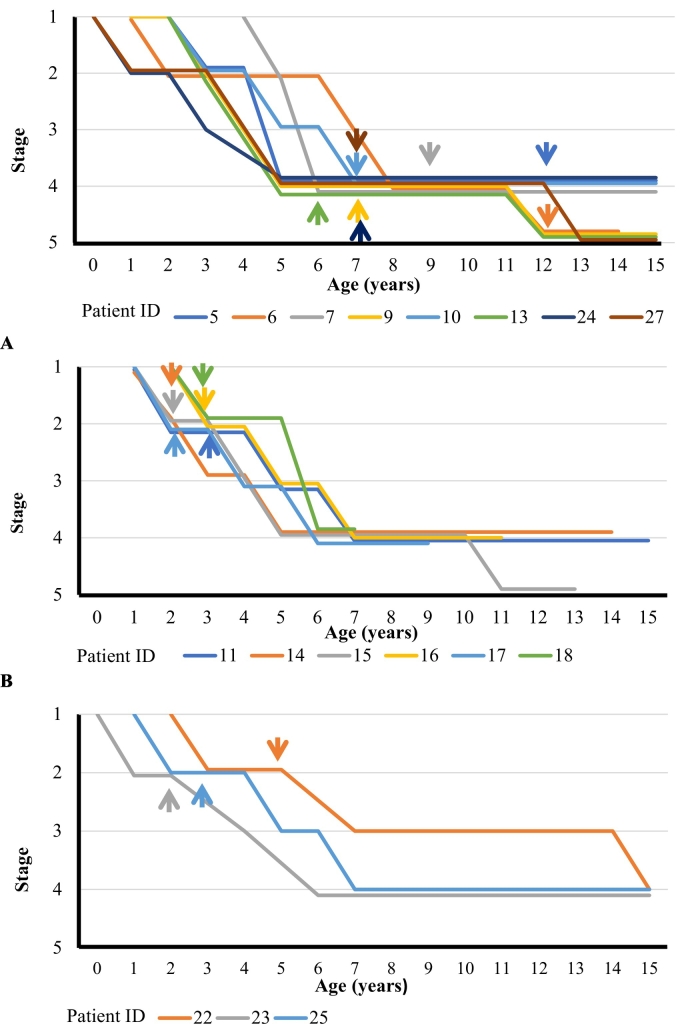
We investigated the decline of activities of daily living with symptomatic progression in patients with mucopolysaccharidosis type II (MPS II) and investigated the associated factors. Clinical data were retrospectively collected from the medical records of 28 patients with MPS II who visited our hospital between October 2007 and August 2019. Activities of daily living were assessed over time using a 5-point scale (from stage 1, indicating independent, to stage 5, indicating total assistance + medical care); the relationships of the interval years from stage 2 (mild symptoms) to stage 4 (total assistance) with therapeutic intervention, anti-drug antibodies (ADA), urinary glycosaminoglycans (uGAG), and genotypes were analyzed. Eight are attenuated types, and 20 are severe types. Further, 20 underwent enzyme replacement therapy (ERT) alone, 5 underwent hematopoietic stem cell transplantation (HSCT) alone, and 3 underwent both therapy. The mean interval years (standard deviation) from stage 2 to 4 was 3.5 (0.7) and 7.3 (3.3) in patients who started undergoing ERT ( = 6) and HSCT ( = 3) at stage 2, respectively, whereas it was 3.1 (1.5) in patients who received no treatment until they reached stage 4 ( = 8). The study findings revealed the process of changes in the activities of daily living over a long duration in patients with MPS II undergoing different treatments. In severe type, the activity deteriorated regardless of the stage at which ERT was initiated. The activity declined slower in patients who received HSCT at an early stage.
我们研究了II型粘多糖贮积症(MPS II)患者日常生活活动能力随症状进展的下降情况,并调查了相关因素。回顾性收集了2007年10月至2019年8月期间来我院就诊的28例MPS II患者的病历临床资料。使用5分制量表(从1级表示独立,到5级表示完全依赖他人协助+医疗护理)对日常生活活动能力进行长期评估;分析了从2期(轻度症状)到4期(完全依赖他人协助)的间隔年数与治疗干预、抗药物抗体(ADA)、尿糖胺聚糖(uGAG)和基因型之间的关系。其中8例为轻型,20例为重型。此外,20例仅接受了酶替代疗法(ERT),5例仅接受了造血干细胞移植(HSCT),3例接受了两种治疗。在2期开始接受ERT(n = 6)和HSCT(n = 3)的患者中,从2期到4期的平均间隔年数(标准差)分别为3.5(0.7)和7.3(3.3),而在4期才开始治疗的患者(n = 8)中,该间隔年数为3.1(1.5)。研究结果揭示了接受不同治疗的MPS II患者长期日常生活活动能力的变化过程。在重型患者中,无论ERT开始的阶段如何,活动能力都会恶化。早期接受HSCT的患者活动能力下降较慢。