Biomedical Research Institute of Murcia (IMIB-Arrixaca), University Clinical Hospital Virgen Arrixaca, Murcia, Spain.
Department of Biochemistry and Molecular Biology B and Immunology, Faculty of Medicine, University of Murcia, Murcia, Spain.
Front Immunol. 2022 May 18;13:894470. doi: 10.3389/fimmu.2022.894470. eCollection 2022.
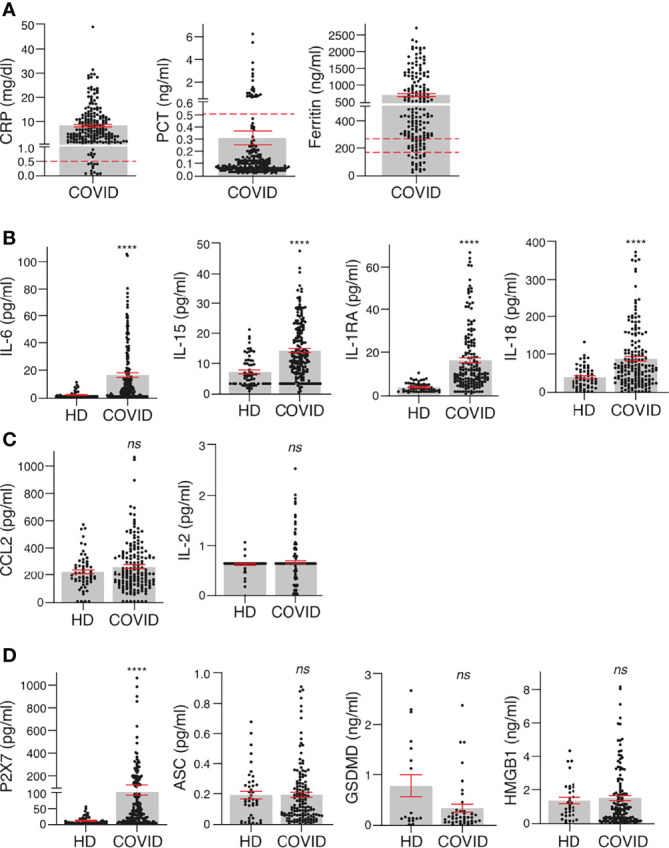
Inflammation is a tightly coordinated response against bacterial and viral infections, triggered by the production of pro-inflammatory cytokines. SARS-CoV-2 infection induces COVID-19 disease, characterized by an inflammatory response mediated through the activation of the NLRP3 inflammasome, which results in the production of IL-1β and IL-18 along with pyroptotic cell death. The NLRP3 inflammasome could be also activated by sterile danger signals such as extracellular ATP triggering the purinergic P2X7 receptor. Severe inflammation in the lungs of SARS-CoV-2-infected individuals is associated with pneumonia, hypoxia and acute respiratory distress syndrome, these being the causes of death associated with COVID-19. Both the P2X7 receptor and NLRP3 have been considered as potential pharmacological targets for treating inflammation in COVID-19. However, there is no experimental evidence of the involvement of the P2X7 receptor during COVID-19 disease. In the present study, we determined the concentration of different cytokines and the P2X7 receptor in the plasma of COVID-19 patients and found that along with the increase in IL-6, IL-18 and the IL-1 receptor antagonist in the plasma of COVID-19 patients, there was also an increase in the purinergic P2X7 receptor. The increase in COVID-19 severity and C-reactive protein concentration positively correlated with increased concentration of the P2X7 receptor in the plasma, but not with the IL-18 cytokine. The P2X7 receptor was found in the supernatant of human peripheral blood mononuclear cells after inflammasome activation. Therefore, our data suggest that determining the levels of the P2X7 receptor in the plasma could be a novel biomarker of COVID-19 severity.
炎症是一种针对细菌和病毒感染的紧密协调反应,由促炎细胞因子的产生触发。SARS-CoV-2 感染引发 COVID-19 疾病,其特征是通过 NLRP3 炎性体的激活介导炎症反应,导致 IL-1β 和 IL-18 的产生以及细胞焦亡。NLRP3 炎性体也可以被细胞外 ATP 等无菌危险信号激活,从而触发嘌呤能 P2X7 受体。SARS-CoV-2 感染个体肺部的严重炎症与肺炎、缺氧和急性呼吸窘迫综合征有关,这些是与 COVID-19 相关的死亡原因。P2X7 受体和 NLRP3 都被认为是治疗 COVID-19 炎症的潜在药物靶点。然而,目前尚无关于 P2X7 受体在 COVID-19 疾病中参与的实验证据。在本研究中,我们测定了 COVID-19 患者血浆中的不同细胞因子和 P2X7 受体浓度,发现随着 COVID-19 患者血浆中 IL-6、IL-18 和 IL-1 受体拮抗剂的增加,嘌呤能 P2X7 受体也增加。COVID-19 严重程度和 C 反应蛋白浓度的增加与血浆中 P2X7 受体浓度的增加呈正相关,但与 IL-18 细胞因子无关。在炎性体激活后,我们在人外周血单核细胞的上清液中发现了 P2X7 受体。因此,我们的数据表明,测定血浆中 P2X7 受体的水平可能是 COVID-19 严重程度的一个新的生物标志物。