Zhejiang Provincial Key Laboratory of Aging and Neurological Disorder Research, The First Affiliated Hospital of Wenzhou Medical University, Wenzhou 325000, China.
Department of Neurosurgery, The First Affiliated Hospital of Wenzhou Medical University, Wenzhou 325000, China.
Theranostics. 2022 May 9;12(8):3847-3861. doi: 10.7150/thno.71100. eCollection 2022.
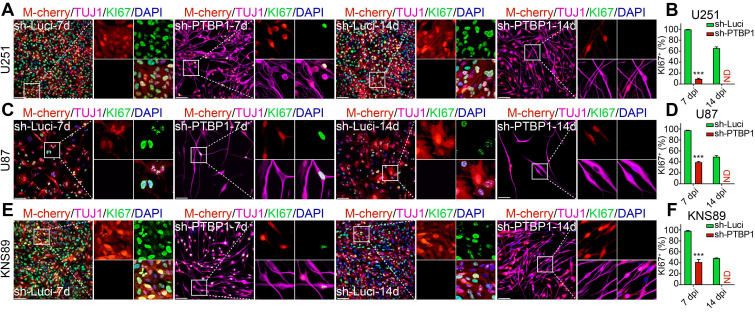
Cell reprogramming technology is utilized to prevent cancer progression by transforming cells into terminally differentiated, non-proliferating states. Polypyrimidine tract binding protein 1 (PTBP1) is an RNA binding protein required for the growth of neurons and may directly transform multiple normal human cells into functioning neurons and when expressed at low levels. As a result, we identified it as a key to inhibiting cancer cell proliferation by boosting glioblastoma cell neural differentiation. Immunocytofluorescence (ICF) targeting TUJ1, MAP2, KI67, and EdU were utilized to evaluate glioblastoma cell reprogramming under knockdown or other conditions. and other target genes were detected using Western blotting and qRT-PCR. Activating protein phosphatase 2A (PP2A) and RhoA were detected using specific kits. CCK8 assays were employed to detect cell viability. Bioluminescence, immunohistofluorescence (IHF), and Kaplan-Meier survival analyses were utilized to demonstrate the reprogramming efficiency of knockdown in U87 murine glioblastoma model. In this study, RNA-seq technology was used to examine the intrinsic pathway. The expression of TUJ1 and MAP2 neural markers, as well as the absence of KI67 and EdU proliferative markers in U251, U87, and KNS89 cells, indicated that glioblastoma cell reprogramming was successful. , U87 growth generated xenografts was substantially shrank due to knockdown induced neural differentiation, and these tumor-bearing mice had a prolonged survival time. Following RNA-seq, ten potential downstream genes were eliminated. Lentiviral interference and inhibitors blocking tests demonstrated that UNC5B receptor and its downstream signaling were essential in the neural differentiation process mediated by knockdown in glioblastoma cells. Our results indicate that knockdown promotes neural differentiation of glioblastoma cells via UNC5B receptor, consequently suppressing cancer cell proliferation and , providing a promising and feasible approach for glioblastoma treatment.
细胞重编程技术被用于通过将细胞转化为终末分化、非增殖状态来阻止癌症的进展。多嘧啶 tract 结合蛋白 1(PTBP1)是一种 RNA 结合蛋白,对于神经元的生长是必需的,并且可以在低水平表达时直接将多种正常人类细胞转化为功能性神经元。因此,我们将其鉴定为通过促进神经胶质母细胞瘤细胞神经分化来抑制癌细胞增殖的关键。免疫细胞荧光(ICF)针对 TUJ1、MAP2、KI67 和 EdU 用于评估在敲低或其他条件下神经胶质母细胞瘤细胞的重编程。使用 Western blot 和 qRT-PCR 检测其他靶基因。使用特定试剂盒检测激活的蛋白磷酸酶 2A(PP2A)和 RhoA。CCK8 测定用于检测细胞活力。使用生物发光、免疫细胞荧光(IHF)和 Kaplan-Meier 生存分析来证明 U87 鼠神经胶质母细胞瘤模型中 敲低的重编程效率。在这项研究中,使用 RNA-seq 技术来检查内在途径。U251、U87 和 KNS89 细胞中 TUJ1 和 MAP2 神经标记物的表达以及 KI67 和 EdU 增殖标记物的缺失表明神经胶质母细胞瘤细胞的重编程是成功的。在体内实验中,由于 敲低诱导的神经分化,U87 生长产生的异种移植物明显缩小,并且这些荷瘤小鼠的存活时间延长。在 RNA-seq 之后,消除了十个潜在的下游基因。慢病毒干扰和抑制剂阻断试验表明,UNC5B 受体及其下游信号在 敲低介导的神经胶质母细胞瘤细胞中的神经分化过程中是必需的。我们的结果表明, 敲低通过 UNC5B 受体促进神经胶质母细胞瘤细胞的神经分化,从而抑制癌细胞的增殖和肿瘤生长,为神经胶质母细胞瘤的治疗提供了一种有前途和可行的方法。