Kee Ping Siu, Maggo Simran D S, Kennedy Martin A, Barclay Murray L, Miller Allison L, Lehnert Klaus, Curtis Maurice A, Faull Richard L M, Parker Remai, Chin Paul K L
Department of Pathology and Biomedical Science, University of Otago, Christchurch, New Zealand.
Department of Medicine, University of Otago, Christchurch, New Zealand.
Front Genet. 2022 May 19;13:869160. doi: 10.3389/fgene.2022.869160. eCollection 2022.
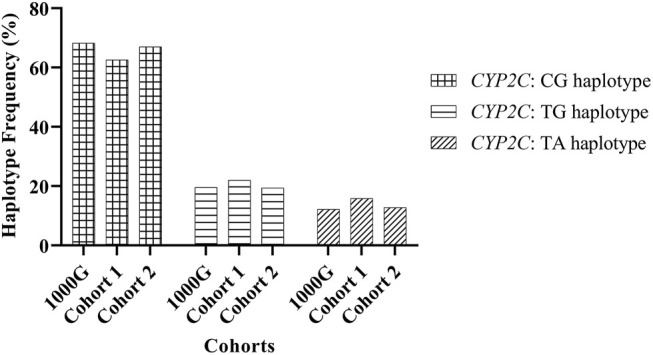
Omeprazole is extensively used to manage gastroesophageal reflux disease (GERD). It is primarily metabolized by CYP2C19. The (rs12248560) allele and the recently described haplotype (rs11188059 and rs2860840) are associated with increased enzymatic activity, and may reduce omeprazole exposure. This observational study aimed to investigate the association between these genetic variants and omeprazole treatment failure in GERD. We recruited predominantly New Zealand European GERD patients who either did not respond to omeprazole or experienced breakthrough heartburn symptoms despite at least 8 weeks of omeprazole (≥40 mg/day). The GerdQ score was used to gauge symptomatic severity. A total of 55 cases were recruited with a median age (range) of 56 years (19-82) and GerdQ score of 11 (5-17). Of these, 19 (34.5%) were heterozygotes and two (3.6%) were homozygotes. A total of 30 (27.3%) haplotypes was identified in our cohort, with seven (12.7%) homozygotes, and 16 (29%) heterozygotes. No significant differences were observed for overall alleles, , overall haplotypes, and heterozygotes ( > 0.05 for all comparisons). Gastroscopy and 24-h esophageal pH/impedance tests demonstrated objective evidence of GERD in a subgroup of 39 (71%) cases, in which the was significantly enriched ( = 0.03) when compared with the haplotype frequencies in a predominantly (91%) New Zealand European reference population, but not the ( > 0.99), when compared with the allele frequencies for the non-Finnish European subset of gnomAD. We conclude that omeprazole treatment failure in GERD is associated with , but not .
奥美拉唑被广泛用于治疗胃食管反流病(GERD)。它主要通过细胞色素P450 2C19(CYP2C19)进行代谢。CYP2C19基因的C等位基因(rs12248560)以及最近描述的单倍型(rs11188059和rs2860840)与酶活性增加相关,可能会减少奥美拉唑的暴露量。这项观察性研究旨在调查这些基因变异与GERD患者奥美拉唑治疗失败之间的关联。我们主要招募了新西兰欧洲裔GERD患者,这些患者要么对奥美拉唑无反应,要么在接受至少8周(≥40毫克/天)的奥美拉唑治疗后仍出现烧心症状。使用GerdQ评分来评估症状严重程度。共招募了55例患者,中位年龄(范围)为56岁(19 - 82岁),GerdQ评分为11(5 - 17)。其中,19例(34.5%)为C杂合子,2例(3.6%)为C纯合子。在我们的队列中总共鉴定出30种(27.3%)C单倍型,其中7例(12.7%)为C纯合子,16例(29%)为C杂合子。在总体C等位基因、C单倍型以及C杂合子方面未观察到显著差异(所有比较的P值均>0.05)。胃镜检查和24小时食管pH/阻抗测试在39例(71%)患者的亚组中显示出GERD的客观证据,与主要为(91%)新西兰欧洲裔的参考人群的单倍型频率相比,其中C单倍型显著富集(P = 0.03),但与gnomAD非芬兰欧洲裔子集的等位基因频率相比,C等位基因则不然(P>0.99)。我们得出结论,GERD患者中奥美拉唑治疗失败与C单倍型相关,但与C等位基因无关。