Azher Sharmeen, Pinheiro Joaquim M B, Philbin Brendan, Gifford Jamie, Khalak Rubia
Albany Medical Center, Department of Pediatrics, Division of Neonatology, Albany, NY, United States.
Albany Medical College, Department of Medical Education, Albany, NY, United States.
Front Pediatr. 2022 May 18;10:863165. doi: 10.3389/fped.2022.863165. eCollection 2022.
Research on the effects of maternal obesity on neonates has focused on clinical outcomes. Despite growing interest in obesity as a driver of healthcare expenditure, the financial impact of maternal obesity in the neonatal setting is little understood.
To determine if maternal obesity is associated with higher incurred costs in NICU and full-term nursery.
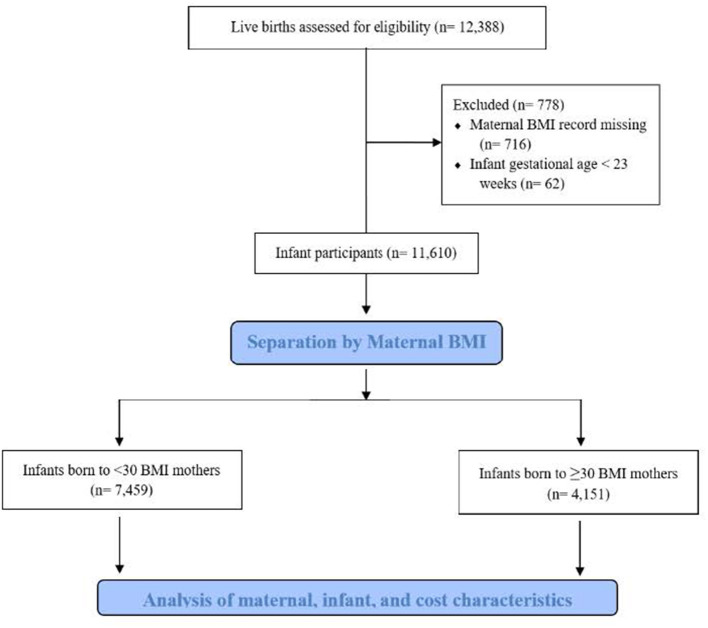
Data for all live births (1/1/14-12/31/19) at our academic medical center was obtained from the New York State Perinatal Data System for infants >23 weeks gestational age. Financial data was obtained from the hospital's cosprocessing application. Infants with missing clinical and/or financial data were excluded. The NIH definition of obesity was used (BMI ≥ 30 kg/m) to separate infants born to obese and non-obese mothers. Student's tests and chi square tests were used to compare maternal data, delivery, and infant outcomes between both groups. A logistic regression model was used to compare infant outcomes using odds ratios while controlling for maternal risk factors (smoking status, pre-pregnancy and gestational diabetes, pre-pregnancy and gestational hypertension). Multivariate regression analysis adjusting for maternal risk factors was also used to compare length-of-stay, total and direct costs in the NICU and full-term nursery between infant groups.
Of the 11,610 pregnancies in this retrospective study, obese mothers more frequently had other risk factors (smoke, pre-pregnancy and gestational diabetes, and pre-pregnancy and gestational hypertension). Infants born to obese mothers were more often preterm, had Cesarean delivery, lower APGAR scores, required assisted ventilation in the delivery room, and required NICU admission. Adjusting for maternal risk factors, infants born to obese mothers were less frequently preterm (OR 0.82 [0.74-0.91], < 0.01) and had NICU stays (OR 0.98 [0.81-0.98], = 0.02), but more frequently had Cesarean births (OR 1.54 [1.42-1.67], < 0.01). They also had longer adjusted LOS (2.03 ± 1.51 vs. 1.92 ± 1.45 days, < 0.01) and higher mean costs per infant in the full-term nursery ($3,638.34 ± $6,316.69 vs. $3,375.04 ± $4,994.18, = 0.03) but not in NICU.
Maternal obesity correlates with other risk factors. Prolonged maternal stay may explain increased LOS and costs in the full-term nursery for infants born to obese mothers, as infants wait to be discharged with mothers.
关于母亲肥胖对新生儿影响的研究主要集中在临床结局上。尽管人们越来越关注肥胖是医疗保健支出的驱动因素,但母亲肥胖在新生儿护理环境中的经济影响却鲜为人知。
确定母亲肥胖是否与新生儿重症监护病房(NICU)和足月儿保育室的更高费用相关。
从纽约州围产期数据系统获取了我们学术医疗中心所有活产(2014年1月1日至2019年12月31日)、孕周大于23周婴儿的数据。财务数据来自医院的联合处理应用程序。排除临床和/或财务数据缺失的婴儿。采用美国国立卫生研究院(NIH)的肥胖定义(BMI≥30kg/m²)来区分肥胖母亲和非肥胖母亲所生的婴儿。使用学生t检验和卡方检验比较两组之间的母亲数据、分娩情况和婴儿结局。使用逻辑回归模型,在控制母亲风险因素(吸烟状况、孕前和孕期糖尿病、孕前和孕期高血压)的同时,通过比值比比较婴儿结局。还采用调整母亲风险因素的多变量回归分析,比较婴儿组在NICU和足月儿保育室的住院时间、总费用和直接费用。
在这项回顾性研究的11610例妊娠中,肥胖母亲更常伴有其他风险因素(吸烟、孕前和孕期糖尿病、孕前和孕期高血压)。肥胖母亲所生的婴儿更常早产、剖宫产、阿氏评分较低、在产房需要辅助通气且需要入住NICU。在调整母亲风险因素后,肥胖母亲所生的婴儿早产的频率较低(比值比0.82[0.74 - 0.91],P<0.01)且入住NICU的频率较低(比值比0.98[0.81 - 0.98],P = 0.02),但剖宫产的频率较高(比值比1.54[1.42 - 1.67],P<0.01)。他们在足月儿保育室的调整住院时间也更长(2.03±1.51天对1.92±1.45天,P<0.01),且每个婴儿的平均费用更高(3638.34美元±6316.69美元对3375.04美元±4994.18美元,P = 0.03),但在NICU并非如此。
母亲肥胖与其他风险因素相关。母亲住院时间延长可能解释了肥胖母亲所生婴儿在足月儿保育室住院时间和费用增加的原因,因为婴儿要等待与母亲一起出院。