Ren Huiying, Pu Zhaoli, Sun Tianyi, Chen Tangting, Liu Leiying, Liu Zhu, O'Shea Christopher, Pavlovic Davor, Tan Xiaoqiu, Lei Ming
Laboratory of Medical Electrophysiology, Ministry of Education, Collaborative Innovation Center for Prevention and Treatment of Cardiovascular Disease/Institute of Cardiovascular Research, Luzhou Medical College, Luzhou, China.
Department of Cardiology, The Affiliated Hospital of Southwest Medical University, Luzhou, China.
Front Physiol. 2022 May 18;13:779514. doi: 10.3389/fphys.2022.779514. eCollection 2022.
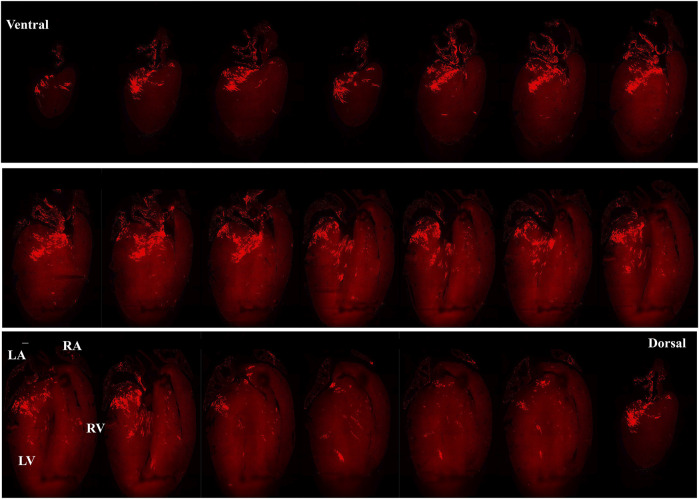
Biological tissues are naturally three-dimensional (3D) opaque structures, which poses a major challenge for the deep imaging of spatial distribution and localization of specific cell types in organs in biomedical research. Here we present a 3D heart imaging reconstruction approach by combining an improved heart tissue-clearing technique with high-resolution light-sheet fluorescence microscopy (LSFM). We have conducted a three-dimensional and multi-scale volumetric imaging of the ultra-thin planes of murine hearts for up to 2,000 images per heart in x-, y-, and z three directions. High-resolution 3D volume heart models were constructed in real-time by the Zeiss Zen program. By using such an approach, we investigated detailed three-dimensional spatial distributions of two specific cardiomyocyte populations including HCN4 expressing pacemaker cells and Pnmt cell-derived cardiomyocytes by using reporter mouse lines Hcn4 and Pnmt. HCN4 is distributed throughout right atrial nodal regions (i.e., sinoatrial and atrioventricular nodes) and the superior-inferior vena cava axis, while Pnmt cell-derived cardiomyocytes show distinct ventral, left heart, and dorsal side distribution pattern. Our further electrophysiological analysis indicates that Pnmt + cell-derived cardiomyocytes rich left ventricular (LV) base is more susceptible to ventricular arrhythmia under adrenergic stress than left ventricular apex or right ventricle regions. Thus, our 3D heart imaging reconstruction approach provides a new solution for studying the geometrical, topological, and physiological characteristics of specific cell types in organs.
生物组织是天然的三维(3D)不透明结构,这给生物医学研究中对器官内特定细胞类型的空间分布和定位进行深度成像带来了重大挑战。在此,我们提出一种3D心脏成像重建方法,该方法将改进的心脏组织透明化技术与高分辨率光片荧光显微镜(LSFM)相结合。我们对小鼠心脏的超薄平面进行了三维多尺度体积成像,每个心脏在x、y和z三个方向上最多可获取2000张图像。通过蔡司Zen程序实时构建了高分辨率3D心脏体积模型。利用这种方法,我们通过报告基因小鼠品系Hcn4和Pnmt研究了两种特定心肌细胞群体的详细三维空间分布,包括表达HCN4的起搏细胞和Pnmt细胞衍生的心肌细胞。HCN4分布于整个右心房结区(即窦房结和房室结)以及上下腔静脉轴,而Pnmt细胞衍生的心肌细胞呈现出明显的腹侧、左心和背侧分布模式。我们进一步的电生理分析表明,富含Pnmt + 细胞的左心室基部在肾上腺素能应激下比左心室尖部或右心室区域更容易发生室性心律失常。因此,我们的3D心脏成像重建方法为研究器官内特定细胞类型的几何、拓扑和生理特征提供了一种新的解决方案。