Wang Xiaoying, Han Qing, Kong Jude Dzevela
Department of Mathematics, Trent University Peterborough, ON, K9L 0G2, Canada.
Africa-Canada Artificial Intelligence and Data Innovation Consortium (ACADIC) Laboratory for Industrial and Applied Mathematics (LIAM) Department of Mathematics and Statistics, York University Toronto, ON, M3J 1P3, Canada.
Infect Dis Model. 2022 Jun;7(2):250-260. doi: 10.1016/j.idm.2022.05.006. Epub 2022 May 28.
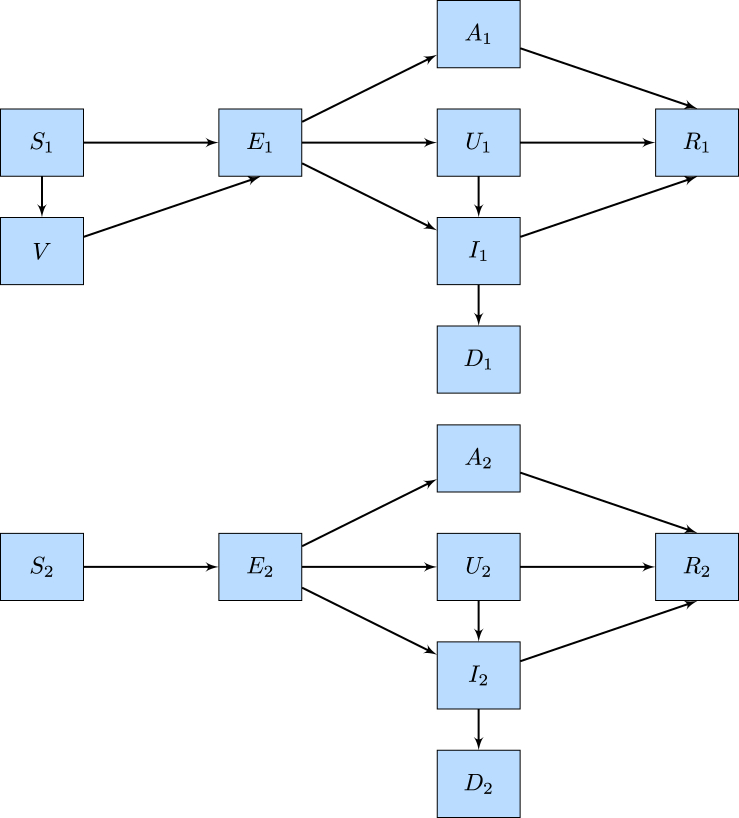
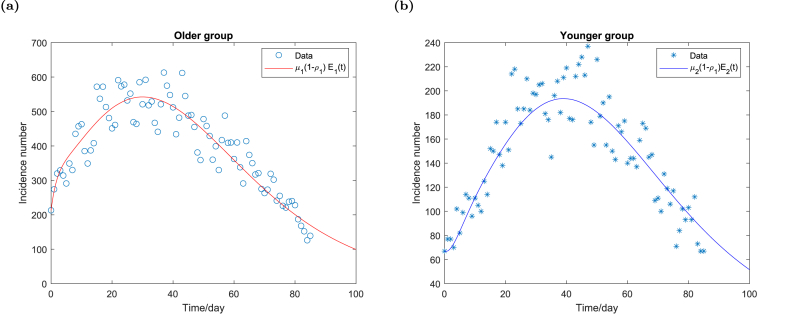
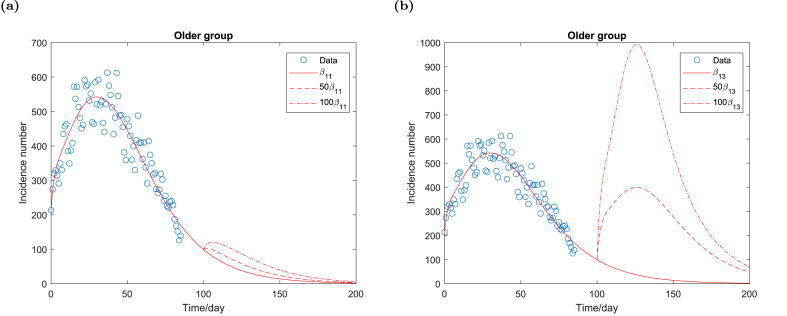
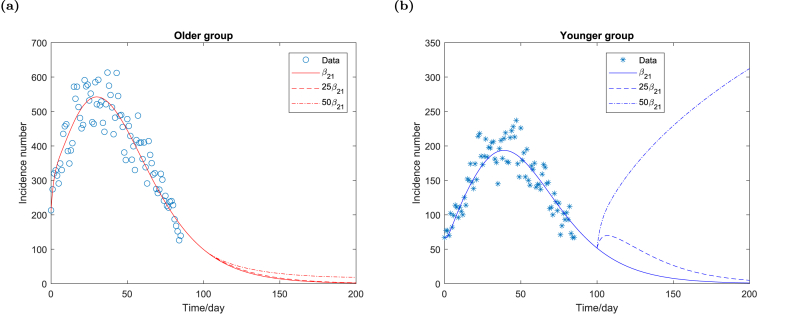
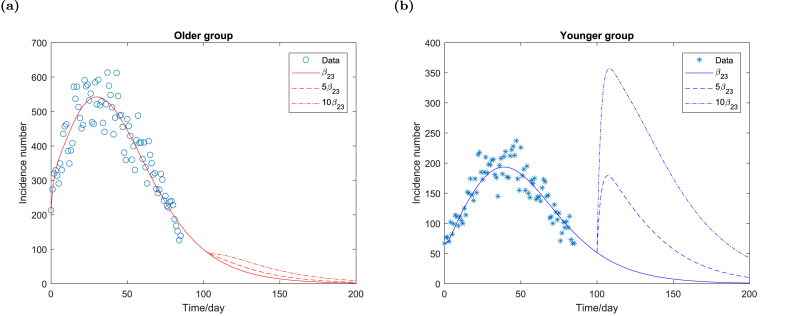
COVID-19 has been prevalent worldwide for about 2 years now and has brought unprecedented challenges to our society. Before vaccines were available, the main disease intervention strategies were non-pharmaceutical. Starting December 2020, in Ontario, Canada, vaccines were approved for administering to vulnerable individuals and gradually expanded to all individuals above the age of 12. As the vaccine coverage reached a satisfactory level among the eligible population, normal social activities resumed and schools reopened starting September 2021. However, when schools reopen for in-person learning, children under the age of 12 are unvaccinated and are at higher risks of contracting the virus. We propose an age-stratified model based on the age and vaccine eligibility of the individuals. We fit our model to the data in Ontario, Canada and obtain a good fitting result. The results show that a relaxed between-group contact rate may trigger future epidemic waves more easily than an increased within-group contact rate. An increasing mixed contact rate of the older group quickly amplifies the daily incidence numbers for both groups whereas an increasing mixed contact rate of the younger group mainly leads to future waves in the younger group alone. The results indicate the importance of accelerating vaccine rollout for younger individuals in mitigating disease spread.
新冠疫情在全球范围内已流行约两年,给我们的社会带来了前所未有的挑战。在疫苗可用之前,主要的疾病干预策略是非药物性的。从2020年12月开始,在加拿大安大略省,疫苗被批准用于给弱势群体接种,并逐渐扩大到所有12岁以上的人群。随着疫苗接种率在 eligible population 中达到令人满意的水平,正常的社会活动得以恢复,学校也从2021年9月开始重新开放。然而,当学校重新开放进行面对面学习时,12岁以下的儿童未接种疫苗,感染病毒的风险更高。我们基于个体的年龄和疫苗接种资格提出了一个年龄分层模型。我们将我们的模型应用于加拿大安大略省的数据,并获得了良好的拟合结果。结果表明,与组内接触率增加相比,组间接触率的放松可能更容易引发未来的疫情浪潮。老年组混合接触率的增加会迅速放大两组的每日发病率,而年轻组混合接触率的增加主要仅导致年轻组未来的疫情浪潮。结果表明,加快为年轻人接种疫苗对于减轻疾病传播至关重要。 (注:原文中“eligible population”未明确翻译,可理解为“符合条件的人群” )