State Key Joint Laboratory of Environmental Simulation and Pollution Control, College of Environmental Sciences and Engineering, Peking University, Beijing, 100871, China.
School of Atmospheric Sciences, Sun Yat-sen University, Guangzhou, 510275, China.
Nat Commun. 2022 Jun 6;13(1):3126. doi: 10.1038/s41467-022-30854-y.
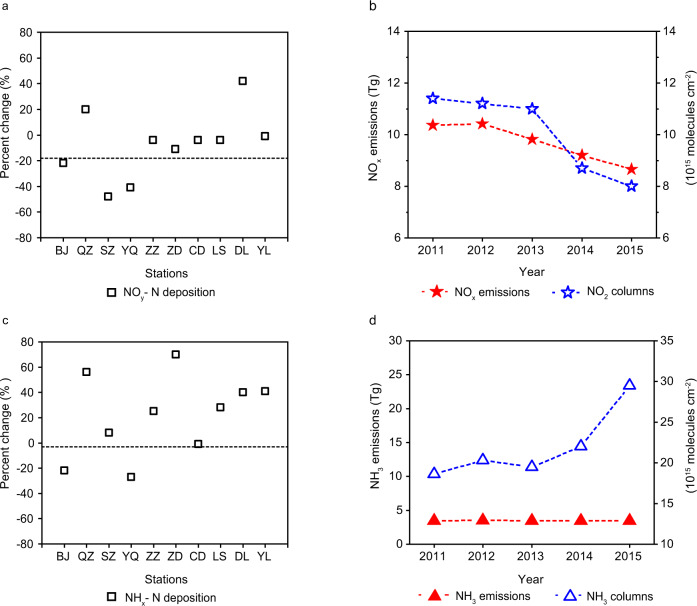
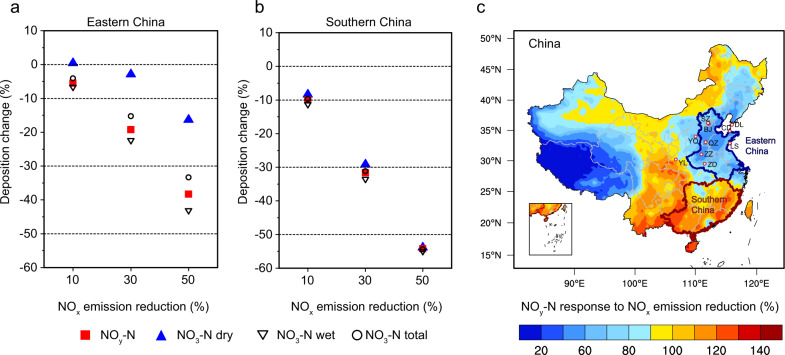
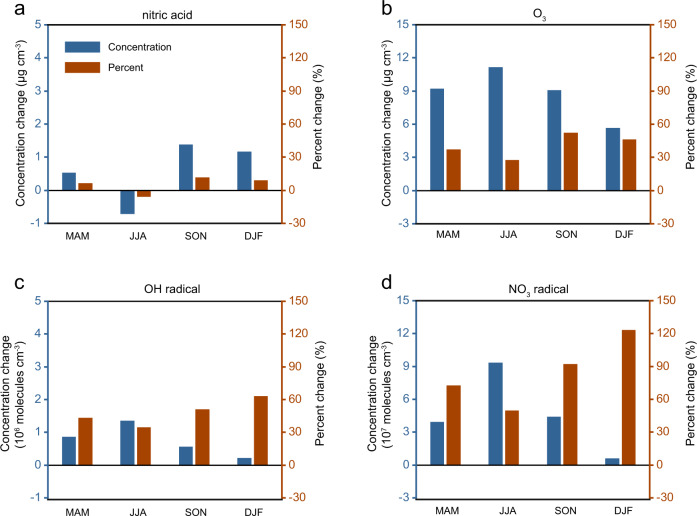
Terrestrial ecosystems in China receive the world's largest amount of reactive nitrogen (N) deposition. Recent controls on nitrogen oxides (NO = NO + NO) emissions in China to tackle air pollution are expected to decrease N deposition, yet the observed N deposition fluxes remain almost stagnant. Here we show that the effectiveness of NO emission controls for reducing oxidized N (NO = NO + its oxidation products) deposition is unforeseen in Eastern China, with one-unit reduction in NO emission leading to only 55‒76% reductions in NO-N deposition, as opposed to the high effectiveness (around 100%) in both Southern China and the United States. Using an atmospheric chemical transport model, we demonstrate that this unexpected weakened response of N deposition is attributable to the enhanced atmospheric oxidizing capacity by NO emissions reductions. The decline in N deposition could bear a penalty on terrestrial carbon sinks and should be taken into account when developing pathways for China's carbon neutrality.
中国的陆地生态系统接收了全球最大量的活性氮(N)沉降。为解决空气污染问题,中国最近对氮氧化物(NO=NO+NO)排放的控制预计将减少 N 沉降,但观测到的 N 沉降通量几乎保持不变。在这里,我们表明,在中国东部,NO 排放控制减少氧化 N(NO=NO+其氧化产物)沉降的效果是意料之外的,NO 排放减少一个单位,仅导致 NO-N 沉降减少 55-76%,而在中国南方和美国,其效果很高(约 100%)。我们使用大气化学输送模型表明,这种 N 沉降响应的意外减弱归因于 NO 排放减少导致的大气氧化能力增强。N 沉降的下降可能会对陆地碳汇产生影响,在制定中国碳中和的途径时应予以考虑。