Department of Orthopaedic and Trauma, The Second People's Hospital of Yunnan Province, Kunming, China.
Department of Orthopaedic and Trauma, The Affiliated Hospital of Yunnan University, No.176 Qingnian Road, Wuhua District, Kunming City, 650021, Yunnan Province, China.
BMC Musculoskelet Disord. 2022 Jun 6;23(1):540. doi: 10.1186/s12891-022-05487-3.
Complex acetabular fractures involving the anterior and posterior columns are an intractable clinical challenge. The study investigated the safety and efficacy of oblique-ilioischial plate technique for acetabular fractures involving low posterior column.
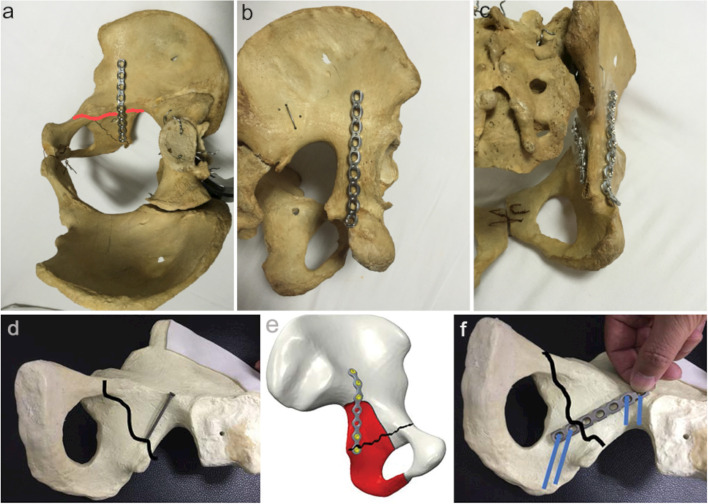
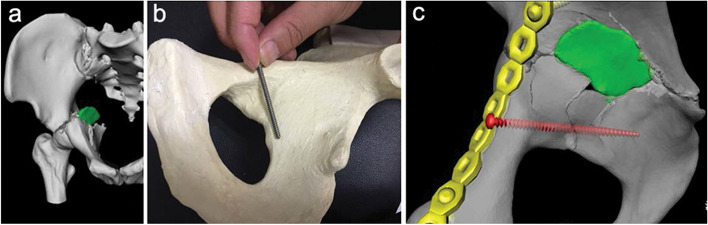
A retrospective analysis of 18 patients operated with the oblique-ilioischial plate technique by the modified Stoppa approach (or combined with iliac fossa approach) between August 2016 and July 2021 for low posterior column acetabular fractures was conducted. The anterior column was fixed with a reconstructed plate from the iliac wing along the iliopectineal line to the pubis. The low posterior column was fixed with the novel oblique-ilioischial plate running from the ilium to the ischial ramus. Operative time, intraoperative blood loss, reduction quality, and postoperative hip function were recorded.
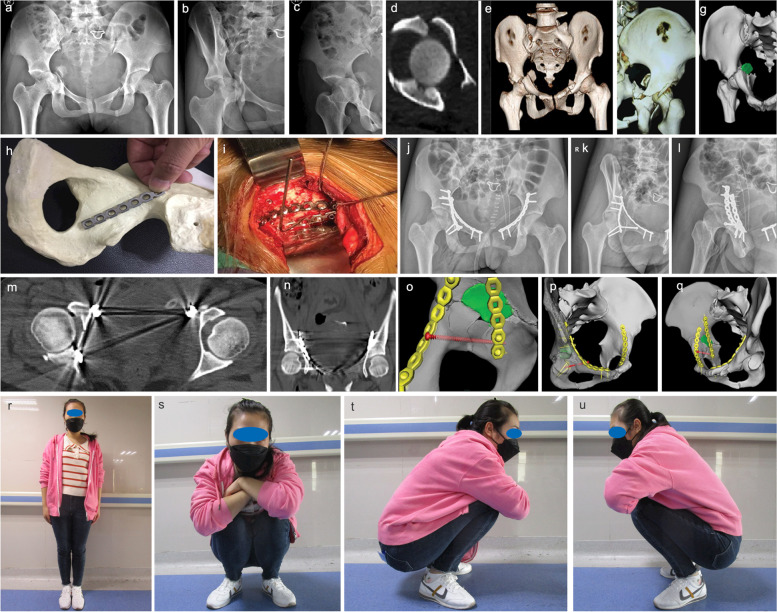
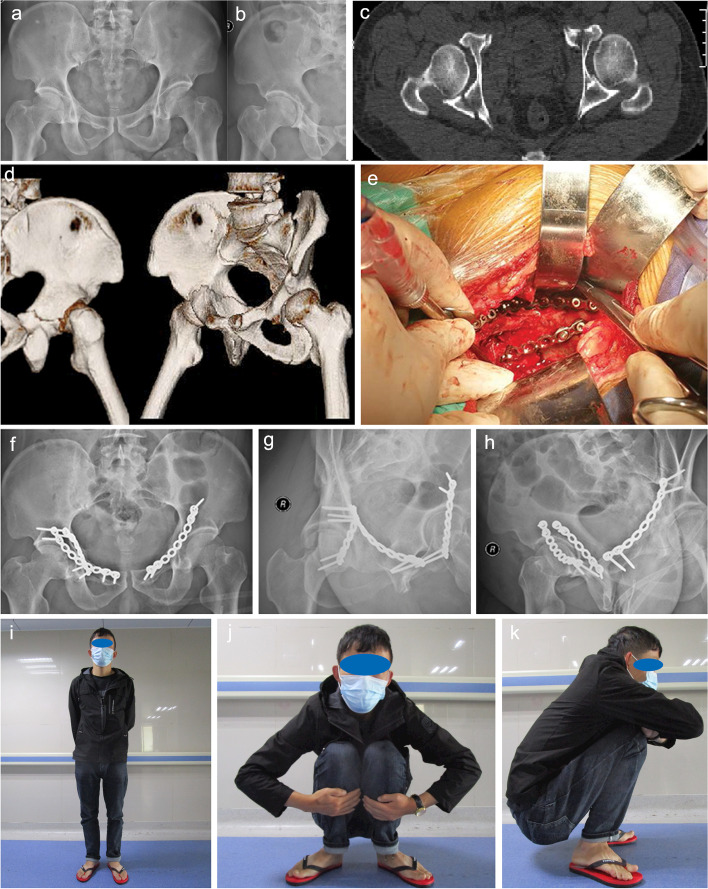
Out of the 18 patients, 10 were male and 8 were female. The mean age was 48.6±10.2 years (range: 45-62 years); The mean interval from injury to operation was 7.2±1.4 days (range: 5-19 days); The mean operative time was 2.1±0.3 h (range: 1.0-3.2 hours); The mean intraoperative blood loss was 300±58.4 mL (range: 200-500 mL). Postoperative reduction (Matta's criteria) was deemed as excellent (n = 9), good (n = 4), and fair (n = 5). At the final follow-up, the hip function (modified Merle d'Aubigne-Postel scale) was deemed as excellent (n = 11), good (n = 3), and fair (n = 4). The mean union time was 4.5±1.8 months (range: 3-6 months). No implant failure, infection, heterotopic ossification, or neurovascular injury were reported.
The oblique-ilioischial plate technique via anterior approach for acetabular fractures involving low posterior column offers reliable fixation, limited invasion, little intraoperative bleeding, and fewer complications. However, larger multicenter control studies are warranted.
累及前、后柱的复杂髋臼骨折是临床棘手的难题。本研究探讨了改良Stoppa 入路(或联合髂腹股沟入路)下斜-髂坐骨板技术治疗累及后柱下低髋臼骨折的安全性和疗效。
回顾性分析 2016 年 8 月至 2021 年 7 月采用改良 Stoppa 入路(或联合髂腹股沟入路)下斜-髂坐骨板技术治疗的 18 例累及后柱下低髋臼骨折患者的临床资料。前柱采用髂嵴沿髂耻线至耻骨重建钢板固定,后柱下低部采用新型斜-髂坐骨板从髂骨至坐骨支固定。记录手术时间、术中出血量、复位质量及术后髋关节功能。
18 例患者中,男 10 例,女 8 例;年龄 45~62 岁,平均 48.6±10.2 岁;受伤至手术时间 5~19 天,平均 7.2±1.4 天;手术时间 1.0~3.2 小时,平均 2.1±0.3 小时;术中出血量 200~500 mL,平均 300±58.4 mL。术后根据 Matta 复位标准评定复位优 9 例、良 4 例、可 5 例。末次随访髋关节功能按改良 Merle d'Aubigne-Postel 评分评定优 11 例、良 3 例、可 4 例。骨折愈合时间 3~6 个月,平均 4.5±1.8 个月。无内固定物失败、感染、异位骨化及神经血管损伤等并发症发生。
经前入路斜-髂坐骨板技术治疗累及后柱下低髋臼骨折固定可靠,创伤小,术中出血少,并发症少。但需要更大样本量的多中心对照研究进一步验证。