Giallini Ilaria, Nicastri Maria, Inguscio Bianca M S, Portanova Ginevra, Magliulo Giuseppe, Greco Antonio, Mancini Patrizia
Department of Sense Organs, University Sapienza of Rome, Rome, Italy.
Front Psychol. 2022 May 20;13:827684. doi: 10.3389/fpsyg.2022.827684. eCollection 2022.
The present study aimed to evaluate the effects of the Active Communication Education (ACE) program on the social/emotional impacts of hearing loss (HL) in a group of older adults with a cochlear implant (CI).
Prospective cohort study design, with a "within-subject" control procedure.
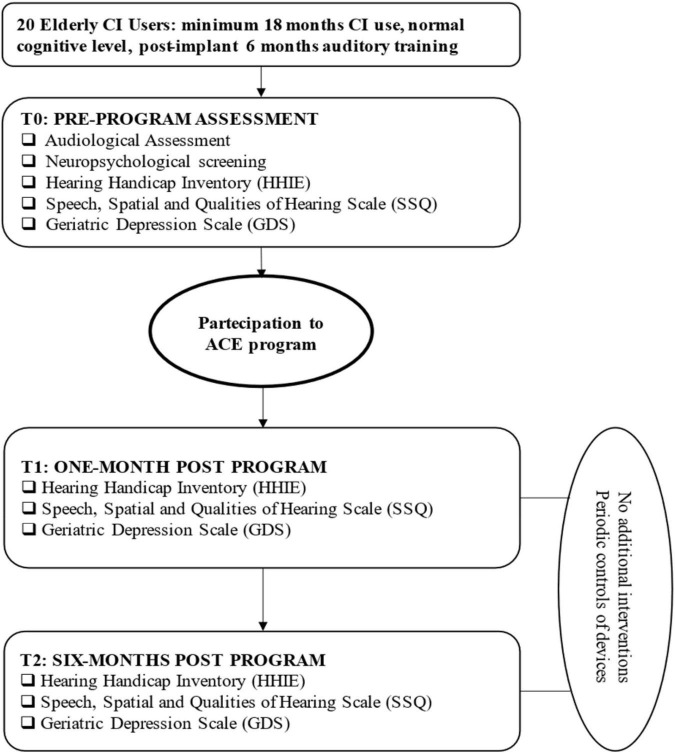
Twenty adults over-65 post-lingually deafened CI users. All subjects were required to be native Italian speakers, to have normal cognitive level, have no significant psychiatric conditions and/or diagnosed incident dementia, and used CI for at least 9 months.
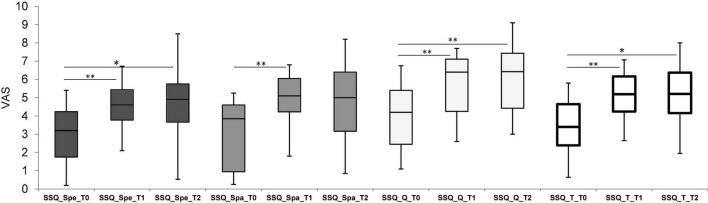
Twenty participants were assessed using the Hearing Handicap Inventory for the Elderly (HHIE), the Geriatric Depression Scale (GDS), and the Speech, Spatial, and Qualities of Hearing Scale (SSQ) before, during, and after ACE program, with a one and 6-month follow up. The cognitive and audiological evaluation was carried out before commencing the ACE program.
The ACE program had a positive impact by reducing HL's social/emotional effects. Participants benefited from a rehabilitative approach by improving multilevel skills: comprehension of audiological and hearing dimensions, acquisition of communicative, pragmatic and problem-solving strategies, and interaction and sharing of experiences with peers.
Although targeting the older adults with moderate HL, the ACE program also seemed to benefit older adult CI users. An improvement in social and emotional adaptation to hearing difficulties can, in turn, significantly promote optimal use of CI in the older adults, thereby possibly reducing the risk of losing motivation and engagement in device use and in rehabilitation protocols.
本研究旨在评估主动沟通教育(ACE)项目对一组植入人工耳蜗(CI)的老年人听力损失(HL)的社会/情感影响。
前瞻性队列研究设计,采用“受试者内”对照程序。
20名65岁以上的成人语后聋人工耳蜗使用者。所有受试者均要求为意大利语母语者,认知水平正常,无明显精神疾病和/或确诊的突发性痴呆,且使用人工耳蜗至少9个月。
20名参与者在ACE项目实施前、实施期间和实施后,以及在1个月和6个月随访时,使用老年人听力障碍量表(HHIE)、老年抑郁量表(GDS)和言语、空间及听力质量量表(SSQ)进行评估。认知和听力学评估在ACE项目开始前进行。
ACE项目通过减少HL的社会/情感影响产生了积极作用。参与者通过提高多层次技能从康复方法中受益:理解听力学和听力维度、获得沟通、语用和解决问题的策略,以及与同龄人互动和分享经验。
尽管ACE项目针对的是中度HL的老年人,但似乎也使老年人工耳蜗使用者受益。社会和情感上对听力困难的适应能力的提高,反过来可以显著促进老年人对人工耳蜗的最佳使用,从而可能降低失去使用设备和康复方案的动力和参与度的风险。