Akhtar Waqas, Gamble Brigitte, Kiff Kristine, Wypych-Zych Agnieszka, Raj Binu, Takata Junko, Gil Fernando Riesgo, Hurtado Ana, Rosenberg Alex, Bowles Christopher T
Harefield Hospital, Hill End Road, Harefield, Uxbridge UB96JH, United Kingdom.
Resusc Plus. 2022 May 31;10:100254. doi: 10.1016/j.resplu.2022.100254. eCollection 2022 Jun.
Published guidance concerning emergency management of left ventricular assist device (LVAD) recipients is both limited and lacking in consensus which increases the risk of delayed and/or inappropriate actions.
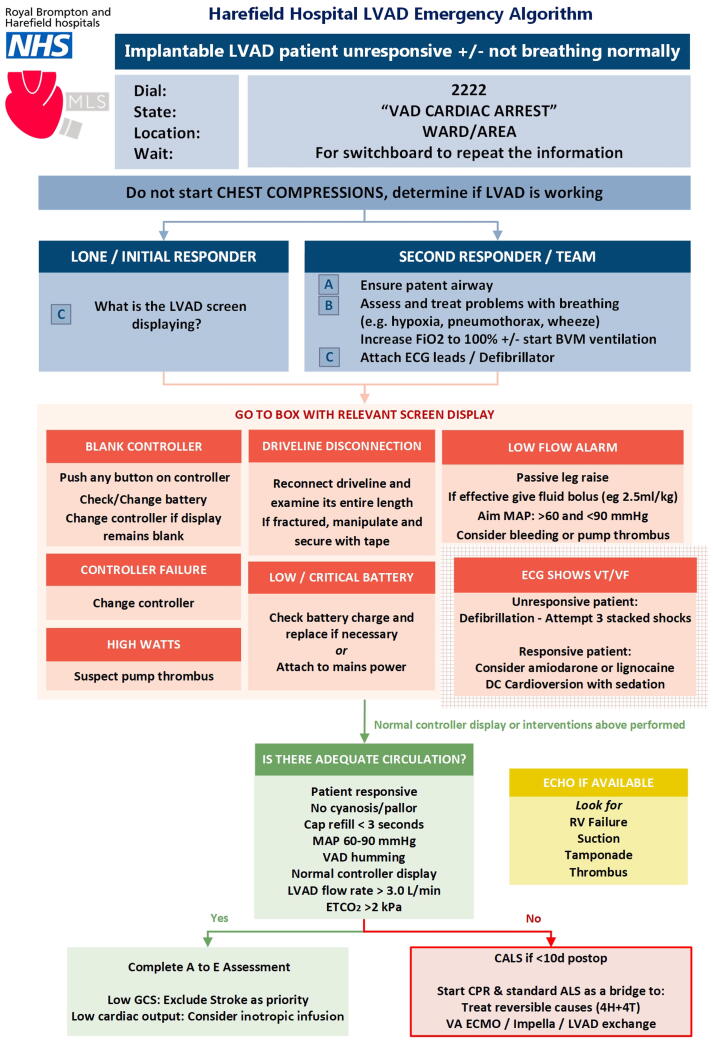
In our specialist tertiary referral centre we developed, by iteration, a novel in-hospital resuscitation algorithm for LVAD emergencies which we validated through simulation and assessment of our multi-disciplinary team. A Mechanical Life Support course was established to provide theoretical and practical education combined with simulation to consolidate knowledge and confidence in algorithm use. We assessed these measures using confidence scoring, a key performance indicator (the time taken to restart LVAD function) and a multiple-choice question (MCQ) examination.
The mean baseline staff confidence score in management of LVAD emergencies was 2.4 ± 1.2 out of a maximum of 5 (n = 29). After training with simulation, mean confidence score increased to 3.5 ± 0.8 (n = 13).Clinical personnel who were provided with the novel resuscitation algorithm were able to reduce time taken to restart LVAD function from a mean value of 49 ± 8.2 seconds (pre-training) to 20.4 ± 5 seconds (post-training) (n = 42, p < 0.0001).The Mechanical Life Support course increased mean confidence from 2.5 ± 1.2 to 4 ± 0.6 (n = 44, p < 0.0001) and mean MCQ score from 18.7 ± 3.4 to 22.8 ± 2.6, out of a maximum of 28 (n = 44, p < 0.0001).
We present a simplified LVAD Advanced Life Support algorithm to aid the crucial first minutes of resuscitation where basic interventions are likely to be critical in assuring good patient outcomes.
关于左心室辅助装置(LVAD)接受者的应急管理,已发表的指南有限且缺乏共识,这增加了延迟和/或采取不当行动的风险。
在我们的专科三级转诊中心,我们通过反复迭代制定了一种针对LVAD紧急情况的新型院内复苏算法,并通过模拟和对多学科团队的评估对其进行了验证。我们设立了机械生命支持课程,提供理论和实践教育,并结合模拟,以巩固对算法使用的知识和信心。我们使用信心评分、一项关键绩效指标(恢复LVAD功能所需的时间)和多项选择题(MCQ)考试来评估这些措施。
在LVAD紧急情况管理方面,工作人员的平均基线信心评分为2.4±1.2(满分5分,n = 29)。经过模拟培训后,平均信心评分提高到3.5±0.8(n = 13)。获得新型复苏算法的临床人员能够将恢复LVAD功能所需的时间从平均49±8.2秒(培训前)缩短至20.4±5秒(培训后)(n = 42,p < 0.0001)。机械生命支持课程将平均信心从2.5±1.2提高到4±0.6(n = 44,p < 0.0001),平均MCQ评分从18.7±3.4提高到22.8±2.6(满分28分,n = 44,p < 0.0001)。
我们提出了一种简化的LVAD高级生命支持算法,以帮助在复苏的关键最初几分钟,此时基本干预措施对于确保良好的患者预后可能至关重要。