Department of Behavioral and Social Sciences, Brown University School of Public Health, Providence, RI 02912, USA.
Department of Behavioral and Social Sciences, Brown University School of Public Health, Providence, RI 02912, USA.
Addict Behav. 2022 Oct;133:107376. doi: 10.1016/j.addbeh.2022.107376. Epub 2022 May 23.
Among people without psychiatric disorders who smoke, very low nicotine content (VLNC) cigarette use reduces cigarette reinforcement. Whether this is true of people with serious mental illness (SMI) who smoke is unknown. Using a hypothetical purchase task, we compared the effects of 6-week use of VLNC versus normal nicotine content (NNC) cigarettes on study cigarette and usual brand (UB) cigarette reinforcement among people with SMI who smoke.
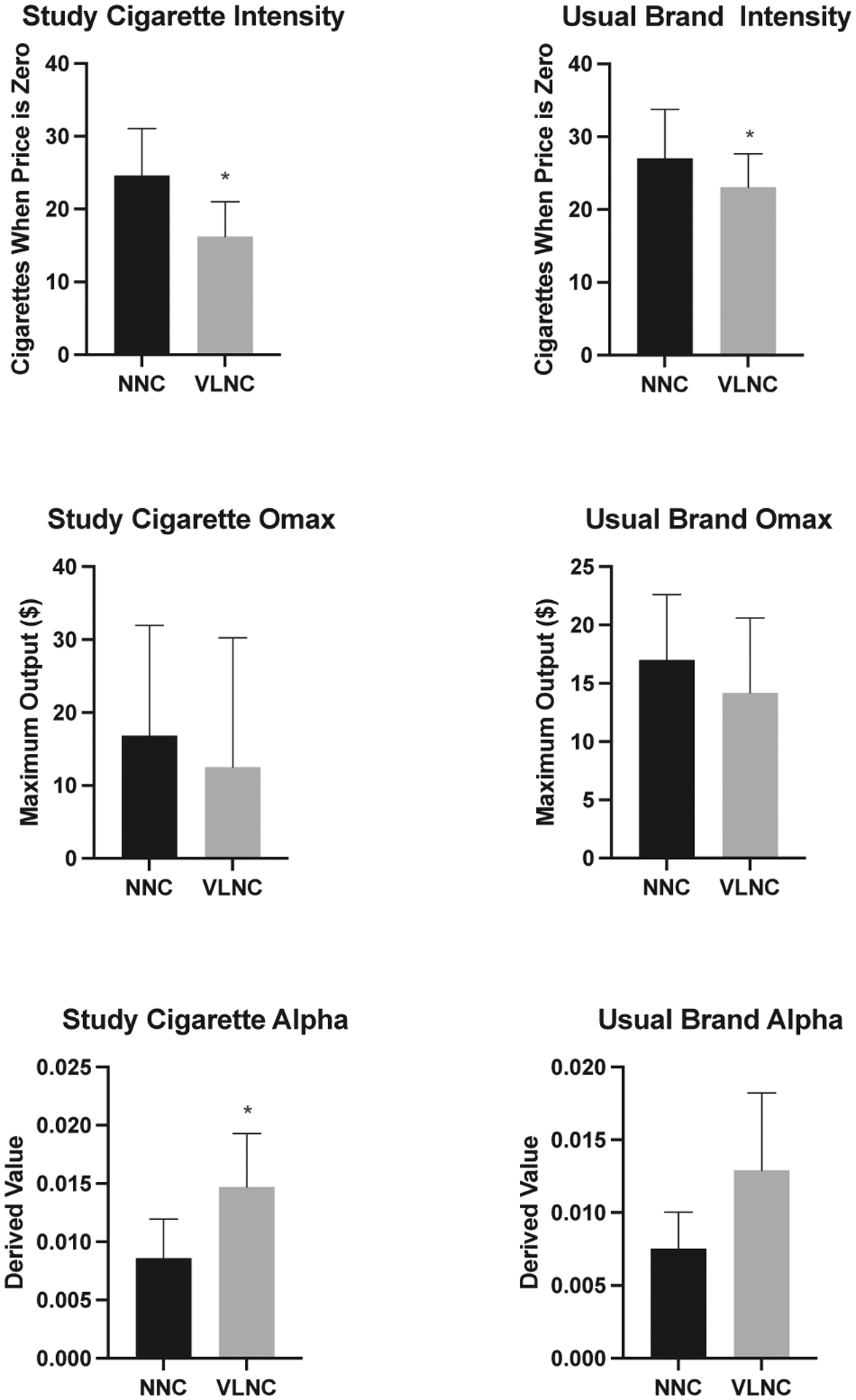
After a baseline period of UB cigarette use, participants with SMI (n = 58) were randomized to use NNC cigarettes (15.8 mg nicotine/g tobacco) or VLNC cigarettes (0.4 mg/g) for 6 weeks. At Week 6, they completed the CPT for both their assigned study cigarette and UB. The groups were compared on demand intensity (number of cigarettes purchased at no cost) and elasticity (rate of decline in demand as price increases) using extra sum-of-squares F-tests. The effects of treatment on demand indices while controlling for covariates were assessed using hierarchical regression.
At Week 6, intensity of demand for study cigarettes was lower and elasticity was higher for the VLNC group relative to the NNC group (p < 0.0001). Furthermore, intensity of demand for UB cigarettes was lower for participants in the VLNC group relative to participants in the NNC group (p < 0.01). When controlling for baseline cigarettes per day, intensity remained significantly different for study cigarettes and usual brand cigarettes at Week 6.
A nicotine reduction policy may reduce cigarette reinforcement in this vulnerable population.
在没有精神障碍的吸烟者中,极低尼古丁含量(VLNC)香烟的使用会降低香烟的强化作用。患有严重精神疾病(SMI)的吸烟者是否也是如此尚不清楚。通过使用假设购买任务,我们比较了 6 周使用 VLNC 与正常尼古丁含量(NNC)香烟对患有 SMI 且吸烟的人群对研究香烟和常用品牌(UB)香烟的强化作用。
在使用 UB 香烟的基线期后,患有 SMI 的参与者(n=58)被随机分配使用 NNC 香烟(15.8mg 尼古丁/克烟草)或 VLNC 香烟(0.4mg/g)6 周。在第 6 周,他们完成了对他们指定的研究香烟和 UB 的 CPT。使用额外的总和平方 F 检验比较了两组在需求强度(免费购买的香烟数量)和弹性(价格上涨时需求下降的速度)方面的差异。使用分层回归评估了在控制协变量的情况下治疗对需求指标的影响。
在第 6 周,VLNC 组对研究香烟的需求强度较低,弹性较高,而 NNC 组则相反(p<0.0001)。此外,VLNC 组对 UB 香烟的需求强度也低于 NNC 组(p<0.01)。当控制基线每日吸烟量时,VLNC 组的研究香烟和常用品牌香烟的需求强度在第 6 周仍存在显著差异。
减少尼古丁政策可能会降低这一脆弱人群对香烟的强化作用。