Difficult Liver Disease and Artificial Liver Center, Beijing You'an Hospital, Capital Medical University, No. 8, You An Men Outer Street, Fengtai, Beijing, 100069, China.
Eur J Med Res. 2022 Jun 7;27(1):88. doi: 10.1186/s40001-022-00718-8.
Patients with HBV-related acute-on-chronic liver failure (HBV-ACLF) have a high 90-day mortality rate, so early prognostic evaluation is important.
We aimed to explore the correlation between dynamic changes in free triiodothyronine (FT3) levels and 90-day prognosis of patients with HBV-ACLF.
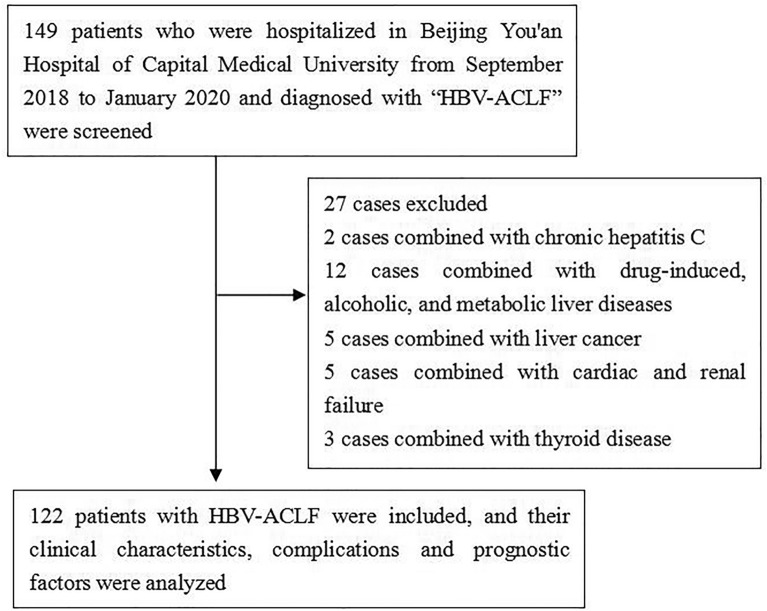
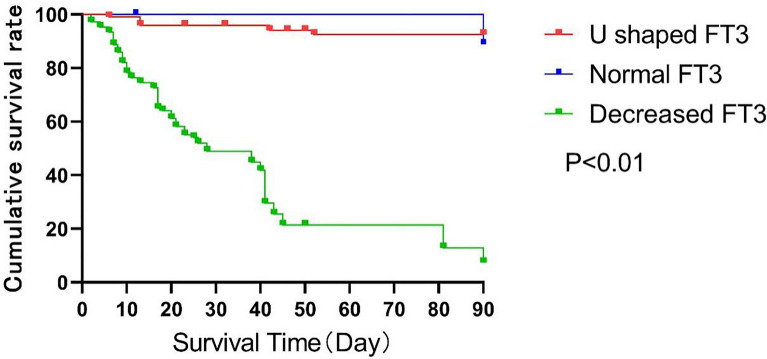
A prospective cohort study investigated 122 inpatients with HBV-ACLF. Patients were divided into three groups based on the dynamic change in FT3 level, as follows: continuous normal FT3; continuous decreased FT3; and FT3 U-shaped change groups, and patients were divided into survival group and non-survival group according to whether they were alive or not. The correlation between the change in FT3 level and 90-day prognosis was explored. Three factors that affected the prognosis most significantly were used to form an FT3 correlation formula to compare the difference in predicting prognosis between the formula score and the conventional score.
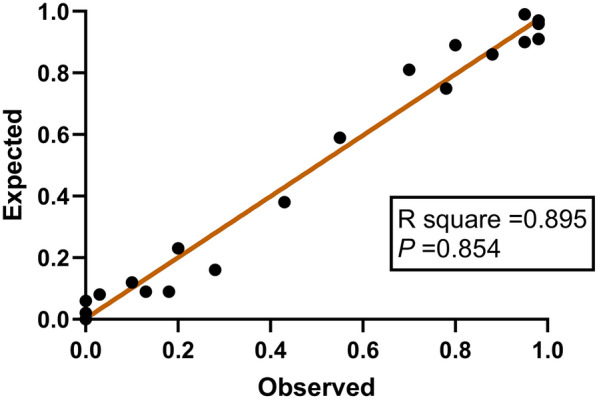
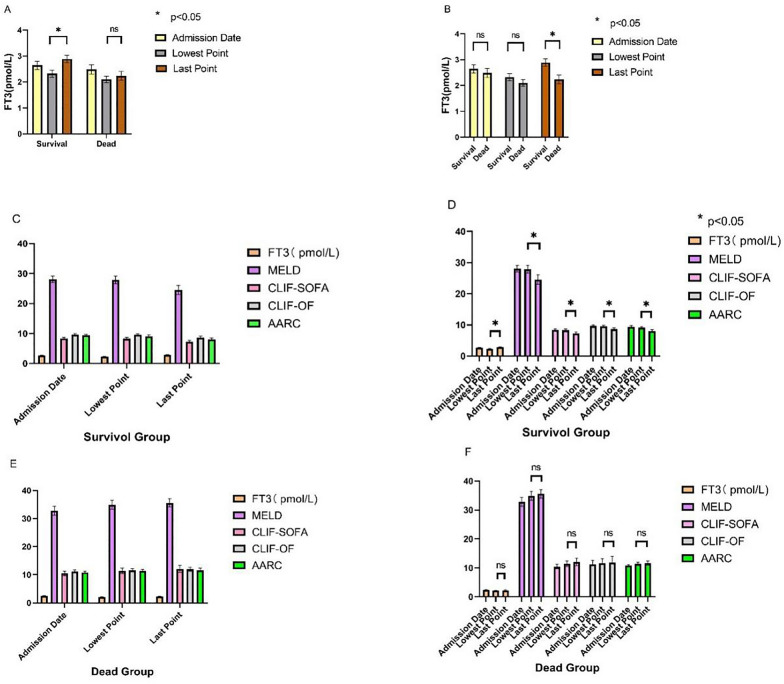
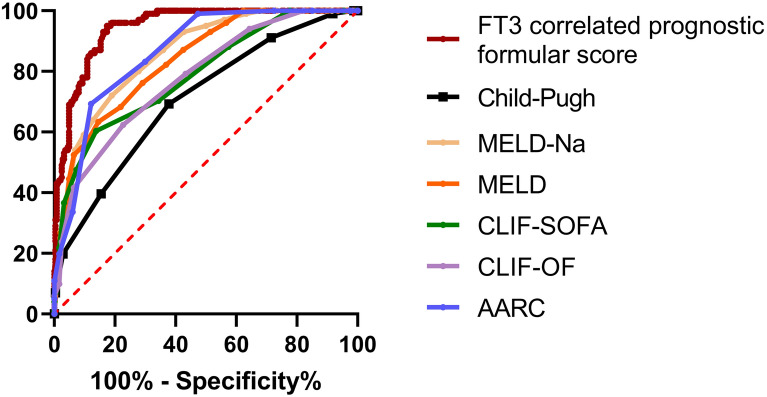
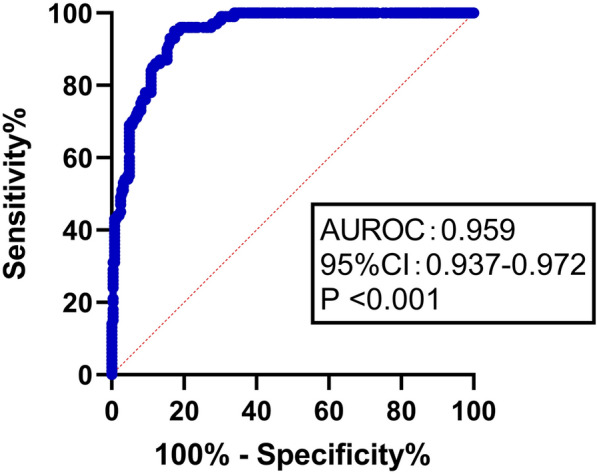
There were 98 patients with decreased FT3 level (80.33%), and the lowest FT3 level was at 8.52 ± 6.38 days after admission, which lasted for 16 days. There were no significant differences in FT3 levels at admission and at the lowest point between the survival and non-survival groups. Cox regression analysis showed that the FT3 level, FT3 change type, and hepatic encephalopathy (HE) grading were important factors related to prognosis. The area under the receiver operating characteristics curve for the FT3 correlation formula score was 0.892, which was significantly higher than that of the CTP, MELD, MELD-Na, CLIF-SOFA, CLIF-C OF, and AARC scores (P < 0.001).
The FT3 level and its dynamic change type together with the HE grading can facilitate prediction of 90-day prognosis for patients with HBV-ACLF.
HBV 相关慢加急性肝衰竭(HBV-ACLF)患者 90 天病死率较高,因此早期预后评估很重要。
探讨游离三碘甲状腺原氨酸(FT3)水平动态变化与 HBV-ACLF 患者 90 天预后的相关性。
前瞻性队列研究纳入 122 例 HBV-ACLF 住院患者。根据 FT3 水平的动态变化将患者分为 3 组:连续正常 FT3 组、连续降低 FT3 组和 FT3 U 型变化组,并根据患者是否存活分为存活组和死亡组。探讨 FT3 水平变化与 90 天预后的相关性。采用对预后影响最显著的 3 个因素构建 FT3 相关公式,比较公式评分与常规评分预测预后的差异。
共有 98 例患者 FT3 降低(80.33%),FT3 最低值出现在入院后 8.52±6.38 天,持续 16 天。存活组和死亡组患者入院时及最低点 FT3 水平比较,差异均无统计学意义。Cox 回归分析显示,FT3 水平、FT3 变化类型和肝性脑病(HE)分级是与预后相关的重要因素。FT3 相关公式评分的受试者工作特征曲线下面积为 0.892,明显高于 CTP、MELD、MELD-Na、CLIF-SOFA、CLIF-C OF 和 AARC 评分(P<0.001)。
FT3 水平及其动态变化类型与 HE 分级有助于预测 HBV-ACLF 患者 90 天预后。