Stamp Lisa K, Grainger Rebecca, Frampton Christopher, Drake Jill, Hill Catherine L
Department of Medicine, University of Otago, Christchurch, PO Box 4345, Christchurch, 8140, New Zealand.
University of Otago, Wellington, Wellington, New Zealand.
BMC Rheumatol. 2022 Jun 8;6(1):31. doi: 10.1186/s41927-022-00263-1.
To determine the effect of omega-three supplementation with fish oil on serum urate, weight and body mass index (BMI) in people with gout.
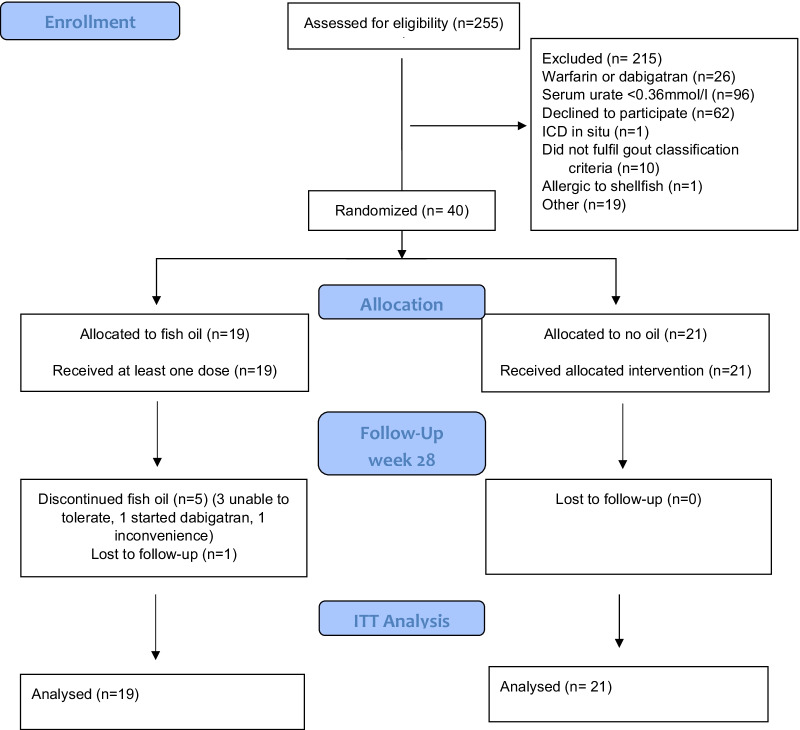
A pilot 6-month, randomized, open-label clinical trial was undertaken in people with gout with serum urate ≥ 0.36 mmol/l. Forty participants were randomized to receive 6.2 g omega-3 fish oil daily or no fish oil for 24 weeks. Blood was obtained monthly for serum urate and red cell EPA (20:5n-3) DHA (22:6n-3) were measured using a blood spot collection system.
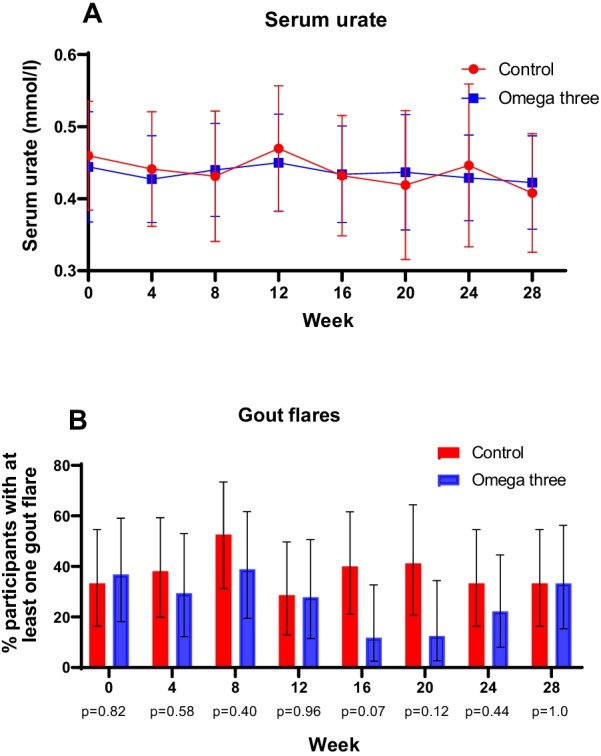
There was no statistically significant difference in the mean (SEM) decrease in serum urate between baseline and week 24 between randomized groups: fish oil - 0.021 (0.02) mmol/l versus control - 0.006 (0.02) mmol/l. There was no significant difference in change in weight or BMI between baseline and week 24 between randomized groups. There was a statistically significant correlation between red cell omega-three concentrations and the total number of flares per participant between week 12 and week 24; total omega-three r = - 0.75 (p ≤ 0.001), EPA r = - 0.75 (p ≤ 0.001) and DHA r = -0.76 (p ≤ 0.001). In the omega-three fish oil group four participants reported gastrointestinal adverse effects definitely or probably related to the omega-three supplementation.
The lack of untoward effect of omega three fish oil supplementation on serum urate and BMI together with the relationship between higher omega-three concentrations and lower gout flares supports the development of further adequately powered clinical trials to determine the role of omega-three supplements as prophylaxis against gout flares in people starting urate lowering therapy. Clinical trial registration ACTRN12617000539336p Registered 13/04/2017.
确定补充ω-3鱼油对痛风患者血清尿酸、体重和体重指数(BMI)的影响。
对血清尿酸≥0.36 mmol/l的痛风患者进行了一项为期6个月的随机、开放标签的临床试验。40名参与者被随机分为两组,一组每天服用6.2 g ω-3鱼油,另一组不服用鱼油,为期24周。每月采集血液检测血清尿酸,并使用血斑采集系统测量红细胞中的二十碳五烯酸(EPA,20:5n-3)和二十二碳六烯酸(DHA,22:6n-3)。
随机分组的两组在基线至第24周期间血清尿酸平均(标准误)下降幅度无统计学显著差异:鱼油组为-0.021(0.02)mmol/l,对照组为-0.006(0.02)mmol/l。随机分组的两组在基线至第24周期间体重或BMI变化无显著差异。在第12周和第24周之间,红细胞ω-3浓度与每位参与者的痛风发作总数之间存在统计学显著相关性;总ω-3相关系数r = -0.75(p≤0.001),EPA相关系数r = -0.75(p≤0.001),DHA相关系数r = -0.76(p≤0.001)。在ω-3鱼油组中,有4名参与者报告了肯定或可能与ω-3补充剂相关的胃肠道不良反应。
补充ω-3鱼油对血清尿酸和BMI没有不良影响,以及较高的ω-3浓度与较低的痛风发作之间的关系,支持开展进一步有足够效力的临床试验,以确定ω-3补充剂在开始降尿酸治疗的人群中预防痛风发作的作用。临床试验注册号ACTRN12617000539336p,于2017年4月13日注册。