Ghoraba Hashem H, Matsumiya Wataru, Khojasteh Hassan, Akhavanrezayat Amir, Karaca Irmak, Or Christopher, Yavari Negin, Lajevardi Sherin, Hwang Jaclyn, Yasar Cigdem, Do Diana, Nguyen Quan Dong
Spencer Center for Vision Research, Byers Eye Institute, Stanford University, Palo Alto, CA, USA.
Department of Surgery, Division of Ophthalmology, Kobe University Graduate School of Medicine, Kobe, Japan.
Clin Ophthalmol. 2022 May 31;16:1697-1706. doi: 10.2147/OPTH.S366370. eCollection 2022.
To evaluate the safety of intravenous high-dose pulse methylprednisolone succinate (IVHDM) in the management of severe or refractory non-infectious pediatric uveitis.
We reviewed all uveitis patients who were ≤16 years of age and who received IVHDM with a dose of ≥500 mg per day (1-3 days a month) for at least 3 months during their management at a tertiary care eye hospital.
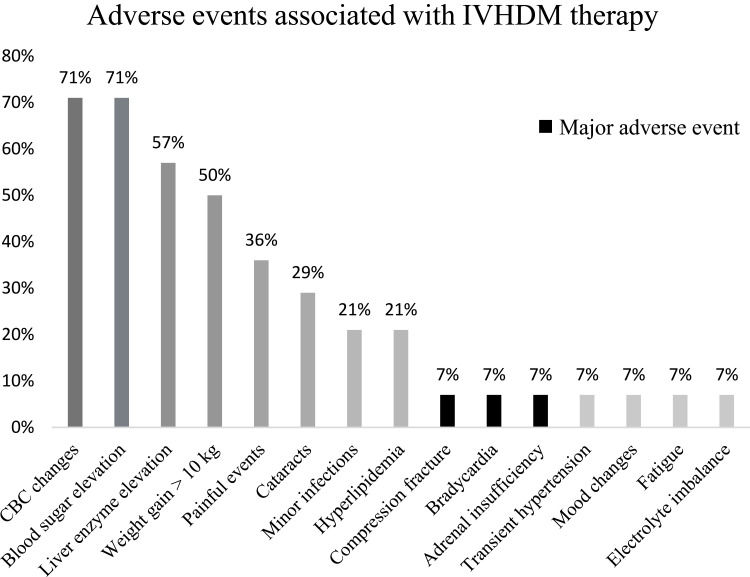
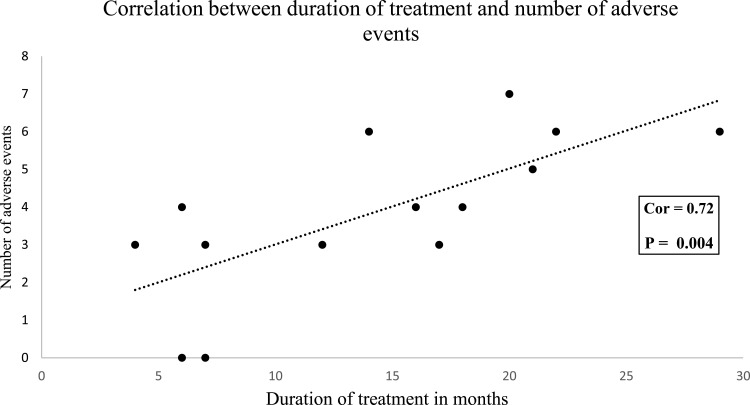
Twenty pediatric patients with severe or refractory uveitis who received IVHDM were identified. Six patients received IVHDM either once, as a preoperative medication, or at a lower dose than 500 mg, and were excluded. The remaining 14 patients received IVHDM for at least 4 months. Age (mean±SD) was 11.9±2.4 years and 50% were female. Duration of treatment was 14.2±7.5 months. Thirteen patients received IVHDM in combination with other immunomodulatory therapy (IMT). Except for two outliers, IVHDM was given at a dose of 8-25 mg/kg per infusion. Three major adverse events (AEs) occurred in two patients: a single episode of bradycardia, compression fracture following minor trauma and adrenal insufficiency. The number of AEs (major and minor) strongly correlated with duration of treatment (=0.004) and moderately correlated with the cumulative dose/weight (=0.051). Weight gain was associated with the use of concomitant oral steroids and not with duration of treatment or cumulative dose.
IVHDM may be a valid therapeutic option for aggressive/refractory pediatric uveitis. The reported AEs in this series can also be attributed to the concurrent IMT or the underlying disease itself.
评估静脉注射大剂量脉冲式琥珀酸甲泼尼龙(IVHDM)治疗重度或难治性儿童非感染性葡萄膜炎的安全性。
我们回顾了一家三级眼科专科医院中所有年龄≤16岁且在治疗期间接受IVHDM(每日剂量≥500毫克,每月1 - 3天)至少3个月的葡萄膜炎患者。
确定了20例接受IVHDM治疗的重度或难治性葡萄膜炎患儿。6例患者接受IVHDM的次数为一次(作为术前用药)或剂量低于500毫克,被排除在外。其余14例患者接受IVHDM治疗至少4个月。年龄(均值±标准差)为11.9±2.4岁,50%为女性。治疗持续时间为14.2±7.5个月。13例患者接受IVHDM联合其他免疫调节治疗(IMT)。除两个异常值外,每次输注IVHDM的剂量为8 - 25毫克/千克。两名患者发生了3起主要不良事件(AE):一次心动过缓、轻微外伤后压缩性骨折和肾上腺功能不全。AE的数量(主要和次要)与治疗持续时间显著相关(=0.004),与累积剂量/体重中度相关(=0.051)。体重增加与同时使用口服类固醇有关,而与治疗持续时间或累积剂量无关。
IVHDM可能是积极治疗/难治性儿童葡萄膜炎的有效治疗选择。本系列报道的AE也可能归因于同时进行的IMT或潜在疾病本身。