Cann Alexandra, Clarke Candice, Brown Jonathan, Thomson Tina, Prendecki Maria, Moshe Maya, Badhan Anjna, Simmons Bryony, Klaber Bob, Elliott Paul, Darzi Ara, Riley Steven, Ashby Deborah, Martin Paul, Gleeson Sarah, Willicombe Michelle, Kelleher Peter, Ward Helen, Barclay Wendy S, Cooke Graham S
Department of Infectious Disease, Imperial College London, London, UK.
Imperial College Healthcare NHS Trust, London, UK.
Wellcome Open Res. 2022 May 26;6:358. doi: 10.12688/wellcomeopenres.17231.2. eCollection 2021.
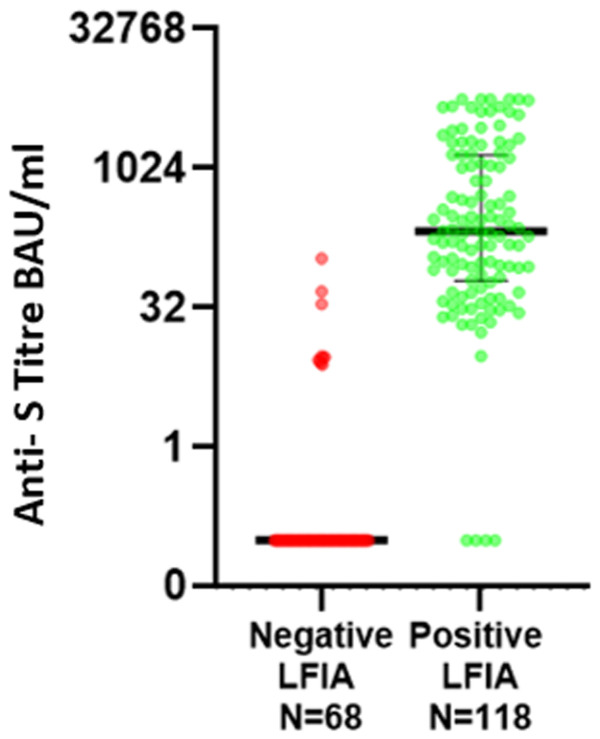
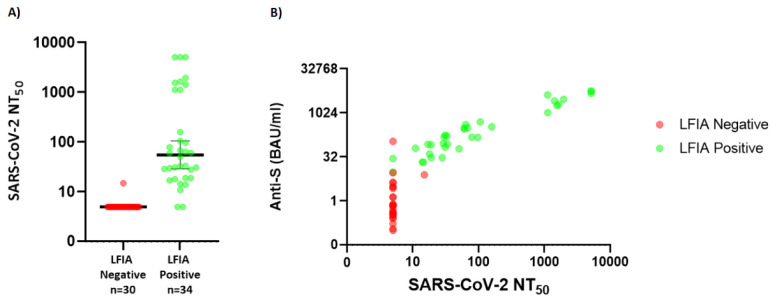
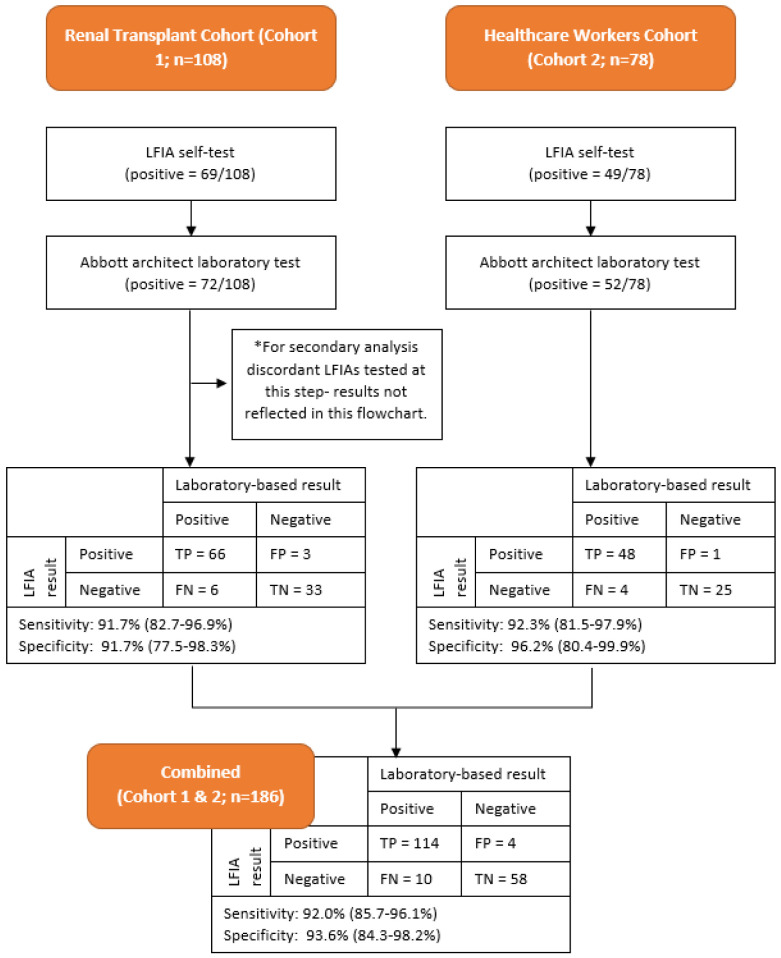
Lateral flow immunoassays (LFIAs) are able to achieve affordable, large scale antibody testing and provide rapid results without the support of central laboratories. As part of the development of the REACT programme extensive evaluation of LFIA performance was undertaken with individuals following natural infection. Here we assess the performance of the selected LFIA to detect antibody responses in individuals who have received at least one dose of severe acute respiratory syndrome coronavirus 2 (SARS-CoV-2) vaccine. This was a prospective diagnostic accuracy study. Sampling was carried out at renal outpatient clinic and healthcare worker testing sites at Imperial College London NHS Trust. Two cohorts of patients were recruited; the first was a cohort of 108 renal transplant patients attending clinic following two doses of SARS-CoV-2 vaccine, the second cohort comprised 40 healthcare workers attending for first SARS-CoV-2 vaccination and subsequent follow up. During the participants visit, finger-prick blood samples were analysed on LFIA device, while paired venous sampling was sent for serological assessment of antibodies to the spike protein (anti-S) antibodies. Anti-S IgG was detected using the Abbott Architect SARS-CoV-2 IgG Quant II CMIA. A total of 186 paired samples were collected. The accuracy of Fortress LFIA in detecting IgG antibodies to SARS-CoV-2 compared to anti-spike protein detection on Abbott Assay The LFIA had an estimated sensitivity of 92.0% (114/124; 95% confidence interval [CI] 85.7% to 96.1%) and specificity of 93.6% (58/62; 95% CI 84.3% to 98.2%) using the Abbott assay as reference standard (using the threshold for positivity of 7.10 BAU/ml) Fortress LFIA performs well in the detection of antibody responses for intended purpose of population level surveillance but does not meet criteria for individual testing.
侧向流动免疫分析(LFIA)能够实现经济实惠的大规模抗体检测,并且无需中央实验室的支持即可快速得出结果。作为REACT计划开发的一部分,对自然感染后的个体进行了LFIA性能的广泛评估。在此,我们评估所选LFIA在检测至少接种一剂严重急性呼吸综合征冠状病毒2(SARS-CoV-2)疫苗的个体中抗体反应的性能。这是一项前瞻性诊断准确性研究。在伦敦帝国理工学院国民保健服务信托基金的肾脏门诊和医护人员检测点进行采样。招募了两组患者;第一组是108名在接种两剂SARS-CoV-2疫苗后到诊所就诊的肾移植患者,第二组包括40名前来接种第一剂SARS-CoV-2疫苗及后续随访的医护人员。在参与者就诊期间,用LFIA设备分析手指刺破采集的血样,同时将配对的静脉血样送去进行针对刺突蛋白抗体(抗S)的血清学评估。使用雅培Architect SARS-CoV-2 IgG Quant II CMIA检测抗S IgG。总共收集了186对样本。与雅培检测法检测抗刺突蛋白相比,Fortress LFIA检测SARS-CoV-2 IgG抗体的准确性 以雅培检测法为参考标准(使用阳性阈值7.10 BAU/ml),LFIA的估计灵敏度为92.0%(114/124;95%置信区间[CI] 85.7%至96.1%),特异性为93.6%(58/62;95% CI 84.3%至98.2%)。Fortress LFIA在用于人群水平监测的预期目的的抗体反应检测中表现良好,但不符合个体检测标准。