National Astronomical Observatories, Chinese Academy of Sciences, Beijing, China.
Department of Physics and Astronomy, West Virginia University, Morgantown, WV, USA.
Nature. 2022 Jun;606(7916):873-877. doi: 10.1038/s41586-022-04755-5. Epub 2022 Jun 8.
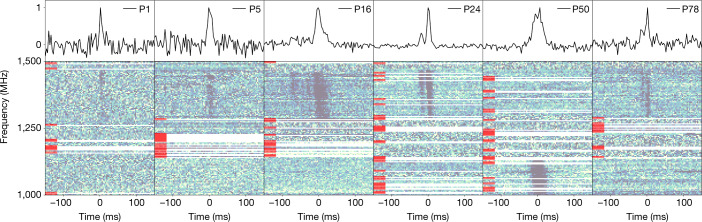
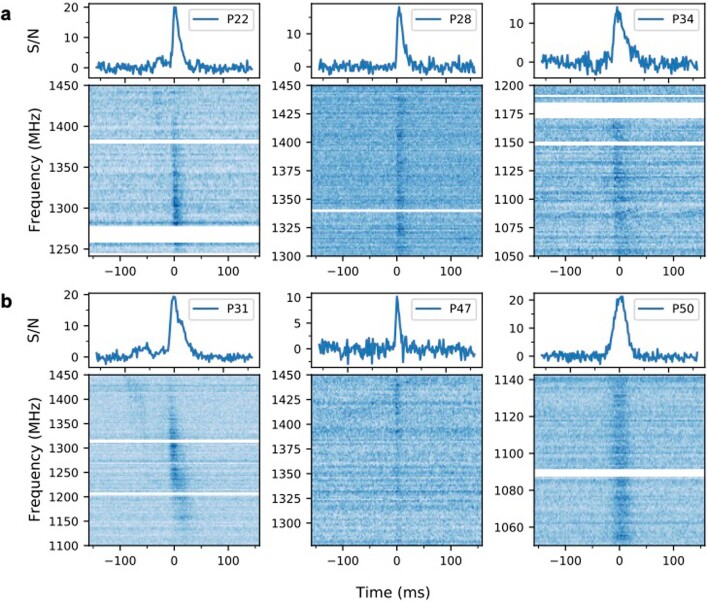
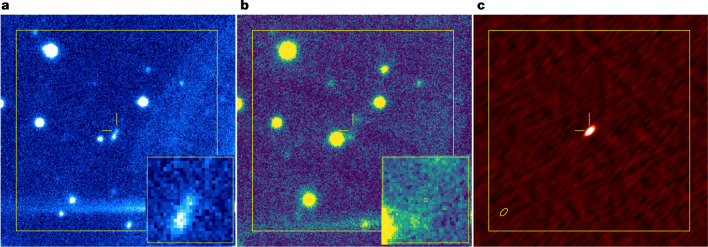
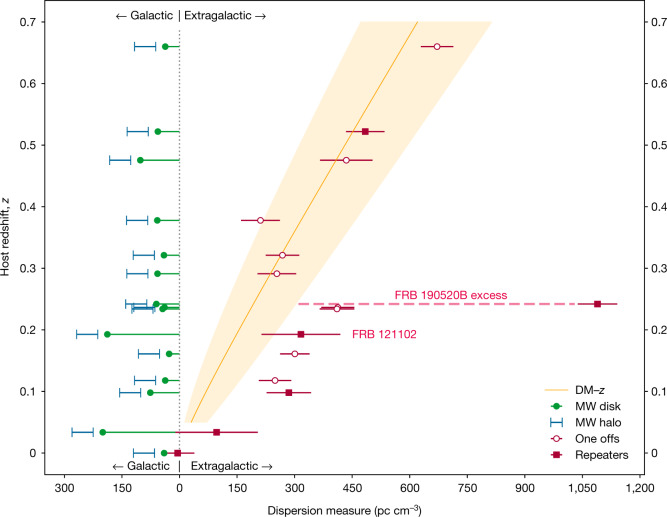
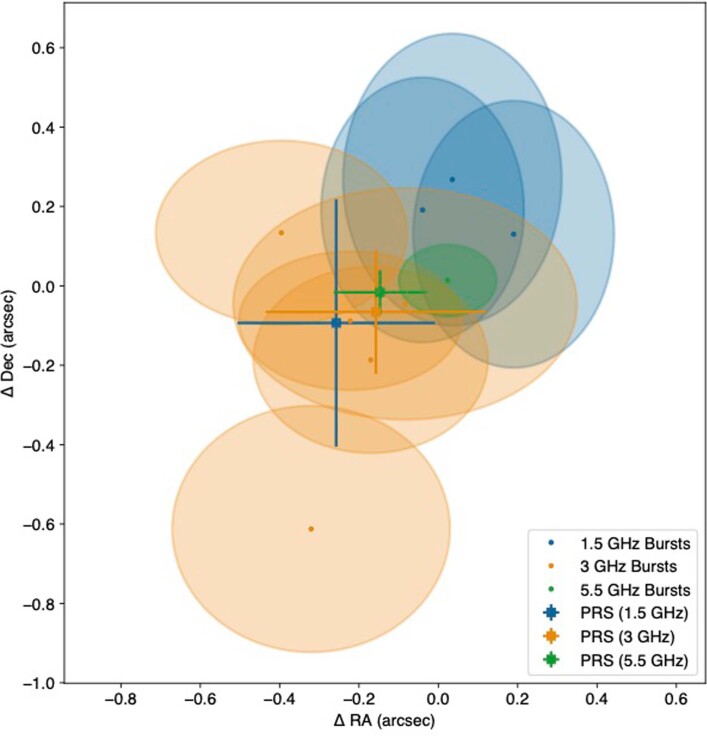
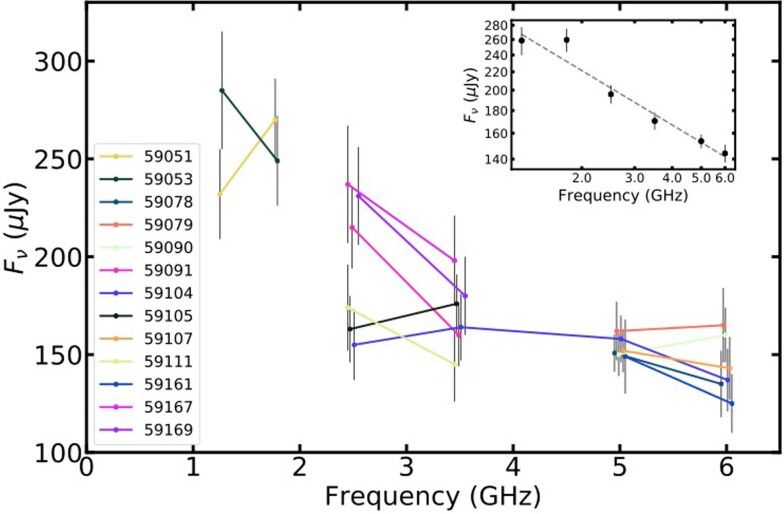
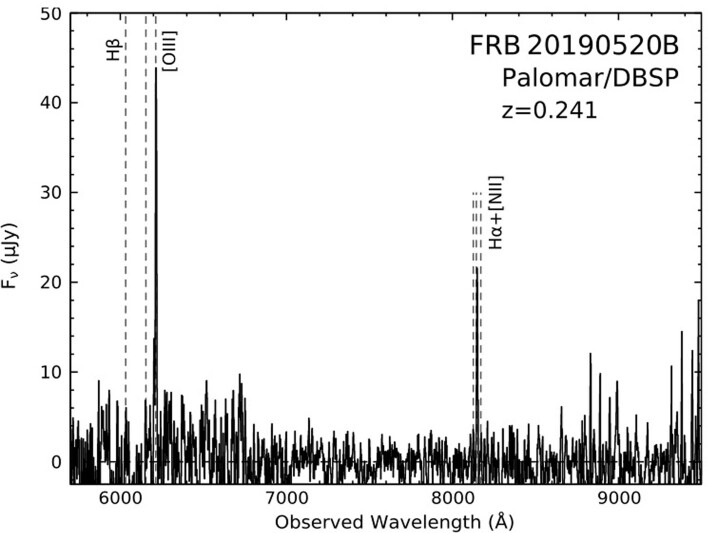
The dispersive sweep of fast radio bursts (FRBs) has been used to probe the ionized baryon content of the intergalactic medium, which is assumed to dominate the total extragalactic dispersion. Although the host-galaxy contributions to the dispersion measure appear to be small for most FRBs, in at least one case there is evidence for an extreme magneto-ionic local environment and a compact persistent radio source. Here we report the detection and localization of the repeating FRB 20190520B, which is co-located with a compact, persistent radio source and associated with a dwarf host galaxy of high specific-star-formation rate at a redshift of 0.241 ± 0.001. The estimated host-galaxy dispersion measure of approximately [Formula: see text] parsecs per cubic centimetre, which is nearly an order of magnitude higher than the average of FRB host galaxies, far exceeds the dispersion-measure contribution of the intergalactic medium. Caution is thus warranted in inferring redshifts for FRBs without accurate host-galaxy identifications.
快速射电暴(FRB)的弥散扫描被用来探测星系间介质的电离重子含量,而星系间介质被认为主导着外银河系的总弥散。尽管对于大多数 FRB 来说,星系贡献的色散量看起来很小,但至少有一个案例表明存在极端的磁离子局部环境和紧凑的持续射电源。在这里,我们报告了重复 FRB20190520B 的检测和定位,该 FRB 与一个紧凑、持续的射电源重合,并与一个高特定恒星形成率的矮星系相关联,红移为 0.241±0.001。估计的星系色散量约为[公式:见文本]每立方厘米的秒差距,比 FRB 宿主星系的平均水平高出近一个数量级,远远超过了星系间介质对色散量的贡献。因此,在没有准确的星系识别的情况下,推断 FRB 的红移需要谨慎。