Štětkářová Ivana, Ehler Edvard, Židó Michal, Lauer David, Polák Jan, Keller Jiří, Peisker Tomáš
Department of Neurology, Third Faculty of Medicine, Královské Vinohrady University Hospital, Prague, Czechia.
Department of Neurology, Faculty of Health Studies, Pardubice University and Pardubice Regional Hospital, Pardubice, Czechia.
Front Neurol. 2022 May 23;13:875714. doi: 10.3389/fneur.2022.875714. eCollection 2022.
Elevated blood glucose and CRP (C-reactive protein) are usually related to a worsened clinical outcome in neurological diseases. This association in Guillain-Barré syndrome (GBS) has been studied rarely. We tried to analyse if hyperglycaemia and CRP at admission may influence the outcome of GBS, including mechanically ventilated (MV) patients.
We retrospectively studied 66 patients (40 males, 19-93 years, average 56 years) without diabetes mellitus and free of corticoid treatment, who fulfilled the clinical criteria for diagnosis of GBS. Hyperglycaemia (the level of fasting plasma glucose, FPG) was defined as blood glucose level >5.59 mmol/L according to our laboratory. CRP >5 mg/L was considered as an abnormally elevated value.
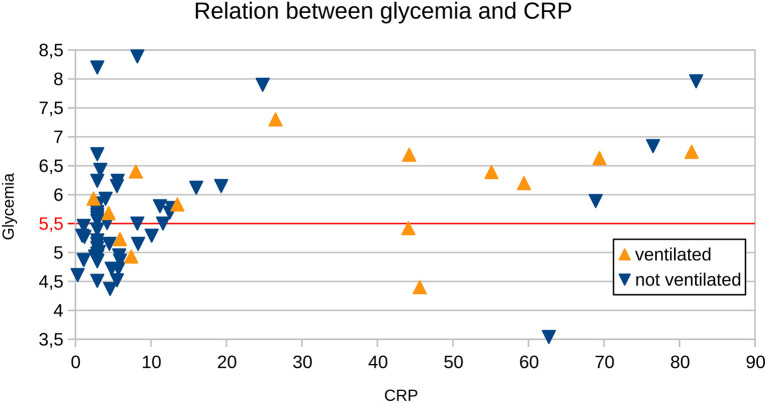
At admission, 32 GBS patients (48%) had hyperglycaemia according to FPG level. A severe form of GBS (>4 according to Hughes GBS scale) was observed in 17 patients (26%); and 8 of them (47%) had hyperglycaemia. Fourteen patients (21%) were MV, and in 10 of them (71%) hyperglycaemia was present. CRP was significantly increased in MV patients. The linear model revealed a significant relationship between CRP and glycemia ( = 0.007) in subjects without MV ( = 0.049). In subjects with MV the relationship was not significant ( = 0.2162, NS).
In the acute phase of GBS at admission, hyperglycaemia and higher CRP occur relatively frequently, and may be a risk factor for the severity of GBS. Stress hyperglycaemia due to impaired glucose homeostasis could be one explanation for this condition.
血糖升高和C反应蛋白(CRP)通常与神经疾病临床预后较差有关。格林-巴利综合征(GBS)中的这种关联鲜有研究。我们试图分析入院时高血糖和CRP是否会影响GBS患者的预后,包括机械通气(MV)患者。
我们回顾性研究了66例符合GBS临床诊断标准、无糖尿病且未接受皮质类固醇治疗的患者(40例男性,年龄19 - 93岁,平均56岁)。根据我们实验室的标准,高血糖(空腹血糖水平,FPG)定义为血糖水平>5.59 mmol/L。CRP>5 mg/L被视为异常升高值。
入院时,根据FPG水平,32例GBS患者(48%)存在高血糖。17例患者(26%)出现严重形式的GBS(根据Hughes GBS量表评分>4);其中8例(47%)有高血糖。14例患者(21%)接受机械通气,其中10例(71%)存在高血糖。MV患者的CRP显著升高。线性模型显示,在未接受MV的患者中,CRP与血糖之间存在显著关系(= 0.007)(= 0.049)。在接受MV的患者中,这种关系不显著(= 0.2162,无统计学意义)。
在GBS急性期入院时,高血糖和较高的CRP相对频繁出现,可能是GBS严重程度的一个危险因素。葡萄糖稳态受损导致的应激性高血糖可能是对此情况的一种解释。