Tarasenka Natalie, Kornev Vladislav, Ramanenka Andrei, Li Ruibin, Tarasenko Nikolai
B. I. Stepanov Institute of Physics, National Academy of Sciences of Belarus, Minsk, 220072, Belarus.
State Key Laboratory of Radiation Medicine and Protection, School for Radiation Medicine & Interdisciplinary Sciences, Soochow University Suzhou, Jiangsu, 215123, China.
Heliyon. 2022 May 29;8(6):e09554. doi: 10.1016/j.heliyon.2022.e09554. eCollection 2022 Jun.
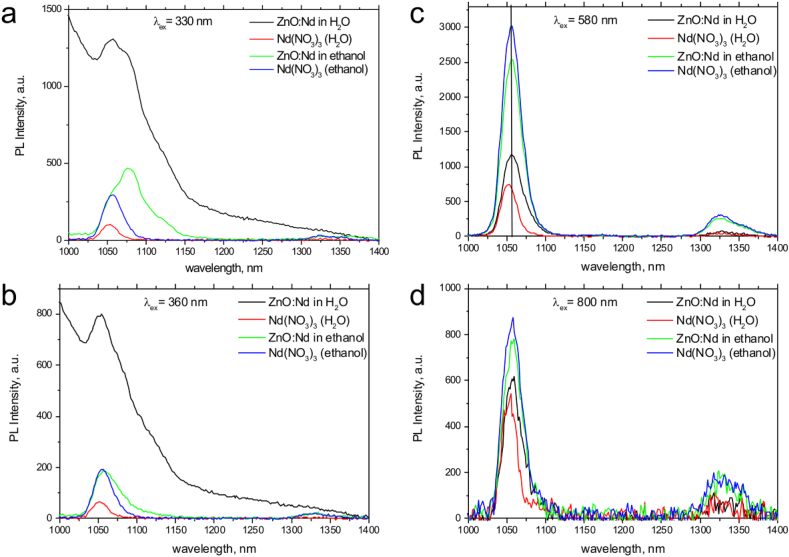
The work reports on the use of laser ablation and post-ablation irradiation techniques for the preparation Nd doped ZnO nanoparticles (NPs). The focus has been made on photoluminescence of Nd-doped ZnO NPs in the second near infrared (NIR-II) spectral window (1000-1700 nm) of the biological transparency. Morphology, phase composition and optical properties of the synthesized NPs were studied by absorption and photoluminescence spectroscopy, X-Ray diffraction (XRD) and transmission (TEM) electron microscopy. Near-infrared luminescence of Nd doped ZnO nanocrystals in the region of 1000-1400 nm was detected both upon excitation from the ground state (800 nm) and upon UV excitation. The latter proves the incorporation of the Nd into ZnO lattice as photoluminescence occurs through the transfer of excitation energy from the ZnO matrix to the Nd ion. The possibility of control over the luminescence properties by a variation of solvent composition and by additional laser irradiation was demonstrated.
该工作报告了使用激光烧蚀和烧蚀后辐照技术制备掺钕氧化锌纳米颗粒(NPs)的情况。重点关注了掺钕氧化锌纳米颗粒在生物透明性的第二近红外(NIR-II)光谱窗口(1000 - 1700 nm)中的光致发光。通过吸收光谱和光致发光光谱、X射线衍射(XRD)以及透射电子显微镜(TEM)研究了合成纳米颗粒的形态、相组成和光学性质。在从基态(800 nm)激发以及紫外激发时,均检测到了掺钕氧化锌纳米晶体在1000 - 1400 nm区域的近红外发光。后者证明钕已掺入氧化锌晶格中,因为光致发光是通过激发能量从氧化锌基质转移到钕离子而发生的。研究表明,通过改变溶剂组成和额外的激光辐照,可以控制发光性质。