Feichtner Andreas, Kugler Valentina, Schwaighofer Selina, Nuener Thomas, Fleischmann Jakob, Stefan Eduard
Institute of Biochemistry and Center for Molecular Biosciences, University of Innsbruck, Innrain 80/82, 6020 Innsbruck, Austria.
Institute of Biochemistry and Center for Molecular Biosciences, University of Innsbruck, Innrain 80/82, 6020 Innsbruck, Austria; Tyrolean Cancer Research Institute, Innrain 66, 6020 Innsbruck, Austria.
Memo. 2022 Jun;15(2):137-142. doi: 10.1007/s12254-021-00790-6. Epub 2022 Jan 21.
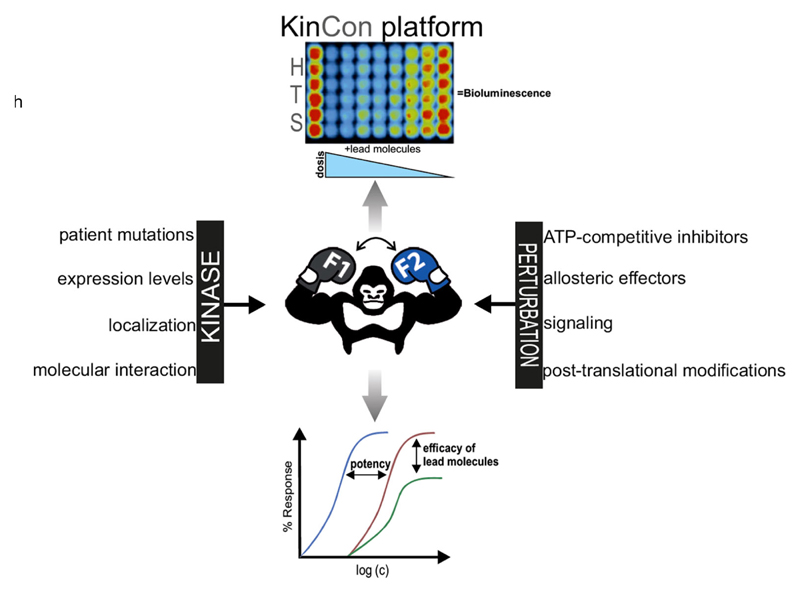
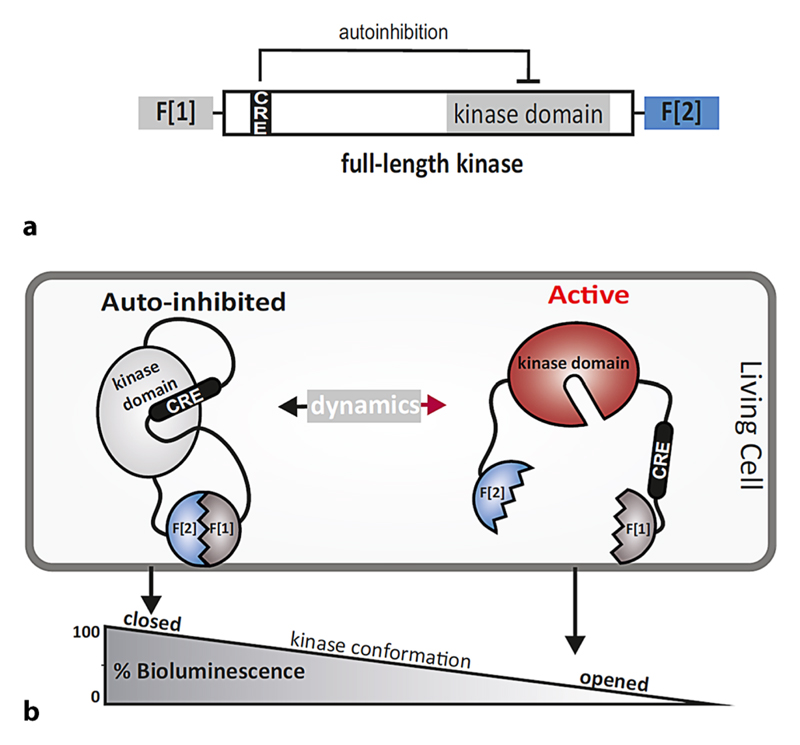
Numerous kinases act as central nodes of cellular signaling networks. As such, many of these enzymes function as molecular switches for coordinating spatiotemporal signal transmission. Typically, it is the compartmentalized phosphorylation of protein substrates which relays the transient input signal to determine decisive physiological cell responses. Genomic alterations affect kinase abundance and/or their activities which contribute to the malignant transformation, progression, and metastasis of human cancers. Thus, major drug discovery efforts have been made to identify lead molecules targeting clinically relevant oncokinases. The concept of personalized medicine aims to apply the therapeutic agent with the highest efficacy towards a patient-specific mutation. Here, we discuss the implementation of a cell-based reporter system which may foster the decision-making process to identify the most promising lead-molecules. We present a modular kinase conformation (KinCon) biosensor platform for live-cell analyses of kinase activity states. This biosensor facilitates the recording of kinase activity conformations of the wild-type and the respective mutated kinase upon lead molecule exposure. We reflect proof-of-principle studies demonstrating how this technology has been extended to profile drug properties of the full-length kinases BRAF and MEK1 in intact cells. Further, we pinpoint how this technology may open new avenues for systematic and patient-tailored drug discovery efforts. Overall, this precision-medicineoriented biosensor concept aims to determine kinase inhibitor specificity and anticipate their drug efficacies.
众多激酶充当细胞信号网络的核心节点。因此,这些酶中的许多作为分子开关来协调时空信号传递。通常,正是蛋白质底物的分区磷酸化传递瞬时输入信号以决定决定性的生理细胞反应。基因组改变影响激酶丰度和/或其活性,这有助于人类癌症的恶性转化、进展和转移。因此,人们已经做出了重大的药物研发努力来鉴定靶向临床相关致癌激酶的先导分子。个性化医疗的概念旨在针对患者特异性突变应用疗效最高的治疗药物。在此,我们讨论一种基于细胞的报告系统的实施,该系统可能有助于决策过程以识别最有前景的先导分子。我们提出了一种模块化激酶构象(KinCon)生物传感器平台,用于对激酶活性状态进行活细胞分析。这种生物传感器有助于记录野生型和各自突变型激酶在接触先导分子后的激酶活性构象。我们展示了原理验证研究,证明了该技术如何扩展到在完整细胞中分析全长激酶BRAF和MEK1的药物特性。此外,我们指出该技术如何为系统的和针对患者的药物研发努力开辟新途径。总体而言,这种面向精准医疗的生物传感器概念旨在确定激酶抑制剂的特异性并预测其药物疗效。