Guarinello Giovanna Golin, D'Amico Raissa Campos, Miranda Ariadne Natalia Mileo, Novack Jaqueline, Coral Francisco Eduardo
Hospital Santa Casa de Curitiba - HSCMC, Curitiba, PR, Brasil.
Universidade Positivo, Curitiba, PR, Brasil..
J Vasc Bras. 2022 May 23;21:e20220027. doi: 10.1590/1677-5449.202200271. eCollection 2022.
During the COVID-19 pandemic, healthcare services reduced the number of elective procedures performed. Vascular surgery patients are a group at risk of contracting severe forms of the infection, but are also susceptible to complications of their underlying diseases if they do not receive routine care. It is therefore necessary to understand the direct and indirect impacts and consequences of the pandemic on vascular patients.
To assess the impact of 1 year of the pandemic on a vascular surgery service and changes to the profile of surgeries during the same period.
An analysis was conducted of the medical records of patients who underwent elective and emergency surgery from 2019 to 2021. A review of the literature was also conducted, using the search terms "vascular surgery", "COVID-19", and "amputations". Data were analyzed with Stata/SE v.14.1 (StataCorpLP, United States).
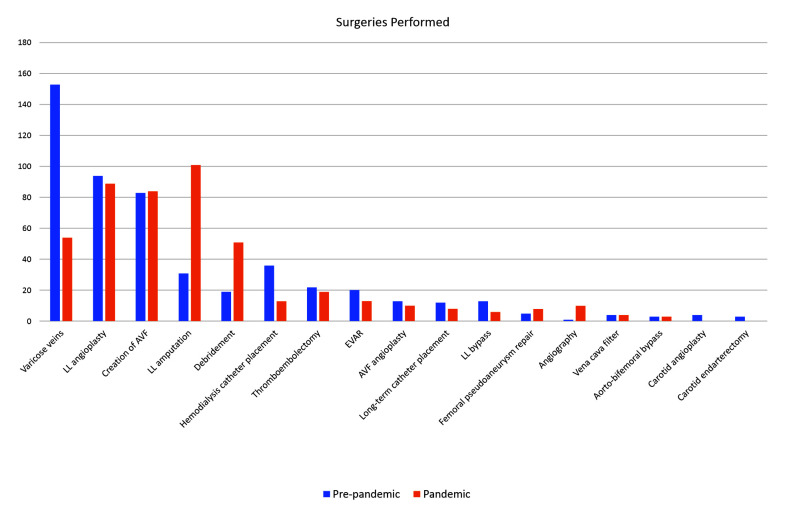
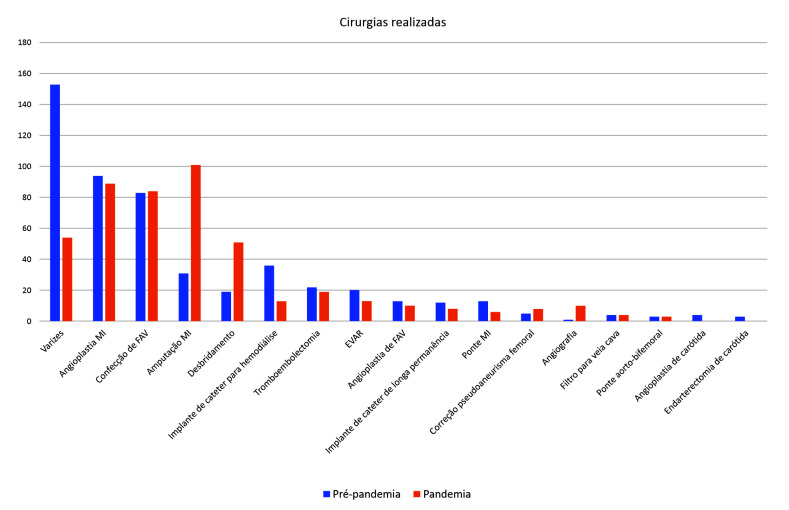
A total of 1,043 surgeries were identified during the study period, 51.6% conducted pre-pandemic and 48.4% performed during the pandemic. There was a reduction in the number of elective surgeries and an increase in the number of lower limb amputations and surgical debridements. Increases were also observed in the proportion of patients with peripheral arterial occlusive disease with advanced Rutherford classifications and in the number of cases of diabetic foot.
The reduction in elective care and patients' reluctance to seek health services during the pandemic are the probable causes of increased severity of patient status, with greater need for lower limb amputation and surgical debridement and changes to the profile of the surgery performed at the service.
在新冠疫情期间,医疗服务减少了择期手术的数量。血管外科患者是感染重症形式的高危人群,但如果不接受常规治疗,他们也易患基础疾病的并发症。因此,有必要了解疫情对血管患者的直接和间接影响及后果。
评估疫情一年对血管外科服务的影响以及同期手术类型的变化。
对2019年至2021年接受择期和急诊手术患者的病历进行分析。还使用“血管外科”“新冠病毒病”和“截肢”等检索词进行了文献综述。数据用Stata/SE v.14.1(美国StataCorpLP公司)进行分析。
研究期间共确定了1043例手术,其中51.6%在疫情前进行,48.4%在疫情期间进行。择期手术数量减少,下肢截肢和手术清创数量增加。卢瑟福分级晚期的外周动脉闭塞性疾病患者比例以及糖尿病足病例数也有所增加。
择期治疗的减少以及疫情期间患者不愿寻求医疗服务可能是患者病情严重程度增加的原因,导致下肢截肢和手术清创的需求更大,以及该科室所进行手术类型的变化。