Cario Anaïs, Larzillière Marina, Nguyen Olivier, Alain Karine, Marre Samuel
Univ. Bordeaux, CNRS, Bordeaux INP, ICMCB, UMR 5026, Pessac, France.
CNRS, Univ. Brest, Ifremer, IRP 1211 MicrobSea, Unité de Biologie et Ecologie des Ecosystèmes Marins Profonds BEEP, IUEM, Plouzané, France.
Front Microbiol. 2022 May 23;13:866681. doi: 10.3389/fmicb.2022.866681. eCollection 2022.
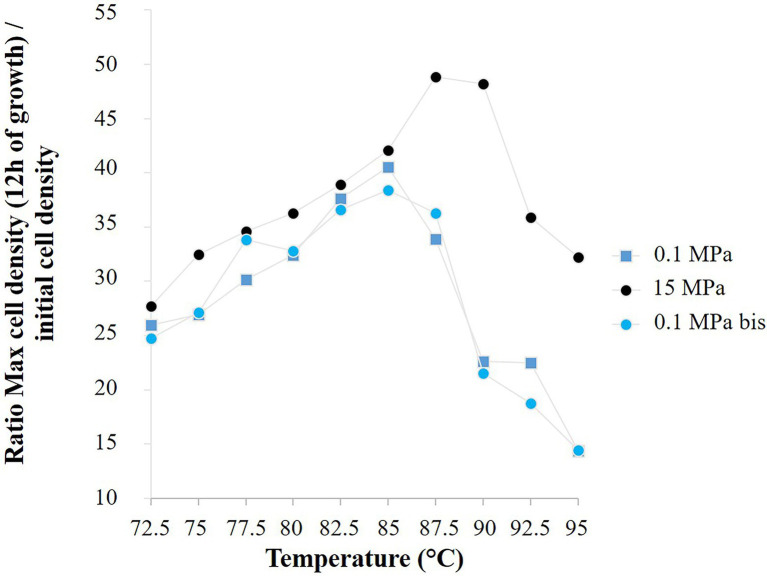
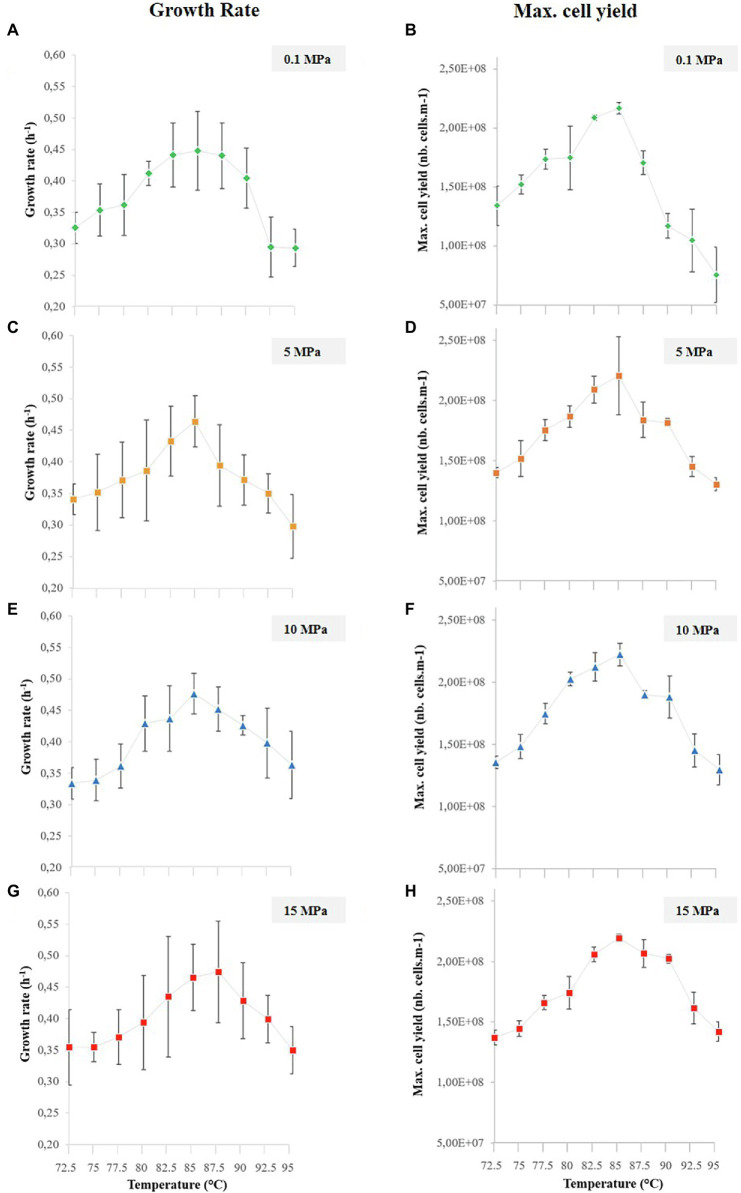
Here, we present a novel methodology based on high-pressure microfluidics to rapidly perform temperature-based phenotyping of microbial strains from deep-sea environments. The main advantage concerns the multiple on-chip temperature conditions that can be achieved in a single experiment at pressures representative of the deep-sea, overcoming the conventional limitations of large-scale batch metal reactors to conduct fast screening investigations. We monitored the growth of the model strain over 40 temperature and pressure conditions, without any decompression, in only 1 week, whereas it takes weeks or months with conventional approaches. The results are later compared with data from the literature. An additional example is also shown for a hydrogenotrophic methanogen strain (), demonstrating the robustness of the methodology. These microfluidic tools can be used in laboratories to accelerate characterizations of new isolated species, changing the widely accepted paradigm that high-pressure microbiology experiments are time-consuming.
在此,我们提出了一种基于高压微流体技术的新方法,用于快速对来自深海环境的微生物菌株进行基于温度的表型分析。主要优势在于能够在代表深海压力的条件下,于单个实验中实现多种芯片上的温度条件,克服了大型批量金属反应器在进行快速筛选研究时的传统局限性。我们在仅40种温度和压力条件下,无需任何减压操作,仅用1周时间就监测了模式菌株的生长情况,而传统方法则需要数周或数月时间。随后将结果与文献数据进行了比较。还展示了另一个关于氢营养型产甲烷菌菌株()的例子,证明了该方法的稳健性。这些微流体工具可用于实验室,以加速对新分离物种的表征,改变了高压微生物学实验耗时这一广泛接受的范式。