Brown Joan, Bhatnagar Manas, Gordon Hugh, Goodner Jared, Cobb J Perren, Lutrick Karen
Clinical Operations Business Intelligence, The Keck School of Medicine of the University of Southern California, Los Angeles, CA, United States.
Department of Surgery, The Keck School of Medicine of the University of Southern California, Los Angeles, CA, United States.
JMIR Hum Factors. 2022 Jun 9;9(2):e35032. doi: 10.2196/35032.
The Discovery Critical Care Research Network Program for Resilience and Emergency Preparedness (Discovery PREP) partnered with a third-party technology vendor to design and implement an electronic data capture tool that addressed multisite data collection challenges during public health emergencies (PHE) in the United States. The basis of the work was to design an electronic data capture tool and to prospectively gather data on usability from bedside clinicians during national health system stress queries and influenza observational studies.
The aim of this paper is to describe the lessons learned in the design and implementation of a novel electronic data capture tool with the goal of significantly increasing the nation's capability to manage real-time data collection and analysis during PHE.
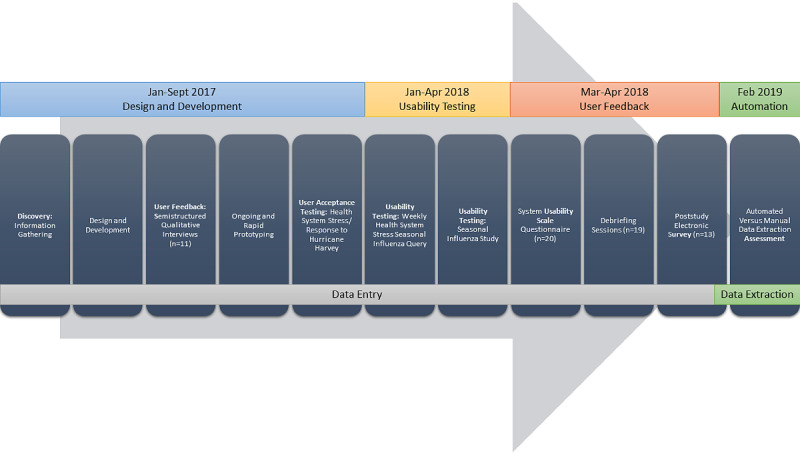
A multiyear and multiphase design approach was taken to create an electronic data capture tool, which was used to pilot rapid data capture during a simulated PHE. Following the pilot, the study team retrospectively assessed the feasibility of automating the data captured by the electronic data capture tool directly from the electronic health record. In addition to user feedback during semistructured interviews, the System Usability Scale (SUS) questionnaire was used as a basis to evaluate the usability and performance of the electronic data capture tool.
Participants included Discovery PREP physicians, their local administrators, and data collectors from tertiary-level academic medical centers at 5 different institutions. User feedback indicated that the designed system had an intuitive user interface and could be used to automate study communication tasks making for more efficient management of multisite studies. SUS questionnaire results classified the system as highly usable (SUS score 82.5/100). Automation of 17 (61%) of the 28 variables in the influenza observational study was deemed feasible during the exploration of automated versus manual data abstraction. The creation and use of the Project Meridian electronic data capture tool identified 6 key design requirements for multisite data collection, including the need for the following: (1) scalability irrespective of the type of participant; (2) a common data set across sites; (3) automated back end administrative capability (eg, reminders and a self-service status board); (4) multimedia communication pathways (eg, email and SMS text messaging); (5) interoperability and integration with local site information technology infrastructure; and (6) natural language processing to extract nondiscrete data elements.
The use of the electronic data capture tool in multiple multisite Discovery PREP clinical studies proved the feasibility of using the novel, cloud-based platform in practice. The lessons learned from this effort can be used to inform the improvement of ongoing global multisite data collection efforts during the COVID-19 pandemic and transform current manual data abstraction approaches into reliable, real time, and automated information exchange. Future research is needed to expand the ability to perform automated multisite data extraction during a PHE and beyond.
发现重症监护研究网络抗逆力与应急准备项目(Discovery PREP)与一家第三方技术供应商合作,设计并实施了一种电子数据采集工具,以应对美国公共卫生紧急事件(PHE)期间多地点数据收集的挑战。这项工作的基础是设计一种电子数据采集工具,并在国家卫生系统压力调查和流感观察性研究期间,前瞻性地收集床边临床医生对其可用性的数据。
本文旨在描述在设计和实施一种新型电子数据采集工具过程中吸取的经验教训,目标是显著提高国家在公共卫生紧急事件期间管理实时数据收集和分析的能力。
采用了一种多年多阶段的设计方法来创建一种电子数据采集工具,该工具在模拟公共卫生紧急事件期间用于试点快速数据采集。试点之后,研究团队回顾性评估了直接从电子健康记录中自动采集电子数据采集工具所捕获数据的可行性。除了半结构化访谈期间的用户反馈外,系统可用性量表(SUS)问卷被用作评估电子数据采集工具可用性和性能的依据。
参与者包括Discovery PREP的医生、他们的当地管理人员以及来自5个不同机构的三级学术医疗中心的数据收集人员。用户反馈表明,设计的系统具有直观的用户界面,可用于自动执行研究沟通任务,从而更高效地管理多地点研究。SUS问卷结果将该系统归类为高度可用(SUS得分82.5/100)。在探索自动与手动数据提取过程中,流感观察性研究中28个变量中的17个(61%)的自动化被认为是可行的。子午项目电子数据采集工具的创建和使用确定了多地点数据收集的6个关键设计要求,包括需要以下几点:(1)无论参与者类型如何都具有可扩展性;(2)各地点通用的数据集;(3)自动化的后端管理功能(如提醒和自助服务状态板);(4)多媒体通信途径(如电子邮件和短信);(5)与当地站点信息技术基础设施的互操作性和集成;(6)用于提取非离散数据元素的自然语言处理。
在多项多地点Discovery PREP临床研究中使用电子数据采集工具证明了在实践中使用这种新型基于云的平台的可行性。从这项工作中吸取的经验教训可用于为改善新冠疫情期间正在进行的全球多地点数据收集工作提供参考,并将当前的手动数据提取方法转变为可靠、实时和自动化的信息交换。未来需要开展研究,以扩大在公共卫生紧急事件期间及之后执行自动多地点数据提取的能力。