Division of Medical Genetics, Department of Medicine, University of Washington, Seattle, WA.
Washington National Primate Research Center, Seattle, WA.
Blood Adv. 2022 Aug 9;6(15):4360-4372. doi: 10.1182/bloodadvances.2022007975.
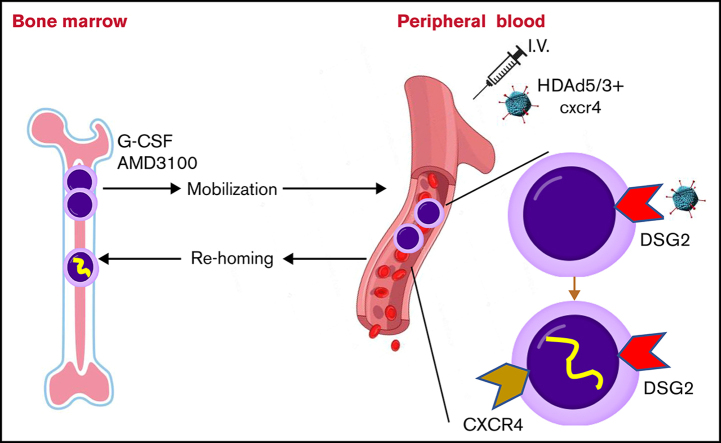
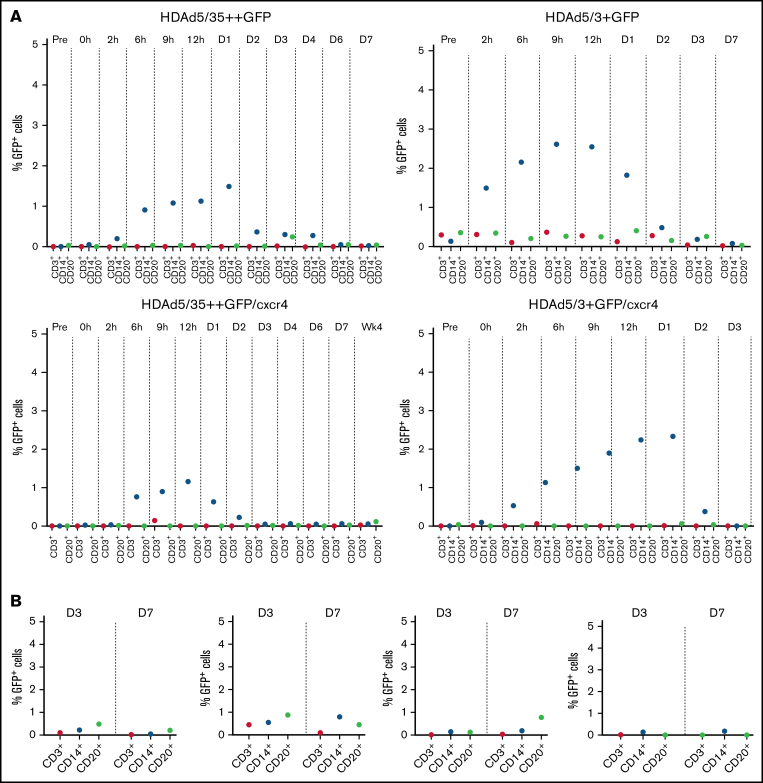
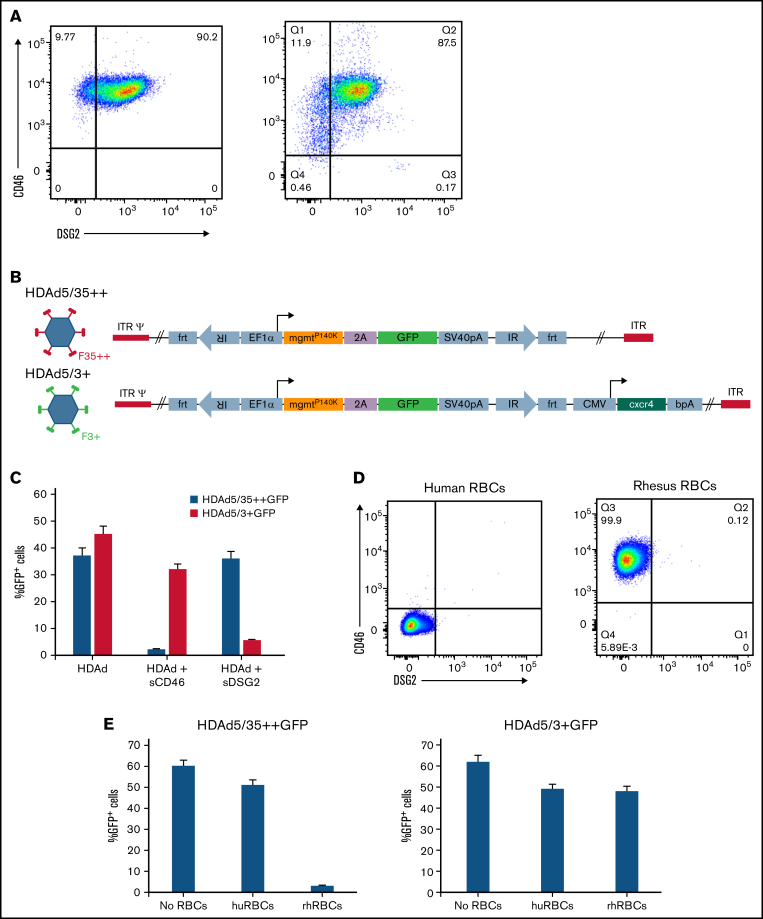
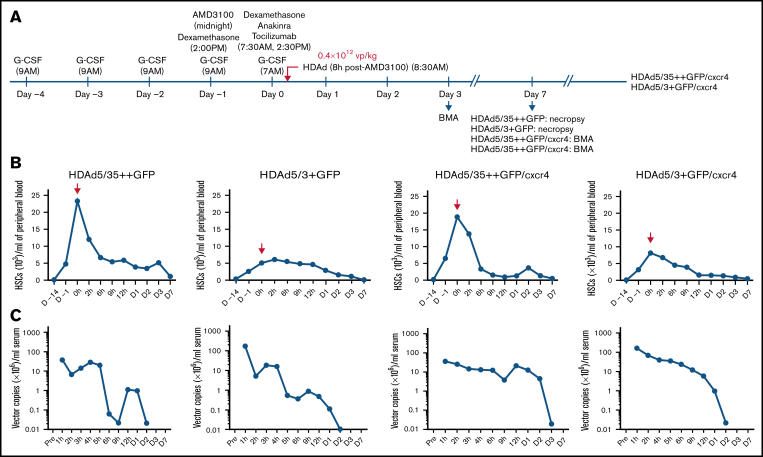
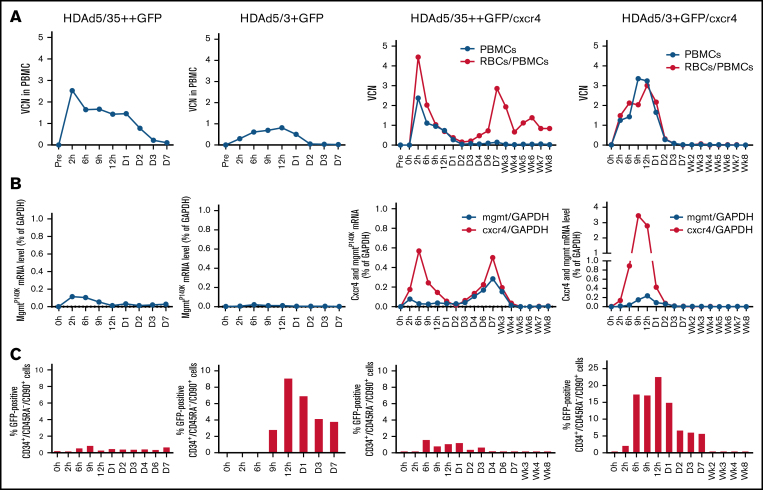
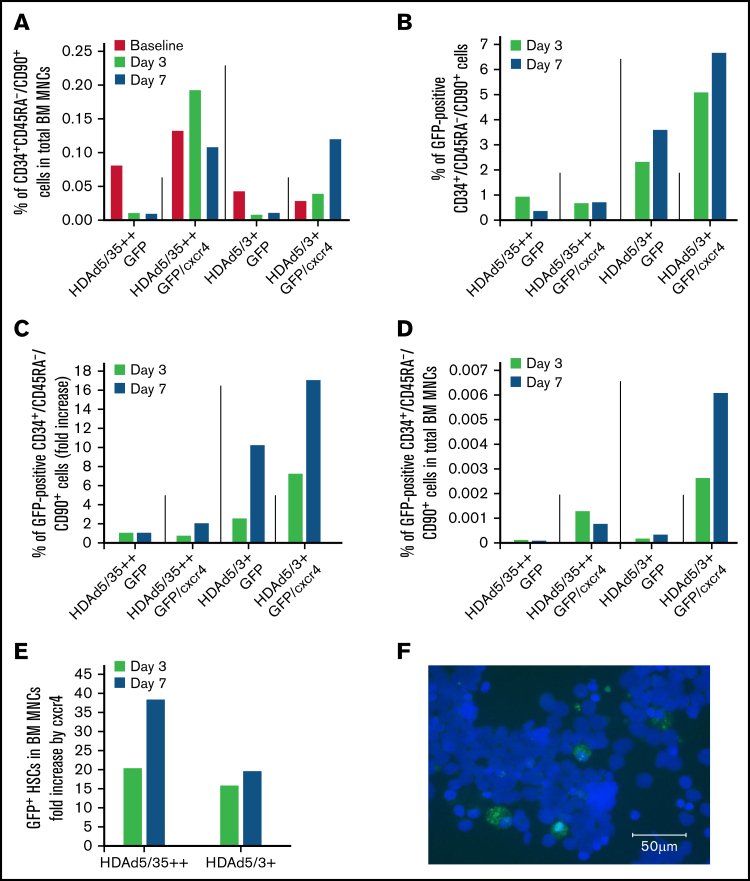
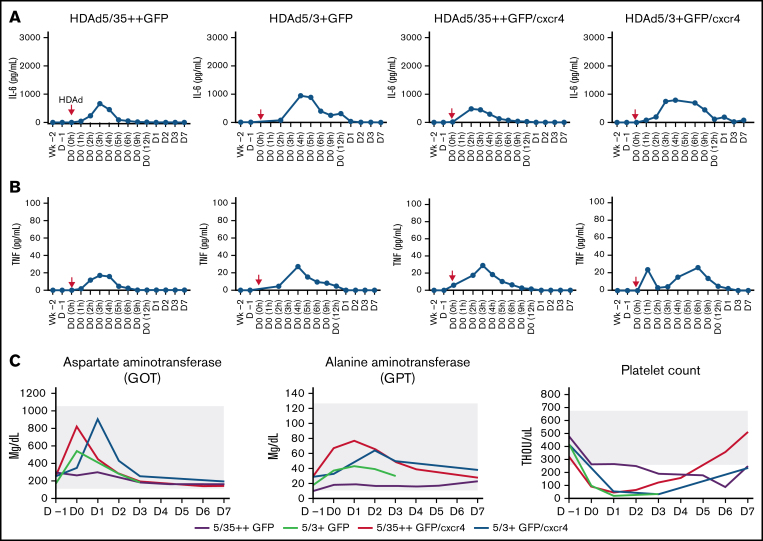
We developed a new in vivo hematopoietic stem cell (HSC) gene therapy approach that involves only IV injections and does not require myeloablation/conditioning and HSC transplantation. In this approach, HSCs are mobilized from the bone marrow into the peripheral bloodstream and transduced with IV injected helper-dependent adenovirus (HDAd) vectors. A fraction of transduced HSCs returns to the bone marrow and persists there long term. Here, we report desmoglein 2 (DSG2) as a new receptor that can be used for in vivo HSC transduction. HDAd5/3+ vectors were developed that use DSG2 as a high-affinity attachment receptor, and in vivo HSC transduction and safety after IV injection of an HDAd5/3+ vector expressing green fluorescent protein (GFP) in granulocyte colony-stimulating factor/AMD3100 (plerixafor)-mobilized rhesus macaques were studied. Unlike previously used CD46-targeting HDAd5/35++ vectors, HDAd5/3+ virions were not sequestered by rhesus erythrocytes and therefore mediated ∼10-fold higher GFP marking rates in primitive HSCs (CD34+/CD45RA-/CD90+ cells) in the bone marrow at day 7 after vector injection. To further increase the return of in vivo transduced, mobilized HSCs to the bone marrow, we transiently expressed cxcr4 in mobilized HSCs from the HDAd5/3+ vector. In vivo transduction with an HDAd5/3+GFP/cxcr4 vector at a low dose of 0.4 × 10¹² viral particles/kg resulted in up to 7% of GFP-positive CD34+/CD45RA-/CD90+ cells in the bone marrow. This transduction rate is a solid basis for in vivo base or prime editing in combination with natural or drug-induced expansion of edited HSCs. Furthermore, our study provides new insights into HSC biology and trafficking after mobilization in nonhuman primates.
我们开发了一种新的体内造血干细胞 (HSC) 基因治疗方法,该方法仅涉及静脉注射,不需要骨髓清除/调理和 HSC 移植。在这种方法中,HSCs 从骨髓动员到外周血液,并通过静脉注射辅助依赖性腺病毒 (HDAd) 载体进行转导。一部分转导的 HSCs 回到骨髓并长期存在。在这里,我们报告桥粒芯糖蛋白 2 (DSG2) 作为一种新的受体,可用于体内 HSC 转导。开发了 HDAd5/3+载体,该载体使用 DSG2 作为高亲和力附着受体,研究了在粒细胞集落刺激因子/AMD3100(plerixafor)动员的恒河猴中静脉注射表达绿色荧光蛋白 (GFP) 的 HDAd5/3+载体后体内 HSC 转导和安全性。与以前使用的靶向 CD46 的 HDAd5/35++载体不同,HDAd5/3+病毒粒子不会被恒河猴红细胞隔离,因此在载体注射后第 7 天骨髓中的原始 HSC(CD34+/CD45RA-/CD90+细胞)中介导 GFP 标记率提高约 10 倍。为了进一步增加体内转导的、动员的 HSCs 返回骨髓,我们在动员的 HSCs 中从 HDAd5/3+载体瞬时表达 cxcr4。以 0.4×10¹² 病毒颗粒/kg 的低剂量静脉内给予 HDAd5/3+GFP/cxcr4 载体导致骨髓中高达 7%的 GFP 阳性 CD34+/CD45RA-/CD90+细胞。这种转导率为体内基础或 Prime 编辑与编辑后的 HSCs 的自然或药物诱导扩增相结合提供了坚实的基础。此外,我们的研究为非人类灵长类动物动员后 HSC 生物学和贩运提供了新的见解。