Division of Medical Genetics, Department of Medicine, University of Washington, Box 357720, Seattle, WA 98195, USA.
Division of Hematology, University of Washington, Box 357720, Seattle, WA 98195, USA.
Mol Ther. 2019 Dec 4;27(12):2195-2212. doi: 10.1016/j.ymthe.2019.08.006. Epub 2019 Aug 19.
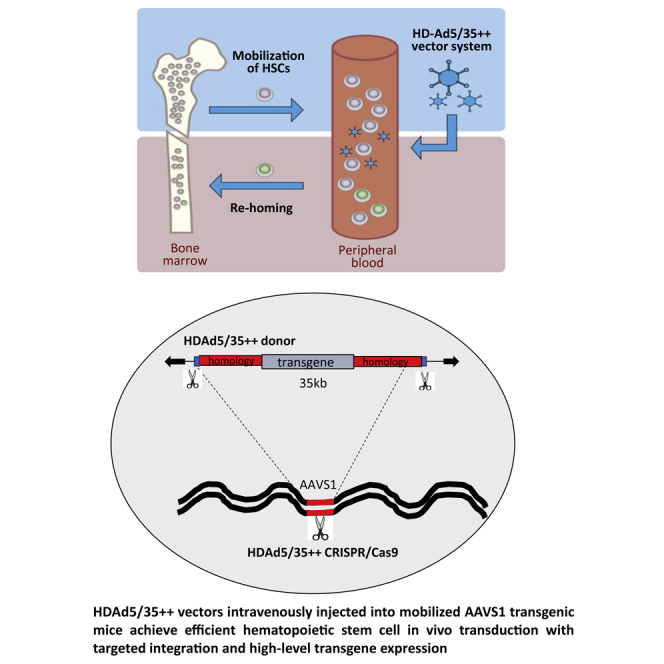
Our goal is the development of in vivo hematopoietic stem cell (HSC) transduction technology with targeted integration. To achieve this, we modified helper-dependent HDAd5/35++ vectors to express a CRISPR/Cas9 specific to the "safe harbor" adeno-associated virus integration site 1 (AAVS1) locus and to provide a donor template for targeted integration through homology-dependent repair. We tested the HDAd-CRISPR + HDAd-donor vector system in AAVS1 transgenic mice using a standard ex vivo HSC gene therapy approach as well as a new in vivo HSC transduction approach that involves HSC mobilization and intravenous HDAd5/35++ injections. In both settings, the majority of treated mice had transgenes (GFP or human γ-globin) integrated into the AAVS1 locus. On average, >60% of peripheral blood cells expressed the transgene after in vivo selection with low-dose OBG/bis-chloroethylnitrosourea (BCNU). Ex vivo and in vivo HSC transduction and selection studies with HDAd-CRISPR + HDAd-globin-donor resulted in stable γ-globin expression at levels that were significantly higher (>20% γ-globin of adult mouse globin) than those achieved in previous studies with a SB100x-transposase-based HDAd5/35++ system that mediates random integration. The ability to achieve therapeutically relevant transgene expression levels after in vivo HSC transduction and selection and targeted integration make our HDAd5/35++-based vector system a new tool in HSC gene therapy.
我们的目标是开发具有靶向整合的体内造血干细胞(HSC)转导技术。为此,我们对依赖辅助的 HDAd5/35++载体进行了修饰,使其表达针对“安全港”腺相关病毒整合位点 1(AAVS1)的 CRISPR/Cas9,并通过同源依赖性修复提供用于靶向整合的供体模板。我们使用标准的体外 HSC 基因治疗方法以及涉及 HSC 动员和静脉内 HDAd5/35++注射的新的体内 HSC 转导方法,在 AAVS1 转基因小鼠中测试了 HDAd-CRISPR+HDAd-供体载体系统。在这两种情况下,大多数接受治疗的小鼠的转基因(GFP 或人γ-球蛋白)都整合到 AAVS1 基因座中。在体内选择使用低剂量 OBG/双氯乙基亚硝脲(BCNU)后,平均有>60%的外周血细胞表达转基因。HDAd-CRISPR+HDAd-球蛋白供体的体外和体内 HSC 转导和选择研究导致γ-球蛋白的稳定表达水平显著高于(>20%的成年小鼠球蛋白中的γ-球蛋白)以前使用基于 SB100x-转座酶的 HDAd5/35++系统进行的随机整合的研究。在体内 HSC 转导和选择以及靶向整合后能够实现治疗相关的转基因表达水平,使我们的 HDAd5/35++载体系统成为 HSC 基因治疗的新工具。