Department of Clinical Laboratory, Shanghai Jiao Tong University Affiliated Sixth People's Hospital, Shanghai, 200233, China.
Department of Molecular Biology Laboratory, Shanghai Jiao Tong University Affiliated Sixth People's Hospital, Shanghai, 200233, China.
Cell Death Dis. 2022 Jun 9;13(6):540. doi: 10.1038/s41419-022-04986-4.
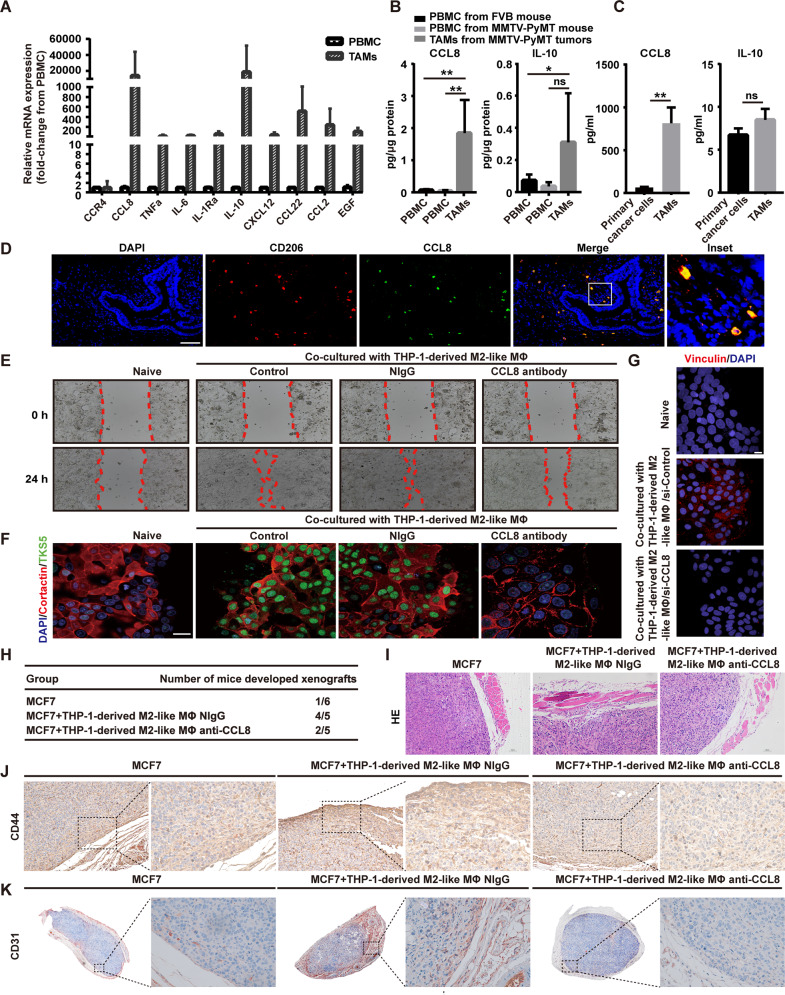
Collective detachment of cancer cells at the invading front could generate efficient metastatic spread. However, how cancer cell clusters shed from the leading front remains unknown. We previously reported that the dynamic expression of CD44 in breast cancers (BrCas) at collectively invading edges was associated with tumor-associated macrophages (TAMs). In this study, we first observed that the highly expressed CD44 (CD44) cancer cell clusters were located in the BrCa circulating vessels, accompanied by CD206 TAMs. Next, we identified that the cancer cell clusters can be converted to an invasive CD44 state which was induced by TAMs, thus giving rise to CD44-associated signaling mediated cohesive detachment. Then, we showed that disrupting CD44-signaling inhibited the TAMs triggered cohesive detaching using 3D organotypic culture and mouse models. Furthermore, our mechanistic study showed that the acquisition of CD44 state was mediated by the MDM2/p53 pathway activation which was induced by CCL8 released from TAMs. Blocking of CCL8 could inhibit the signaling cascade which decreased the CD44-mediated cohesive detachment and spread. Our findings uncover a novel mechanism underlying collective metastasis in BrCas that may be helpful to seek for potential targets.
癌细胞在侵袭前沿的集体脱离可能会产生有效的转移扩散。然而,癌细胞簇如何从前沿脱落仍然未知。我们之前的研究报告表明,在集体侵袭边缘的乳腺癌(BrCas)中 CD44 的动态表达与肿瘤相关巨噬细胞(TAMs)有关。在这项研究中,我们首先观察到,高表达 CD44(CD44)的癌细胞簇位于 BrCa 循环血管中,伴有 CD206 TAMs。接下来,我们确定了癌细胞簇可以转化为一种侵袭性的 CD44 状态,这种状态是由 TAMs 诱导的,从而导致 CD44 相关信号介导的粘着性脱离。然后,我们通过 3D 器官培养和小鼠模型表明,破坏 CD44 信号可以抑制 TAMs 触发的粘着性脱离。此外,我们的机制研究表明,CCL8 从 TAMs 释放后激活 MDM2/p53 通路,从而介导 CD44 状态的获得。阻断 CCL8 可以抑制信号级联反应,从而减少 CD44 介导的粘着性脱离和扩散。我们的研究结果揭示了 BrCas 中集体转移的一个新机制,这可能有助于寻找潜在的靶点。