Division of Medical Oncology and Hematology, Department of Internal Medicine, Korea University Anam Hospital, Seoul, Korea.
K-MASTER Cancer Precision Medicine Diagnosis and Treatment Enterprise, Korea University Medical Center, Seoul, Korea.
Cancer Res Treat. 2023 Jan;55(1):155-166. doi: 10.4143/crt.2021.1567. Epub 2022 Jun 8.
BRCA1 and BRCA2 are among the most important genes involved in DNA repair via homologous recombination (HR). Germline BRCA1/2 (gBRCA1/2)-related cancers have specific characteristics and treatment options but conducting gBRCA1/2 testing and interpreting the genetic imprint are sometimes complicated. Here, we describe the concordance of gBRCA1/2 derived from a panel of clinical tumor tissues using next-generation sequencing (NGS) and genetic aspects of tumors harboring gBRCA1/2 pathogenic variants.
Targeted sequencing was performed using available tumor tissue from patients who underwent gBRCA1/2 testing. Comparative genomic analysis was performed according to gBRCA1/2 pathogenicity.
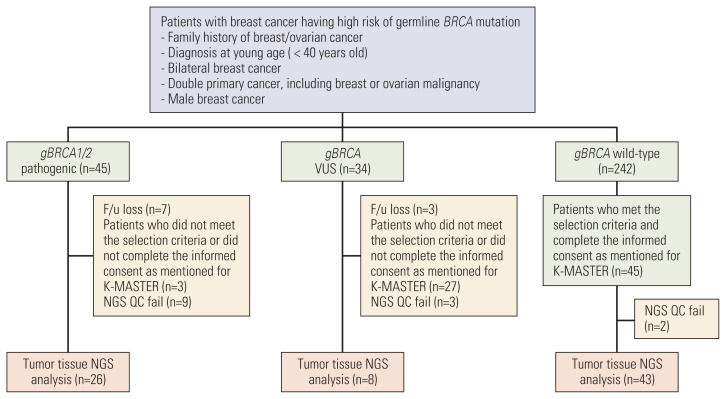
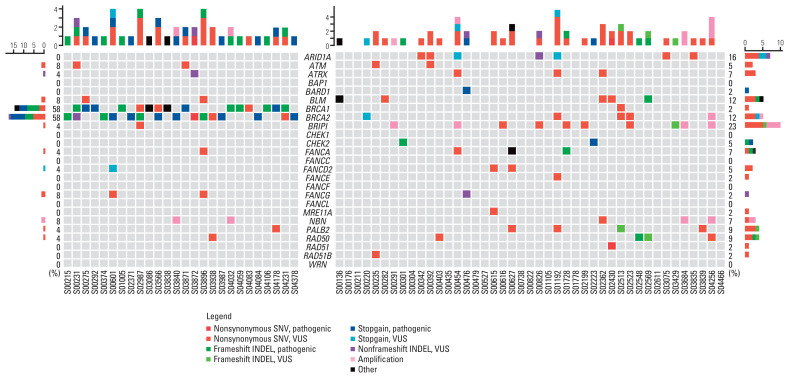
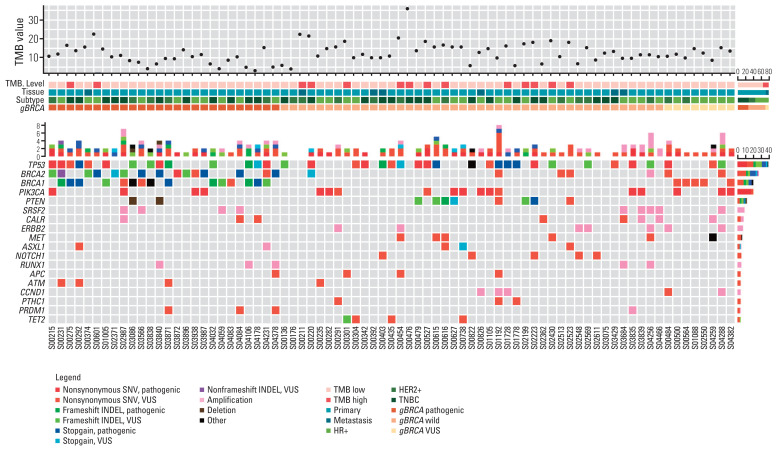
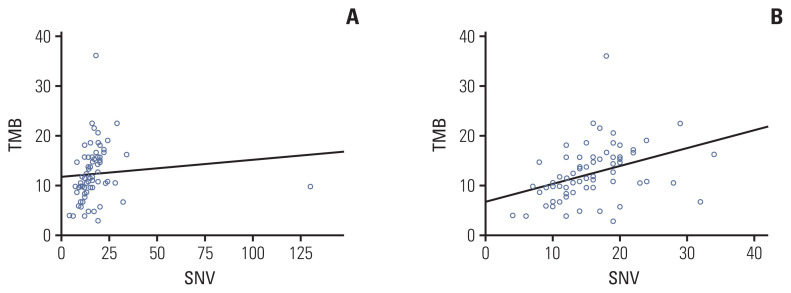
A total of 321 patients who underwent gBRCA1/2 testing were screened, and 26 patients with gBRCA1/2 pathogenic (gBRCA1/2p) variants, eight patients with gBRCA1/2 variants of uncertain significance (VUS; gBRCA1/2v), and 43 patients with gBRCA1/2 wild-type (gBRCA1/2w) were included in analysis. Mutations in TP53 (49.4%) and PIK3CA (23.4%) were frequently detected in all samples. The number of single-nucleotide variants (SNVs) per tumor tissue was higher in the gBRCA1/2w group than that in the gBRCA1/2p group (14.81 vs. 18.86, p=0.278). Tumor mutation burden (TMB) was significantly higher in the gBRCA1/2w group than in the gBRCA1/2p group (10.21 vs. 13.47, p=0.017). Except for BRCA1/2, other HR-related genes were frequently mutated in patients with gBRCA1/2w.
We demonstrated high sensitivity of gBRCA1/2 in tumors analyzed by NGS using a panel of tumor tissues. TMB value and aberration of non-BRCA1/2 HR-related genes differed significantly according to gBRCA1/2 pathogenicity in patients with breast cancer.
BRCA1 和 BRCA2 是参与同源重组 (HR) 介导的 DNA 修复的最重要基因之一。胚系 BRCA1/2(gBRCA1/2)相关癌症具有特定的特征和治疗选择,但进行 gBRCA1/2 检测和解释遗传印记有时很复杂。在这里,我们描述了使用下一代测序 (NGS) 从一组临床肿瘤组织中获得的 gBRCA1/2 的一致性,并描述了携带 gBRCA1/2 致病性变异的肿瘤的遗传特征。
对接受 gBRCA1/2 检测的患者的可用肿瘤组织进行靶向测序。根据 gBRCA1/2 致病性进行比较基因组分析。
共筛选了 321 例接受 gBRCA1/2 检测的患者,其中 26 例患者携带 gBRCA1/2 致病性(gBRCA1/2p)变异,8 例患者携带 gBRCA1/2 意义不明变异(gBRCA1/2v),43 例患者携带 gBRCA1/2 野生型(gBRCA1/2w)。所有样本中均频繁检测到 TP53(49.4%)和 PIK3CA(23.4%)突变。gBRCA1/2w 组肿瘤组织中的单核苷酸变异(SNVs)数量高于 gBRCA1/2p 组(14.81 对 18.86,p=0.278)。gBRCA1/2w 组肿瘤突变负荷(TMB)明显高于 gBRCA1/2p 组(10.21 对 13.47,p=0.017)。除 BRCA1/2 外,gBRCA1/2w 患者的其他 HR 相关基因也经常发生突变。
我们使用一组肿瘤组织通过 NGS 分析证明了 gBRCA1/2 在肿瘤中的高灵敏度。在乳腺癌患者中,根据 gBRCA1/2 致病性,TMB 值和非 BRCA1/2 HR 相关基因的异常存在显著差异。