Department of Internal Medicine, Seoul National University College of Medicine, Seoul National University Hospital, 101, Daehak-ro, Jongno-gu, Seoul, 03080, Republic of Korea.
Interdisciplinary Program in Bioengineering, Seoul National University, Seoul, Republic of Korea.
Hum Genomics. 2023 Jan 6;17(1):2. doi: 10.1186/s40246-022-00447-3.
Germline mutations of breast cancer susceptibility gene BRCA1 and BRCA2 (gBRCA1/2) are associated with elevated risk of breast cancer in young women in Asia. BRCA1 and BRCA2 proteins contribute to genomic stability through homologous recombination (HR)-mediated double-strand DNA break repair in cooperation with other HR-related proteins. In this study, we analyzed the targeted sequencing data of Korean breast cancer patients with gBRCA1/2 mutations to investigate the alterations in HR-related genes and their clinical implications.
Data of the breast cancer patients with pathogenic gBRCA1/2 mutations and qualified targeted next-generation sequencing, SNUH FiRST cancer panel, were analyzed. Single nucleotide polymorphisms, small insertions, and deletions were analyzed with functional annotations using ANNOVAR. HR-related genes were defined as ABL1, ATM, ATR, BARD1, BRCA1, BRCA2, CDKN1A, CDKN2A, CHEK1, CHEK2, FANCA, FANCD2, FANCG, FANCI, FANCL, KDR, MUTYH, PALB2, POLE, POLQ, RAD50, RAD51, RAD51D, RAD54L, and TP53. Mismatch-repair genes were MLH1, MSH2, and MSH6. Clinical data were analyzed with cox proportional hazard models and survival analyses.
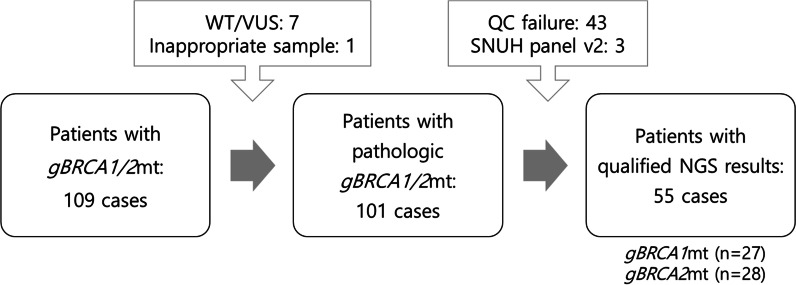
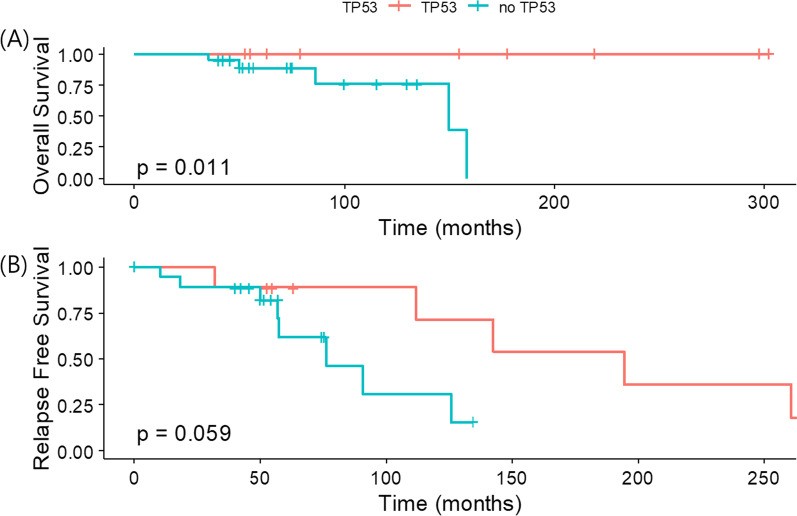
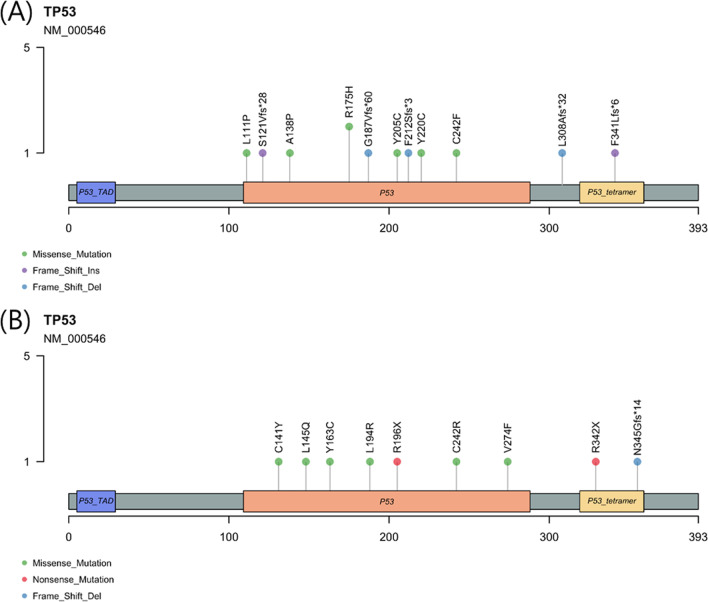
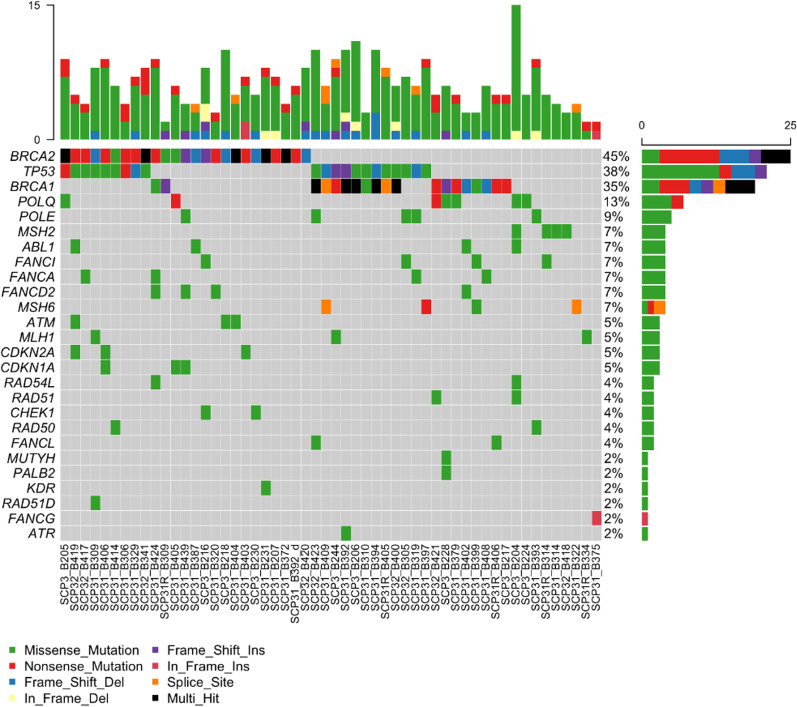
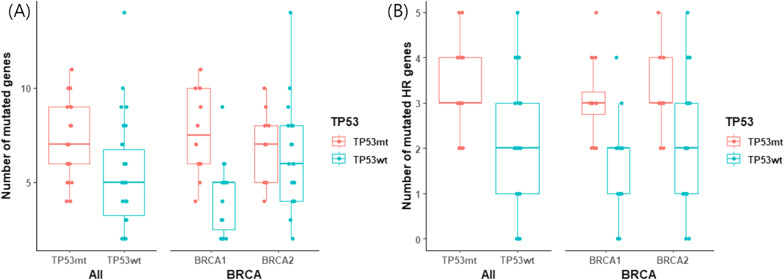
Fifty-five Korean breast cancer patients with known gBRCA1/2 mutations and qualified targeted NGS data were analyzed. Ethnically distinct mutations in gBRCA1/2 genes were noted, with higher frequencies of Val1833Ser (14.8%), Glu1210Arg (11.1%), and Tyr130Ter (11.1%) in gBRCA1 and Arg2494Ter (25.0%) and Lys467Ter (14.3%) in gBRCA2. Considering subtypes, gBRCA1 mutations were associated with triple-negative breast cancers (TNBC), while gBRCA2 mutations were more likely hormone receptor-positive breast cancers. At least one missense mutation of HR-related genes was observed in 44 cases (80.0%). The most frequently co-mutated gene was TP53 (38.1%). In patients with gBRCA1/2 mutations, however, genetic variations of TP53 occurred in locations different from the known hotspots of those with sporadic breast cancers. The patients with both gBRCA1/2 and TP53 mutations were more likely to have TNBC, high Ki-67 values, and increased genetic mutations, especially of HR-related genes. Survival benefit was observed in the TP53 mutants of patients with gBRCA2 mutations, compared to those with TP53 wild types.
Our study showed genetic heterogeneity of breast cancer patients with gBRCA1 and gBRCA2 mutations in the Korean populations. Further studies on precision medicine are needed for tailored treatments of patients with genetic diversity among different ethnic groups.
乳腺癌易感基因 BRCA1 和 BRCA2(gBRCA1/2)的种系突变与亚洲年轻女性乳腺癌风险升高有关。BRCA1 和 BRCA2 蛋白通过同源重组(HR)介导的双链 DNA 断裂修复与其他 HR 相关蛋白协同作用,有助于基因组稳定性。在这项研究中,我们分析了携带 gBRCA1/2 突变的韩国乳腺癌患者的靶向测序数据,以研究 HR 相关基因的改变及其临床意义。
分析了携带致病性 gBRCA1/2 突变和合格靶向下一代测序、SNUH FiRST 癌症面板的乳腺癌患者的数据。使用 ANNOVAR 对单核苷酸多态性、小插入和缺失进行了功能注释分析。HR 相关基因定义为 ABL1、ATM、ATR、BARD1、BRCA1、BRCA2、CDKN1A、CDKN2A、CHEK1、CHEK2、FANCA、FANCD2、FANCG、FANCI、FANCL、KDR、MUTYH、PALB2、POLE、POLQ、RAD50、RAD51、RAD51D、RAD54L 和 TP53。错配修复基因是 MLH1、MSH2 和 MSH6。使用 Cox 比例风险模型和生存分析对临床数据进行了分析。
分析了 55 名具有已知 gBRCA1/2 突变和合格靶向 NGS 数据的韩国乳腺癌患者。gBRCA1/2 基因中存在种族特异性突变,gBRCA1 中的 Val1833Ser(14.8%)、Glu1210Arg(11.1%)和 Tyr130Ter(11.1%)以及 gBRCA2 中的 Arg2494Ter(25.0%)和 Lys467Ter(14.3%)的频率较高。考虑到亚型,gBRCA1 突变与三阴性乳腺癌(TNBC)有关,而 gBRCA2 突变更可能与激素受体阳性乳腺癌有关。在 44 例患者中观察到至少一个 HR 相关基因的错义突变(80.0%)。最常共突变的基因是 TP53(38.1%)。然而,在携带 gBRCA1/2 突变的患者中,TP53 的遗传变异发生在与散发性乳腺癌已知热点不同的位置。同时携带 gBRCA1/2 和 TP53 突变的患者更有可能患有 TNBC、高 Ki-67 值和更多的遗传突变,尤其是 HR 相关基因。与 TP53 野生型相比,携带 gBRCA2 突变的 TP53 突变患者的生存获益更大。
我们的研究显示了韩国人群中携带 gBRCA1 和 gBRCA2 突变的乳腺癌患者的遗传异质性。需要进一步研究精准医学,以针对不同种族群体中具有遗传多样性的患者进行个体化治疗。