Department of Immunobiology and Environment Microbiology, Medical University of Gdansk, 80-219 Gdansk, Poland.
Department of Physiology and Biochemistry, Gdansk University of Physical Education and Sport, 80-336 Gdansk, Poland.
Int J Environ Res Public Health. 2022 May 31;19(11):6719. doi: 10.3390/ijerph19116719.
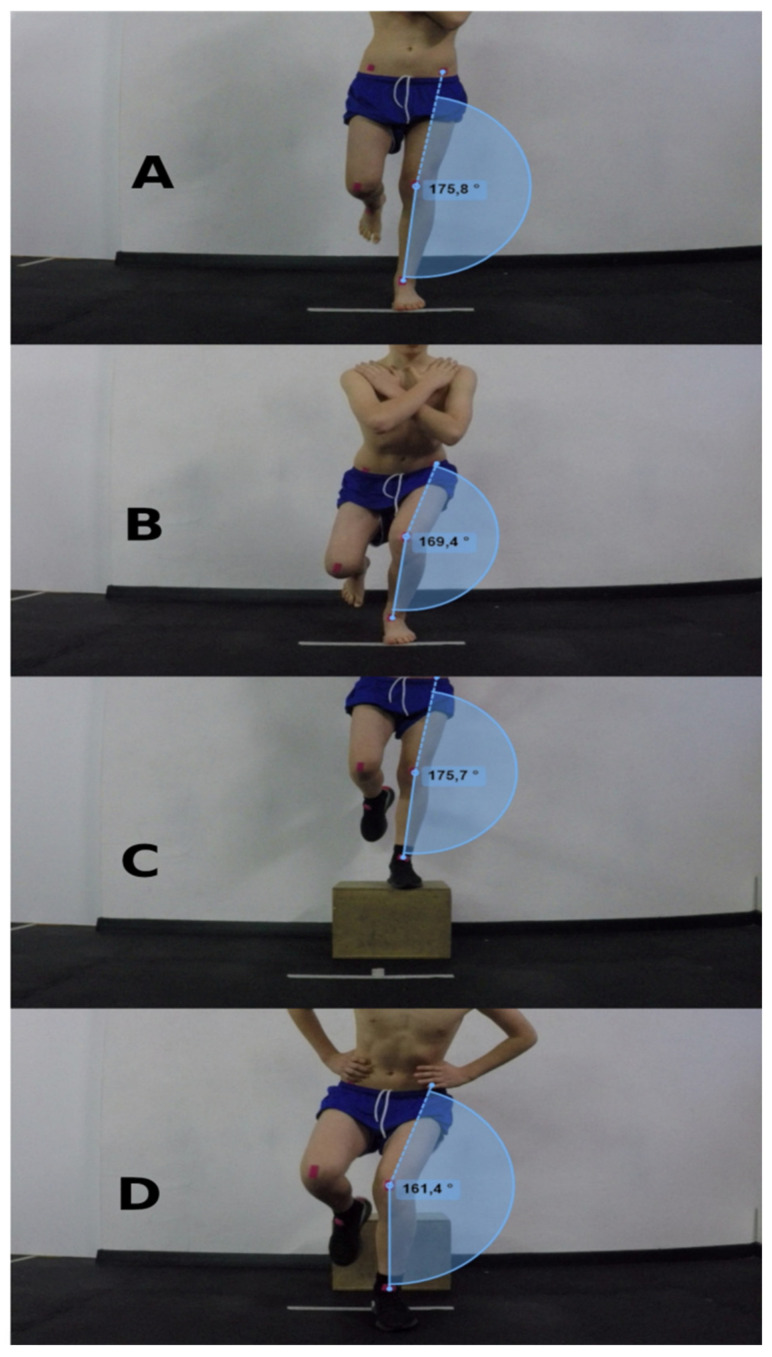
This study aimed to examine the relationship between knee valgus in the frontal plane projection angle (FPPA) during single-leg squat (SLS), single-leg landing (SLL), and other selected clinical tests in young athletes. Forty-three young healthy elite football players (age: 13.2 (1.7) years) that were regularly training in a local sports club participated in the study. The FPPA was assessed using 2D video analysis. The screening tests included the passive single-leg raise (PSLR), hip external and internal rotation (hip ER and IR), sit and reach test, weight-bearing lunge test (WBLT), modified star excursion balance test (mSEBT), countermovement jump (CMJ), single-leg hop for distance (SLHD), and age peak height velocity (APHV). There was a significant positive relationship between the knee valgus angles in the SLS test and the sit and reach test (r = 0.34) and a negative relationship with the hip ER ROM (r = −0.34) (p < 0.05). The knee valgus angles in the SLL were negatively associated with the hip IR (r = −0.32) and ER ROM (r = −0.34) and positive associated with the WBLT (r = 0.35) and sit and reach test (r = 0.33) (p < 0.05). Linear regression analysis showed that the results of the hip ER ROM and sit and reach tests were independent predictors of the FPPA in the SLS test (r2 = 0.11, p = 0.03 and r2 = 0.12, p = 0.02, respectively). The conducted study showed that individuals with more hip range of motion, more spine flexion extensibility, and less ankle dorsiflexion ROM may be more likely to experience high degrees of knee valgus in FPPA.
本研究旨在探讨单腿深蹲(SLS)、单腿落地(SLL)及其他选定临床测试中,额状面投影角度(FPPA)的膝关节外翻与年轻运动员之间的关系。43 名经常在当地运动俱乐部训练的年轻健康精英足球运动员(年龄:13.2(1.7)岁)参与了这项研究。FPPA 使用二维视频分析进行评估。筛选测试包括被动单腿抬高(PSLR)、髋关节外展和内收(hip ER 和 hip IR)、坐立前伸测试、负重弓步测试(WBLT)、改良星状偏移平衡测试(mSEBT)、纵跳测试(CMJ)、单腿跳远测试(SLHD)和年龄高峰身高速度(APHV)。SLS 测试中膝关节外翻角度与坐立前伸测试呈显著正相关(r = 0.34),与髋关节外展活动度呈负相关(r = -0.34)(p < 0.05)。SLL 中膝关节外翻角度与髋关节内收(r = -0.32)和外展活动度(r = -0.34)呈负相关,与 WBLT(r = 0.35)和坐立前伸测试(r = 0.33)呈正相关(p < 0.05)。线性回归分析显示,髋关节外展活动度和坐立前伸测试结果是 SLS 测试中 FPPA 的独立预测因子(r2 = 0.11,p = 0.03 和 r2 = 0.12,p = 0.02)。研究表明,髋关节活动度更大、脊柱屈伸伸展性更大、踝关节背屈活动度更小的个体,可能更容易在 FPPA 中出现较大程度的膝关节外翻。