Tariq Moiz, Khan Azam, Ullah Asad, Shayanfar Javad, Niaz Momina
NUST Institute of Civil Engineering (NICE), School of Civil and Environmental Engineering, National University of Science and Technology (NUST), Sector H-12, Islamabad 44000, Pakistan.
Department of Civil Engineering, University of Minho, Azur'em, 4800-058 Guimaraes, Portugal.
Materials (Basel). 2022 May 24;15(11):3758. doi: 10.3390/ma15113758.
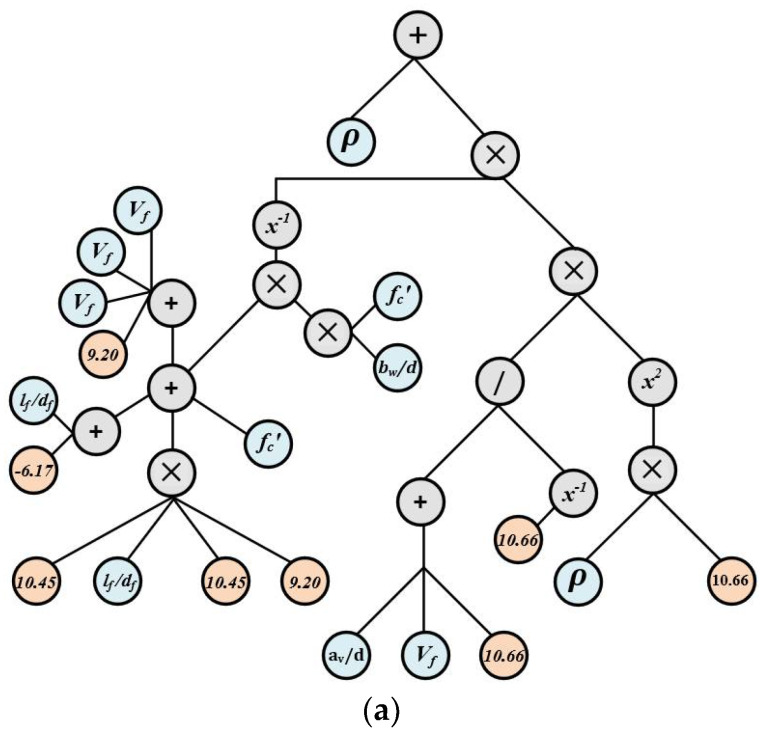
In this study, an artificial intelligence tool called gene expression programming (GEP) has been successfully applied to develop an empirical model that can predict the shear strength of steel fiber reinforced concrete beams. The proposed genetic model incorporates all the influencing parameters such as the geometric properties of the beam, the concrete compressive strength, the shear span-to-depth ratio, and the mechanical and material properties of steel fiber. Existing empirical models ignore the tensile strength of steel fibers, which exercise a strong influence on the crack propagation of concrete matrix, thereby affecting the beam shear strength. To overcome this limitation, an improved and robust empirical model is proposed herein that incorporates the fiber tensile strength along with the other influencing factors. For this purpose, an extensive experimental database subjected to four-point loading is constructed comprising results of 488 tests drawn from the literature. The data are divided based on different shapes (hooked or straight fiber) and the tensile strength of steel fiber. The empirical model is developed using this experimental database and statistically compared with previously established empirical equations. This comparison indicates that the proposed model shows significant improvement in predicting the shear strength of steel fiber reinforced concrete beams, thus substantiating the important role of fiber tensile strength.
在本研究中,一种名为基因表达式编程(GEP)的人工智能工具已成功应用于开发一个能预测钢纤维增强混凝土梁抗剪强度的经验模型。所提出的遗传模型纳入了所有影响参数,如梁的几何特性、混凝土抗压强度、剪跨比以及钢纤维的力学和材料性能。现有的经验模型忽略了钢纤维的抗拉强度,而钢纤维抗拉强度对混凝土基体的裂缝扩展有很大影响,进而影响梁的抗剪强度。为克服这一局限性,本文提出了一个改进的、稳健的经验模型,该模型将纤维抗拉强度与其他影响因素一并纳入。为此,构建了一个包含488个文献试验结果的四点加载的广泛实验数据库。数据根据不同形状(弯钩形或直形纤维)和钢纤维的抗拉强度进行划分。利用该实验数据库开发了经验模型,并与先前建立的经验方程进行了统计比较。这种比较表明,所提出的模型在预测钢纤维增强混凝土梁的抗剪强度方面有显著改进,从而证实了纤维抗拉强度的重要作用。