Agence de la Biomédecine, Saint-Denis, France.
Inserm U1018, CESP, Villejuif, France.
Transpl Int. 2022 May 24;35:10049. doi: 10.3389/ti.2022.10049. eCollection 2022.
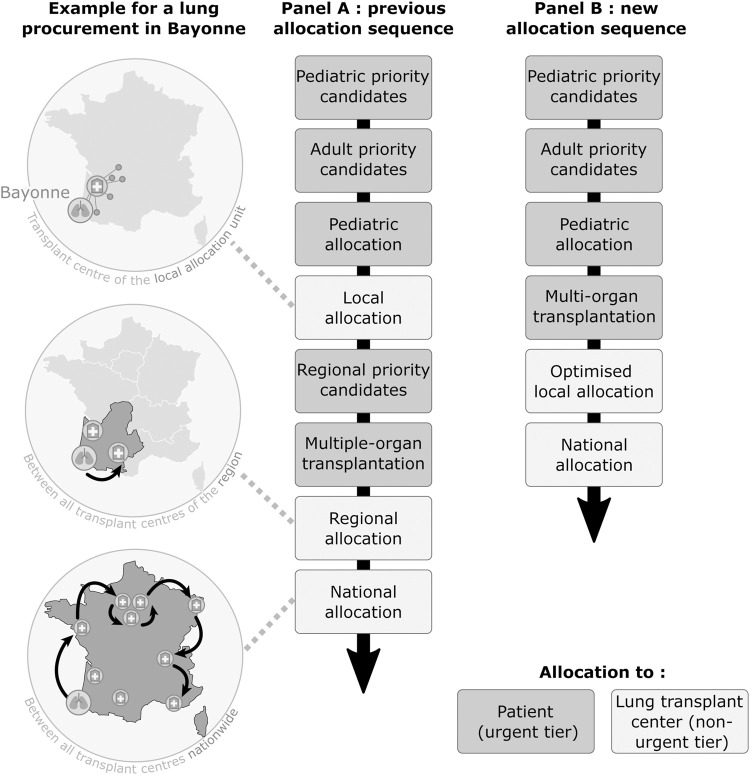
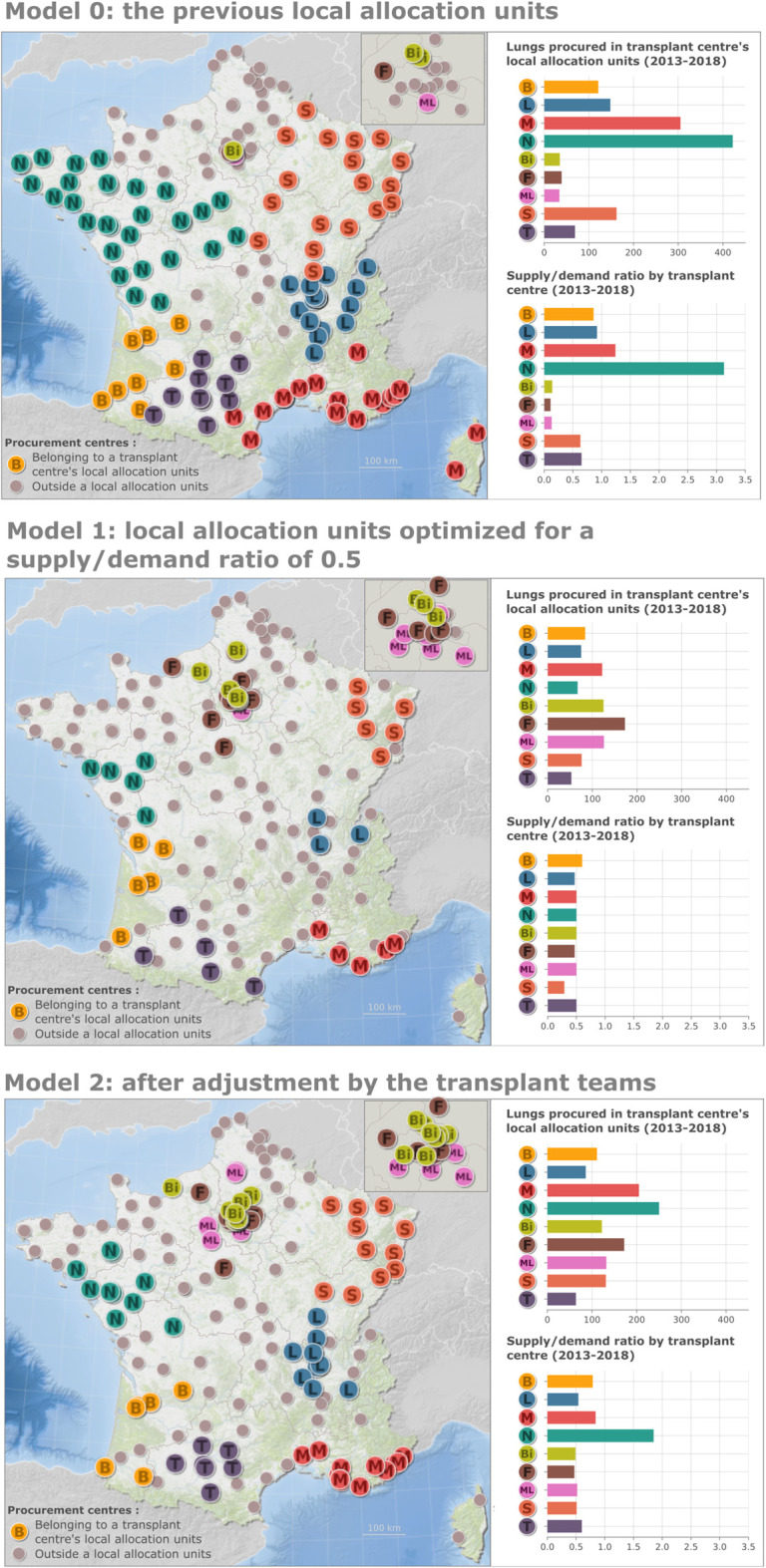
A new lung allocation system was introduced in France in September 2020. It aimed to reduce geographic disparities in lung allocation while maintaining proximity. In the previous two-tiered priority-based system, grafts not allocated through national high-urgency status were offered to transplant centres according to geographic criteria. Between 2013 and 2018, significant geographic disparities in transplant allocation were observed across transplant centres with a mean number of grafts offered per candidate ranging from 1.4 to 5.2. The new system redistricted the local allocation units according to supply/demand ratio, removed regional sharing and increased national sharing. The supply/demand ratio was defined as the ratio of lungs recovered within the local allocation unit to transplants performed in the centre. A driving time between the procurement and transplant centres of less than 2 h was retained for proximity. Using a brute-force algorithm, we designed new local allocation units that gave a supply/demand ratio of 0.5 for all the transplant centres. Under the new system, standard-deviation of graft offers per candidate decreased from 0.9 to 0.5 ( = 0.08) whereas the mean distance from procurement to transplant centre did not change. These preliminary results show that a supply/demand ratio-based allocation system can achieve equity while maintaining proximity.
2020 年 9 月,法国推出了一种新的肺分配系统。其目的是减少肺分配中的地域差异,同时保持就近原则。在之前的两级基于优先级的系统中,未通过国家高度紧急状态分配的移植物根据地理标准提供给移植中心。在 2013 年至 2018 年间,观察到各移植中心之间的移植分配存在显著的地域差异,每个候选者提供的移植物数量从 1.4 到 5.2 不等。新系统根据供需比重新划分了本地分配单位,取消了区域共享,并增加了国家共享。供需比定义为本地分配单位内回收的肺与中心进行的移植数量之比。保留了采购和移植中心之间少于 2 小时的行车时间以保持就近原则。我们使用暴力算法,为所有移植中心设计了新的本地分配单位,使其供需比达到 0.5。在新系统下,每个候选者的移植物提供的标准差从 0.9 降低到 0.5(=0.08),而从采购到移植中心的平均距离没有变化。这些初步结果表明,基于供需比的分配系统可以在保持就近原则的同时实现公平。