Division of Epidemiology & Biostatistics, School of Public Health, University of Illinois at Chicago, Chicago, Illinois, United States of America.
Department of Anesthesiology, Washington University School of Medicine, Saint Louis, Missouri, United States of America.
PLoS One. 2022 Jun 10;17(6):e0269455. doi: 10.1371/journal.pone.0269455. eCollection 2022.
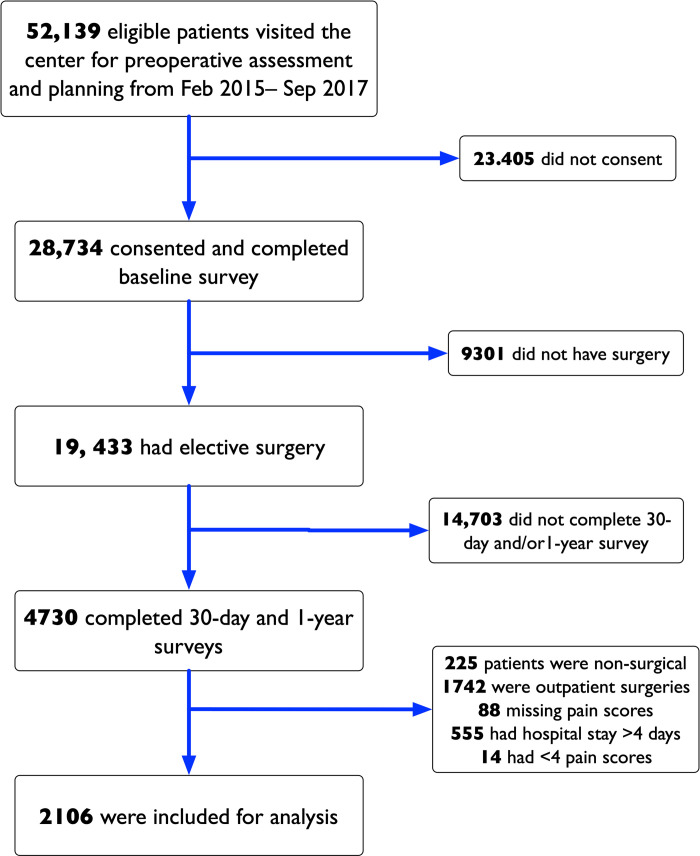
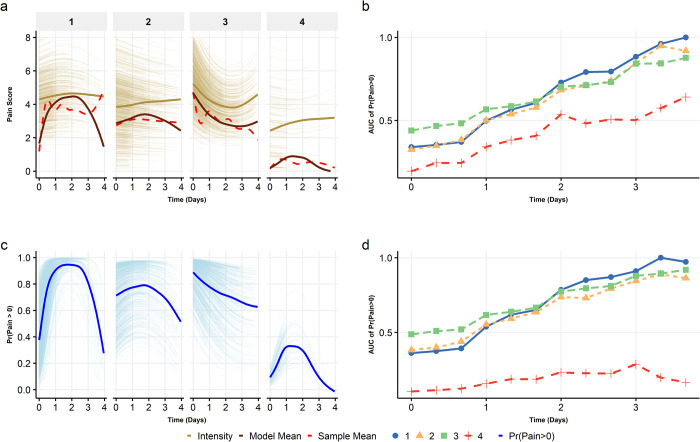
Untreated pain after surgery leads to poor patient satisfaction, longer hospital length of stay, lower health-related quality of life, and non-compliance with rehabilitation regimens. The aim of this study is to characterize the structure of acute pain trajectories during the postsurgical hospitalization period and quantify their association with pain at 30-days and 1-year after surgery. This cohort study included 2106 adult (≥18 years) surgical patients who consented to participate in the SATISFY-SOS registry (February 1, 2015 to September 30, 2017). Patients were excluded if they did not undergo invasive surgeries, were classified as outpatients, failed to complete follow up assessments at 30-days and 1-year following surgery, had greater than 4-days of inpatient stay, and/or recorded fewer than four pain scores during their acute hospitalization period. The primary exposure was the acute postsurgical pain trajectories identified by a machine learning-based latent class approach using patient-reported pain scores. Clinically meaningful pain (≥3 on a 0-10 scale) at 30-days and 1-year after surgery were the primary and secondary outcomes, respectively. Of the study participants (N = 2106), 59% were female, 91% were non-Hispanic White, and the mean (SD) age was 62 (13) years; 41% of patients underwent orthopedic surgery and 88% received general anesthesia. Four acute pain trajectory clusters were identified. Pain trajectories were significantly associated with clinically meaningful pain at 30-days (p = 0.007), but not at 1-year (p = 0.79) after surgery using covariate-adjusted logistic regression models. Compared to Cluster 1, the other clusters had lower statistically significant odds of having pain at 30-days after surgery (Cluster 2: [OR = 0.67, 95%CI (0.51-0.89)]; Cluster 3:[OR = 0.74, 95%CI (0.56-0.99)]; Cluster 4:[OR = 0.46, 95%CI (0.26-0.82)], all p<0.05). Patients in Cluster 1 had the highest cumulative likelihood of pain and pain intensity during the latter half of their acute hospitalization period (48-96 hours), potentially contributing to the higher odds of pain during the 30-day postsurgical period. Early identification and management of high-risk pain trajectories can help in ascertaining appropriate pain management interventions. Such interventions can mitigate the occurrence of long-term disabilities associated with pain.
未经治疗的术后疼痛会导致患者满意度降低、住院时间延长、健康相关生活质量下降以及康复方案不遵守。本研究的目的是描述术后住院期间急性疼痛轨迹的结构,并量化其与术后 30 天和 1 年疼痛的关系。这项队列研究纳入了 2106 名成年(≥18 岁)手术患者,他们同意参加 SATISFY-SOS 登记处(2015 年 2 月 1 日至 2017 年 9 月 30 日)。如果患者未接受侵入性手术、被归类为门诊患者、术后 30 天和 1 年随访评估失败、住院时间超过 4 天、以及/或在急性住院期间记录的疼痛评分少于 4 次,则将其排除在外。主要暴露因素是使用患者报告的疼痛评分通过基于机器学习的潜在类别方法确定的急性术后疼痛轨迹。术后 30 天和 1 年时出现临床有意义的疼痛(0-10 分的评分≥3)分别是主要和次要结局。在研究参与者(N=2106)中,59%为女性,91%为非西班牙裔白人,平均(SD)年龄为 62(13)岁;41%的患者接受骨科手术,88%接受全身麻醉。确定了四个急性疼痛轨迹簇。使用协变量调整的逻辑回归模型,疼痛轨迹与术后 30 天的临床有意义的疼痛显著相关(p=0.007),但与术后 1 年的疼痛不相关(p=0.79)。与簇 1 相比,其他簇在术后 30 天时出现疼痛的几率较低,差异具有统计学意义(簇 2:[OR=0.67,95%CI(0.51-0.89)];簇 3:[OR=0.74,95%CI(0.56-0.99)];簇 4:[OR=0.46,95%CI(0.26-0.82)],均 p<0.05)。簇 1 中的患者在急性住院后期(48-96 小时)的疼痛和疼痛强度累积可能性最高,这可能导致术后 30 天期间疼痛的几率更高。早期识别和管理高危疼痛轨迹有助于确定适当的疼痛管理干预措施。这些干预措施可以减轻与疼痛相关的长期残疾的发生。