Tropical Health Consulting LLP, London, UK.
PATH, Seattle, WA, USA.
Malar J. 2022 Jun 11;21(1):185. doi: 10.1186/s12936-022-04160-3.
Malaria is a major cause of morbidity and mortality globally, especially in sub-Saharan Africa. Widespread resistance to pyrethroids threatens the gains achieved by vector control. To counter resistance to pyrethroids, third-generation indoor residual spraying (3GIRS) products have been developed. This study details the results of a multi-country cost and cost-effectiveness analysis of indoor residual spraying (IRS) programmes using Actellic300CS, a 3GIRS product with pirimiphos-methyl, in sub-Saharan Africa in 2017 added to standard malaria control interventions including insecticide-treated bed nets versus standard malaria control interventions alone.
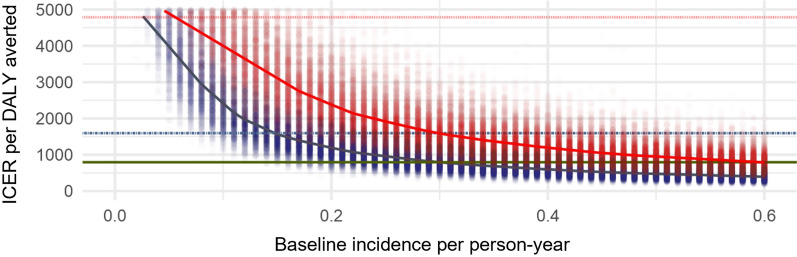
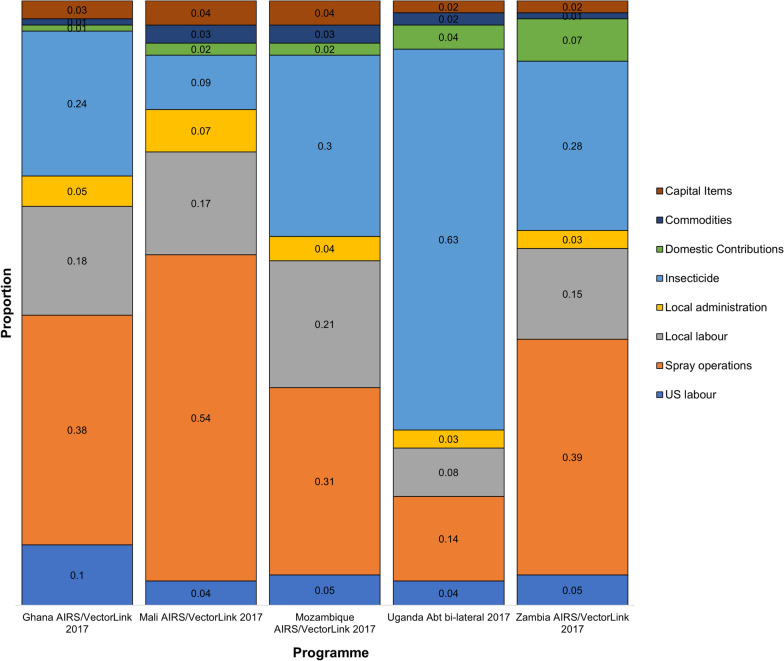
An economic evaluation of 3GIRS using Actellic300CS in a broad range of sub-Saharan African settings was conducted using a variety of primary data collection and evidence synthesis methods. Four IRS programmes in Ghana, Mali, Uganda, and Zambia were included in the effectiveness analysis. Cost data come from six IRS programmes: one in each of the four countries where effect was measured plus Mozambique and a separate programme conducted by AngloGold Ashanti Malaria Control in Ghana. Financial and economic costs were quantified and valued. The main indicator for the cost was cost per person targeted. Country-specific case incidence rate ratios (IRRs), estimated by comparing IRS study districts to adjacent non-IRS study districts or facilities, were used to calculate cases averted in each study area. A deterministic analysis and sensitivity analysis were conducted in each of the four countries for which effectiveness evaluations were available. Probabilistic sensitivity analysis was used to generate plausibility bounds around the incremental cost-effectiveness ratio estimates for adding IRS to other standard interventions in each study setting as well as jointly utilizing data on effect and cost across all settings.
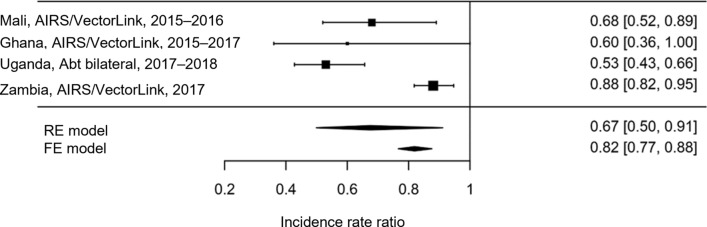
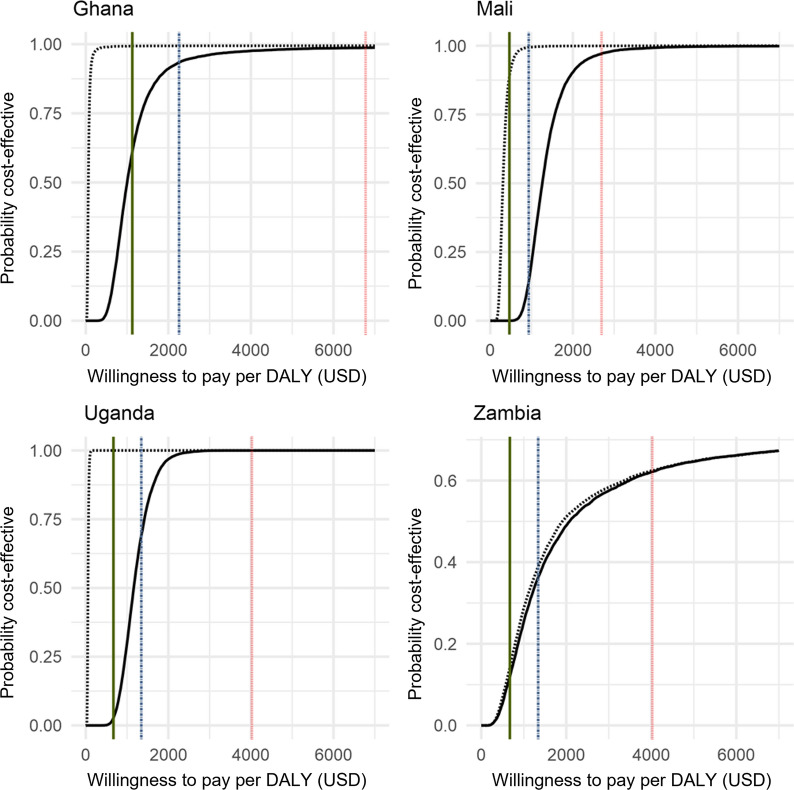
Overall, IRRs from each country indicated that adding IRS with Actellic300CS to the local standard intervention package was protective compared to the standard intervention package alone (IRR 0.67, [95% CI 0.50-0.91]). Results indicate that Actellic300CS is expected to be a cost-effective (> 60% probability of being cost-effective in all settings) or highly cost-effective intervention across a range of transmission settings in sub-Saharan Africa.
Variations in the incremental costs and cost-effectiveness likely result from several sources including: variation in the sprayed wall surfaces and house size relative to household population, the underlying malaria burden in the communities sprayed, the effectiveness of 3GIRS in different settings, and insecticide price. Programmes should be aware that current recommendations to rotate can mean variation and uncertainty in budgets; programmes should consider this in their insecticide-resistance management strategies.
The optimal combination of 3GIRS delivery with other malaria control interventions will be highly context specific. 3GIRS using Actellic300CS is expected to deliver acceptable value for money in a broad range of sub-Saharan African malaria transmission settings.
疟疾是全球发病率和死亡率的主要原因,尤其是在撒哈拉以南非洲地区。拟除虫菊酯类药物的广泛耐药性威胁到了通过病媒控制取得的成果。为了应对拟除虫菊酯类药物的耐药性,已经开发出了第三代室内滞留喷洒(3GIRS)产品。本研究详细介绍了在 2017 年,在撒哈拉以南非洲地区,使用含有吡虫啉的 3GIRS 产品 Actellic300CS 对室内滞留喷洒(IRS)方案进行的多国成本和成本效益分析的结果,该产品添加到包括经杀虫剂处理的蚊帐在内的标准疟疾控制干预措施中,与单独使用标准疟疾控制干预措施进行了比较。
使用各种初级数据收集和证据综合方法,对在广泛的撒哈拉以南非洲环境中使用 Actellic300CS 进行 3GIRS 的经济评估。加纳、马里、乌干达和赞比亚的四个 IRS 方案被纳入效果分析。成本数据来自六个 IRS 方案:每个国家都有一个方案,其中四个国家进行了效果测量,还有一个方案是在加纳由 AngloGold Ashanti 疟疾控制单独进行的。量化和评估了财务和经济成本。成本的主要指标是每个目标人群的成本。使用每个研究区域与相邻非 IRS 研究区域或设施进行比较的 IRS 研究地区的特定国家病例发病率比值(IRR),计算每个研究区域的病例减少数。在每个提供效果评估的国家进行了确定性分析和敏感性分析。概率敏感性分析用于在每个研究环境中添加 IRS 与其他标准干预措施的增量成本效益比估计值生成合理性边界,以及在所有环境中联合使用效果和成本数据。
总体而言,每个国家的 IRR 表明,与单独使用标准干预措施相比,使用 Actellic300CS 对当地标准干预措施进行 IRS 是有保护作用的(IRR 0.67,[95%CI 0.50-0.91])。结果表明,在撒哈拉以南非洲的各种传播环境中,Actellic300CS 有望成为一种具有成本效益的(在所有环境中超过 60%的成本效益概率)或高度具有成本效益的干预措施。
增量成本和成本效益的差异可能源于多个来源,包括:与家庭人口相比,喷洒墙壁表面和房屋大小的差异、喷洒社区的潜在疟疾负担、不同环境中 3GIRS 的有效性以及杀虫剂价格。方案应注意到,目前关于轮换的建议可能意味着预算的变化和不确定性;方案应在其杀虫剂耐药性管理策略中考虑到这一点。
3GIRS 与其他疟疾控制干预措施的最佳组合将高度取决于具体情况。在撒哈拉以南非洲的广泛疟疾传播环境中,使用 Actellic300CS 的 3GIRS 有望提供可接受的性价比。